

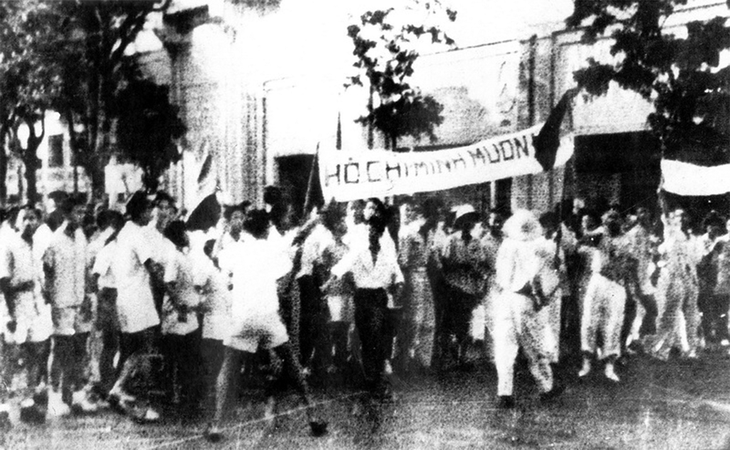
On March 19, 1950, the Saigon - Cho Lon Special Zone Committee mobilized tens of thousands of people and workers to raise the slogan "Long live Ho Chi Minh " and take to the streets to protest against the two American warships Anderson and Sticker docking at Saigon port - Photo: Document
Immediately after the Communist Party of Vietnam was founded in 1930, Saigon port workers who devoted themselves to the Party entered the struggle against French colonialism...
Saigon "red" generation
The farmers and dock workers were the first to join the proletariat in Saigon. Mr. Le Van Son - Deputy Secretary of the Saigon Port Party Committee - said that the dock workers were the forerunners of the Saigon Port workers. Under the guidance of the Communist Party cell, those dock workers were aware that they were a working class fighting for class rights and national independence.
In March 1930, the Saigon Party established 20 Party cells, of which Saigon Port had its first Party cell secretary, Ho Ba. Many of the port's first Party members promoted their leadership roles and upheld their indomitable spirit, setting a shining example to motivate the masses to fight.
Among them, Ly Tu Trong, a party member of the port party cell, was only 17 years old when he was taken to the guillotine on November 21, 1931. Before his execution, Ly Tu Trong shouted "Long live the Indochinese Communist Party" and sang "Arise, all slaves in the world, arise, all those who are miserable and poor...".
Generations of revolutionaries at Saigon Port fought steadfastly throughout the two resistance wars against France and the United States. Port workers’ protests continued from 1930 to 1954. Workers demanded higher wages, shorter working hours, and a ban on beating workers.
According to Mr. Le Van Son, generations of workers at Saigon Port are determined to promote the fine traditions of Saigon Port - a heroic labor port, bearing the historical mark of the nation, and one of the earliest active party cells in the South.
The peak was the demonstration on January 14, 1937 with 40,000 participants, centered on Nha Rong Port, with slogans of freedom of speech, freedom of association, and abolition of poll tax. On the night of October 15, 1945, the Vietnamese resistance organized the burning of the French warship Alex as soon as it docked at Nha Rong Port.
During the period 1954 - 1975, many demonstrations demanding people's livelihood, democracy, and anti-war protests also took place. In particular, in 1964, port workers helped Saigon commandos attack the US aircraft carrier US Card, which was anchored at the port.
On December 22, 1966, a strike by 5,000 port workers prevented 30 US military transport ships from unloading. In 1970, there were two major strikes that kept 6 US military ships and 18 cargo ships idle because port workers did not unload their cargo as planned.
Dr. Nguyen Huu Nguyen, PhD in History, Ho Chi Minh City Institute of Social Studies, said: "The tradition of revolutionary struggle of port workers is a precious spiritual heritage of the next generations of port workers. That tradition is promoted and transformed into the intellectual and spiritual strength of port workers in the process of industrialization, modernization and building a rich and beautiful country."
Hero of Labor
An event that Saigon Port has included in the heroic symbol of the port's operations. That was after the South was unified in April 1975, the port's tugboat CSG 240 was working at Sitahip port - Thailand. The American contractor and the Thai government planned to bring this ship back to the US and bring another ship back to Saigon. However, the crew on the ship fought fiercely for 2 months to bring this ship back to Saigon Port.
CSG 240 with a pulling capacity of 2,400 horsepower was the tugboat with the largest capacity in Vietnam at that time and became a typical example of many outstanding achievements for Saigon Port, and was given the title "Knight at Sea".
Specifically, the Romanian ship Shinala hit a reef while transporting goods. The ship owner decided to run the ship onto a sandbank to avoid sinking, so it ran aground in Dong Ha - Quang Tri. From there, the ship owner hired a Dutch rescue ship with a capacity of 24,000 horsepower, but the Dutch ship "gave up". After that, it was the turn of the Vietnamese salvage company to come to the rescue, but they were also "helpless" and the ship ran aground for 6 months.
Taking on the mission to rescue the Shinala, the crew of CSG 240 proposed an initiative to use the ship's propeller to blow sand close to the Shinala's hull to create a depth from 4m to 6m to create a channel to take the ship out to sea. From here, CSG 240 pulled the Shinala out to sea to the surprise and admiration of the Shinala's captain.
From 1980 to 1984, the CSG 240 crew promoted and applied 25 valuable initiatives, benefiting the public fund by more than half a million VND, through 15,000 hours of operation. The ship participated in many important towing and rescue activities, bringing in hundreds of millions of VND in revenue in the mid-1980s.
Talking about the CSG 240 ship is talking about the chief pilot Ton Tho Khuong whose first achievement was welcoming the Song Huong ship on May 13, 1975 - officially opening the sea transport route between the South and North after decades of interruption.
Notably, on July 3, 1979, this tugboat brought the 50,000-ton Soviet ship JulioAnnonio Melta safely into Saigon port. This was the first and largest ship in history to dock at Saigon port.
From 1975 to 1985, with his pioneering and core role, Chief Pilot Ton Tho Khuong transported 550 overloaded ships without having to transfer, bringing hundreds of millions of dong in benefits to the State. In 1985, the State Council awarded the title "Labor Hero" to Chief Pilot Ton Tho Khuong and the title "Labor Hero" to ship CSG 240.
In 1987, under extremely harsh and fierce operating conditions, the CSG 240 participated in transporting equipment and food to serve the protection of Da Lat Island in Truong Sa. In 2005, the CSG 240 stopped operating.
With many outstanding achievements, on December 19, 1996, Saigon Port received the title "Labor Hero" for officers and employees with outstanding achievements in work from 1986 - 1995.
Mr. Nguyen Manh Ha - former Head of Saigon Port Administration Department - said that for more than a decade since receiving the title of Labor Hero, the port has persistently worked creatively to glorify the place where Uncle Ho left to save the country with the goal of developing Saigon Port to reach the level of the Southeast Asian region.
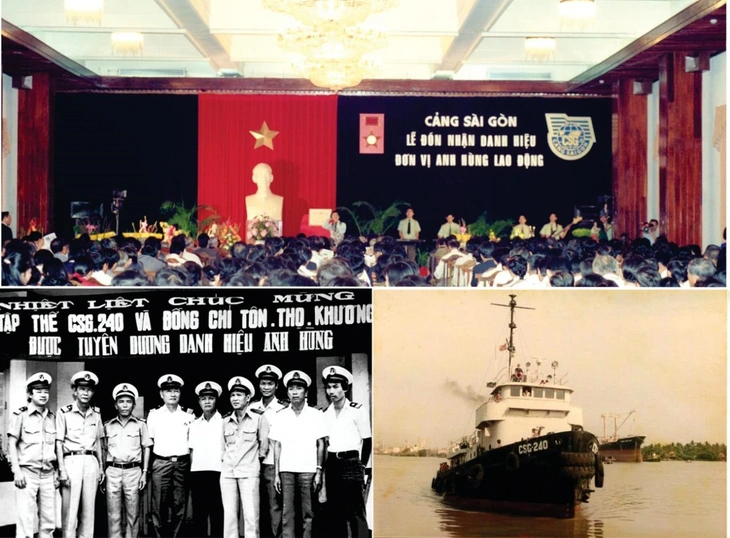
Saigon Port, Hero of Labor - Photo: Saigon Port
Golden football generation
Before 1975, Saigon - Gia Dinh was a great cradle of Southern football and had a reputation in international tournaments. The Japanese national team, after losing to the teams of famous players Pham Huynh Tam Lang (who passed away in 2014), Nguyen Van Rang, and Ho Thanh Cang, compared themselves to being just a small shoe compared to Vietnamese football.
On November 1, 1975, the Saigon Port Workers Football Team was officially established. Because all the players were national team players before 1975, the team quickly asserted its position in Southern football. In 1978 - 1979, the team won the A1 Ho Chi Minh City Championship.
In 1981, after more than a year of training, Pham Huynh Tam Lang said goodbye to the Federal Republic of Germany with an excellent coaching certificate to return to Saigon Port in a new position - head coach.
At that time, the famous names in the team were Luu Kim Hoang, Le Dinh Thang, Tu Le, Duong Van Tha... who were workers in the loading and unloading teams, electrical teams, ship drivers... That was the period of the first golden generation that created stability for the Saigon Port brand.
Later, the team added a group of promising young players from the vocational school for the gifted and some other teams, including strikers Dang Tran Chinh, Ha Vuong Ngau Nai; midfielders Nguyen Hoang Chau, Pham Van Tam, Nguyen Thanh Tung; defenders Vo Hoang Tan, Ho Van Tam, Vuong Dieu Thanh. The Saigon Port football team won the championship title 4 times in 1986, 1993 - 1994, 1997 and 2001 - 2002.
Talking about the port’s achievements throughout history, a Saigon Port official said that it is very rare in a unit to have three generations of grandfathers, fathers and sons working in succession. However, in Saigon Port, there are many families with successive generations working at the port. That connection stems from the love for the historical tradition of the heroic port - Saigon Port.
---------------------
On July 23, 1975, Saigon Commercial Port was officially renamed Saigon Port, the time it began operating to serve the unified national economy.
>>> Next: Saigon Port reaches out to the ocean
Source: https://tuoitre.vn/165-nam-thuong-cang-sai-gon-ky-3-sang-danh-cang-bien-anh-hung-20251206232250955.htm






































































Comment (0)