

The series "40 Years of Renovation - Looking Back and Moving Forward" consists of dialogues with individuals who directly participated in, contributed to, and are continuing the achievements of the Renovation process, in the spirit of "learning from the past to understand the present," thereby suggesting a path for the country's development in the new context.
Part I: ECONOMIC EXPERT PHAM CHI LAN: “LIBERATING THE PEOPLE'S POWER IS THE SOURCE OF THE REFORM PROCESS”
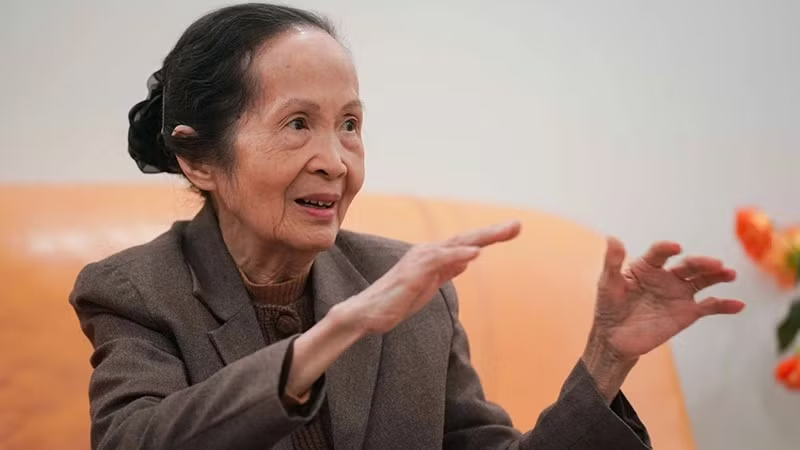
Economist Pham Chi Lan (pictured), former Vice President and Secretary General of the Vietnam Chamber of Commerce and Industry, and a member of the Prime Minister's Research Committee, has directly witnessed and promoted the Doi Moi (Renovation) process from its early days. In a conversation with Nhan Dan Newspaper, at over 80 years old, she still clearly remembers each stage of the country's transformation, from the arduous initial steps to the pivotal policy decisions, and expressed many deep concerns and reflections on the development issues facing the new era.
A "reversal" in thinking.
- Reporter: From the very real "lingering taste" of a time of famine and rationing, what do you think were the biggest pressures that prevented society from continuing to function in the old way and forced it to enter the Doi Moi (Renovation) period?
Ms. Pham Chi Lan: During the subsidy period, the economy was very difficult, if not in crisis. Life was so hard that there was a rhyme: "First, I love you because you have a tank top; second, I love you because you have dried fish to eat gradually…" My family was also very poor. My husband and I only dared to have one child, and raising a child was extremely difficult. Our whole lives were confined to ration coupons, and salaries were already low, and they were only increased once every 6-7 years. These very ordinary experiences clearly show the pressure of life "on the eve" of the Renovation period and why the need for change became so urgent.
Even state-owned enterprises are like that; everything is decided by the state: where to buy, who to sell to, and at what price. There's a humorous but true saying: "Buying is like stealing, selling is like giving away." If businesses can't even cover their costs, where will the motivation to produce come from?
In that context, flexible approaches began to emerge from the grassroots level, such as businesses independently implementing "plan two" and "plan three," because many enterprises were only operating at half capacity, with the rest having to be shut down due to a lack of input.
From that reality, a series of initiatives emerged: "breaking the rules" in circulation, "underground contracting" in agriculture , then contracting out 100, contracting out 10… All of them originated from the grassroots, gradually spread, and were eventually recognized as policies.
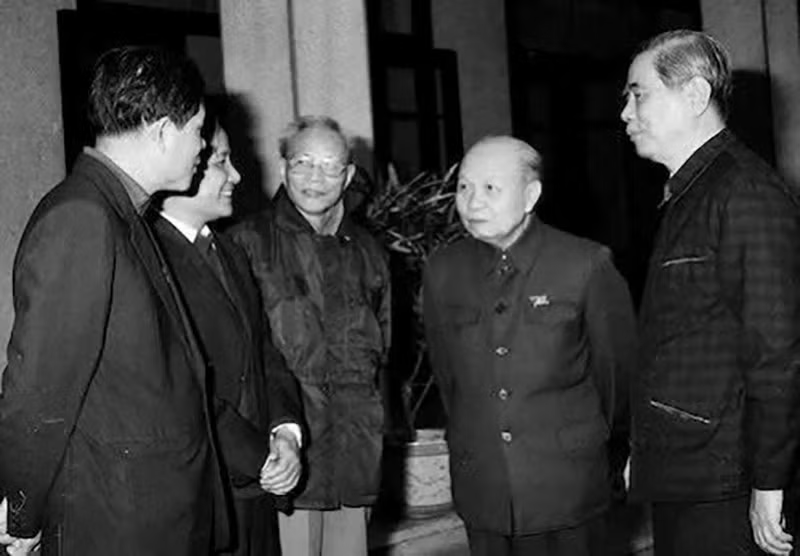
At the central level, it was crucial to recognize and accept these new developments. If the person directly leading the implementation of the Renovation from the Sixth Party Congress was General Secretary Nguyen Van Linh, then the person who laid the foundation in terms of thinking and decision-making was General Secretary Truong Chinh.
It's worth noting that General Secretary Truong Chinh, who was very firm in his theoretical principles, had previously disagreed with the contract farming system in agriculture, arguing that it deviated from the principles of cooperatives. However, reality forced him to reconsider. During his unannounced visits to the grassroots, he clearly saw that households engaged in contract farming were producing well and improving their lives, while cooperatives were struggling. In some places, officials even admitted to "borrowing" the achievements of the people for their reports.
It was these trips that changed his perspective, and subsequently, General Secretary Truong Chinh directed the rewriting of the documents for the Sixth Party Congress. This was a major turning point, almost a "reversal" in thinking. It can be said that the changes in leadership like these paved the way for the later Doi Moi (Renovation) period.
- In the context of the times, what were the pivotal decisions that paved the way for the country's transformation during the Doi Moi (Renovation) period, Madam?
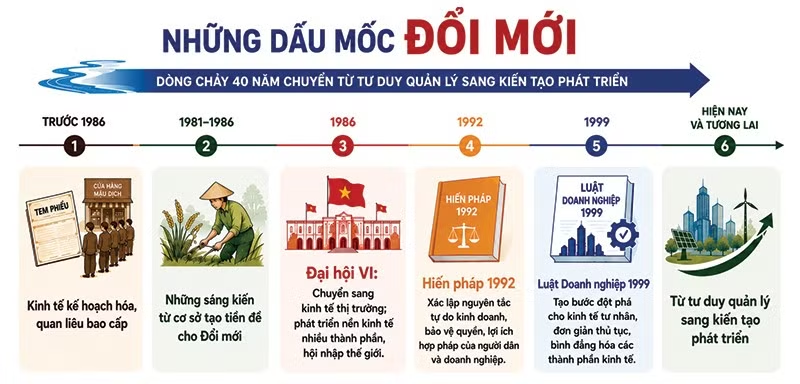
In the documents of the Sixth Party Congress, the spirit of serving the people was clearly demonstrated, along with groundbreaking institutional changes. The biggest institutional breakthrough was the shift from centralized planning to a market mechanism, defining three major directions: reforming the management mechanism, developing a multi-sector economy, and opening up to the outside world.
Regarding specific policies, I was very pleased with the correct selection of priorities. These were: prioritizing food production; consumer goods; and exports. These three priorities addressed the biggest bottlenecks in the economy at that time. Having food ensured stable living standards; having consumer goods met essential needs; and exports generated foreign currency to import what we lacked.
Before the Doi Moi (Renovation) period, Vietnam had to import between half a million and one million tons of food annually. But in just two years, by 1988, we were exporting approximately one million tons of rice. This was a rapid but substantial transformation, behind which lay a fundamental change in the system: farmers were free to cultivate their land and had the right to sell their produce…
I've noticed that innovation doesn't just come from the top down, but accumulates from the bottom up. People already knew how to do things, they just had to do it secretly before. Like the "brokers" who brought goods from the countryside to Hanoi to support many families, including mine, but weren't recognized. When they were given the "green light," they developed very quickly and even shared their methods with each other. From there, society spontaneously formed very flexible networks: if one person lacked something, another would compensate; if one region had a surplus, it would transfer to another. These very natural flows created new vitality for the economy.
Back then, the phrase "liberating the people's power" was often used, but in reality, it meant freeing up production and circulation. In the context of a country under siege and embargo, the crucial point many people understood at the time was that the only way to escape the economic crisis was to change the system, allowing the people themselves to participate in solving difficulties, to be free to do business, and to "help themselves before God helps them," rather than continuing the old way of the State providing complete subsidies.
The biggest gap is between "saying it" and "doing it."
- From the perspective of someone directly involved in promoting reforms, what changes in management thinking and institutions, in your opinion, played a key role in shaping the business environment during the Doi Moi (Renovation) period?
After 1986, the private sector, primarily small traders and business owners, resumed operations. It wasn't until 1990-1991, with the enactment of the Company Law and the Private Enterprise Law, that a formal legal framework was established. However, the principle at that time remained: businesses were only allowed to do what the State permitted. Therefore, establishing a business required obtaining numerous permits, going through many levels of government, sometimes up to 30 "seals" (official stamps).
I remember the 1992 meeting in Ho Chi Minh City, when Prime Minister Vo Van Kiet directly engaged in dialogue with businesses. At that time, we frankly raised a series of major bottlenecks. Prime Minister Vo Van Kiet listened very carefully and decided that change was necessary. Initially, we intended to amend old laws, but then realized that patching things up was not enough; instead, we had to change a fundamental principle. That was the shift from "doing what the State permits" to "doing everything that the law does not prohibit." This principle was enshrined in the 1992 Constitution – a very important step, because for the first time, the people's right to freedom of business was clearly affirmed.
Based on that foundation, the 1999 Enterprise Law was enacted. The law clearly stipulates that only six sectors are prohibited, while the rest are open to business. Conditions for specific business sectors are regulated more clearly and transparently. Simultaneously, there has been a drastic reduction in "sub-licenses."
Looking back, it's clear that institutional change in Vietnam wasn't a sudden leap, but rather a process that began with very specific practical problems, stemming from the voices of businesses and citizens, and was then transformed into changes at the legal level.
- After 40 years of reform, how has the business environment changed, and what is the current role of household businesses and enterprises? And what changes in thinking and action are needed to create a new transformation for this sector in the coming period?
Currently, the country has approximately 900,000 to 1 million businesses, mostly private, and about 5-6 million individual business households – a force deeply embedded in daily life and creating jobs for tens of millions of workers, contributing over 40% of GDP.
But more importantly, it's about their foundational role. Millions of household businesses, from eateries and grocery stores to small workshops, are the "ground" that nourishes the economy. This sector is not the periphery, but the root of the private economy.
Despite numerous reforms, businesses still clearly feel a "discrepancy": on paper, things are open, but in reality, they face numerous obstacles. Recently, there has been positive news with adjustments to tax policies for household businesses, reducing bureaucratic procedures. It may sound technical, but the impact is significant. This is because these 5-6 million households are under the most pressure from rigid regulations, such as requiring invoices and receipts even for selling a few bunches of vegetables or a few sprigs of scallions – seemingly small things, but directly affecting people's livelihoods.
The issue isn't just about procedures, but about management. If we continue with a "lack of trust in the people" approach, demanding proof for everything, we will inadvertently stifle the very vitality of the economy. A clear spirit is needed: freeing people from unnecessary constraints, "holding onto the big things and letting go of the small ones."
The shift from pre-inspection to post-inspection, from management to creation, is the right direction and essentially a return to the spirit of the Renovation: the State does not do things for others, but creates conditions.
Nevertheless, the gap between policy and implementation remains a major issue. We often joke that the biggest gap in Vietnam isn't from Mong Cai at the northernmost point to Ca Mau at the southernmost point, but from "words spoken" to "actions taken." The lesson from the Enterprise Law shows that having a law alone isn't enough; it must be closely aligned with reality. Only when you go directly to businesses do you see hundreds of unnecessary "sub-licenses," many of which are completely unnecessary. Only when these barriers are removed can the law truly be implemented effectively.
Therefore, with hundreds of thousands of sub-licenses and business conditions currently in place, it would be very difficult to be effective if only ministries and agencies were left to review them themselves. International experience is similar; for example, South Korea, after the 1997-1998 crisis, set a goal of cutting 50% of licenses and did so decisively: if they found something reasonable, they cut it immediately without consulting the ministries. Because if they did, no one would want to give up their authority!
Vietnam is still hampered by a "request-and-grant" mechanism, compounded by the "playing both sides" situation – ministries and agencies both draft regulations and implement them, thus tending to retain their own managerial interests. This clearly highlights the need for a stronger and more substantive oversight mechanism.
Another major issue is the double-digit growth target. The important thing isn't just how much growth is achieved, but how it's achieved, at what cost, and who benefits. If growth is driven solely by a few large projects, without strengthening the foundations of agriculture, industry, and services, and if only a select group benefits while the majority are left out, then that growth is unsustainable.
If we talk about the "undercurrent" of the Renovation, I see three elements: a people-centered spirit and close connection with the people from the leadership; the vitality, adaptability, and creativity of the people; and a mechanism that was opened at the right time and place, prioritizing the participation of the majority of the people. These three elements converged to create Renovation. That is the core point when looking back at Renovation and also something to consider for the road ahead.
The core spirit, if we call it "the second wave of innovation," remains unchanged: it stems from the interests of the majority, creating opportunities for the majority to participate and further unleashing the people's potential, but at a higher level. This means not just "allowing people to do," but helping them do better, be more proactive and creative in the new context – possessing skills, knowledge, technology, and competitiveness. And ultimately, the story returns to a very fundamental point: education, because people are always the most important resource.
- Looking back on the Doi Moi (Renovation) period with the spirit of "learning from the past to understand the present," what lessons do you see that remain relevant and practical today, and are they prompting a "second Doi Moi" to create momentum for the country's progress?
Innovation is successful because it stems from the vital needs of reality, not from textbooks; because there is a convergence between "the Party's will" and "the people's aspirations," when the top recognizes the problem, the lower levels already have initiatives, and the mechanisms are relaxed, then innovation flourishes.
Innovation is not a one-time event but a continuous process, but there are times when a strong "push" is needed to overcome old inertia.
Private businesses have grown, but they are not yet strong enough; many obstacles remain. Science and technology, and education are identified as top national priorities, but they haven't truly become driving forces. Infrastructure has improved, but it's not yet synchronized. I believe the current "bottleneck" lies in the institutional framework for quality development.
Therefore, if we only follow the old ways, it will be very difficult to create a breakthrough. A "second wave of innovation" is needed, not to negate what has already been done, but to create a much-needed shift in thinking and approach in the new era. In my opinion, this means: truly considering institutions as the breakthrough of breakthroughs; truly empowering and building trust in businesses, especially the private sector; truly shifting from management to creation. And most importantly, returning to the roots: for the people. Because ultimately, any policy that doesn't translate into real life and doesn't improve people's lives is meaningless. I think the biggest lesson of previous reforms remains valid: unleashing the people's potential. And perhaps, the most important thing is still the initial spirit: daring to think, daring to act, and daring to take responsibility for a common goal.
Thank you very much, ma'am!
Source: https://nhandan.vn/40-nam-doi-moi-nhin-lai-va-di-toi-post963705.html










































































Comment (0)