

On the afternoon of December 8, a working delegation of the People's Committee of An Giang province led by Chairman of the People's Committee Ho Van Mung visited the Hau Giang Biomass Power Plant model in Can Tho city - one of the current typical models in the field of renewable energy from agricultural by-products.
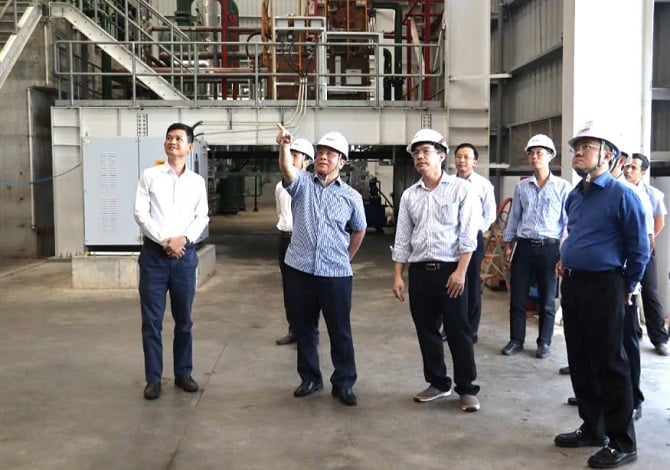
An Giang Provincial People's Committee delegation led by Chairman of the Provincial People's Committee Ho Van Mung visited Hau Giang biomass power plant (Can Tho).
During the survey, the delegation directly learned about the operating process, technological chain, environmental protection work as well as the biomass fuel collection mechanism. The factory uses rice husk as the main raw material - a common by-product in rice production in the Mekong Delta. The designed capacity reaches 20 MW, the average electricity output is about 130 million kWh per year, contributing to the stable supply of electricity for the region and significantly reducing emissions into the environment.
According to the investor's report, the factory consumes about 120,000 tons of rice husks each year, thereby reducing more than 200,000 tons of CO₂ emissions. Utilizing agricultural by-products not only solves the problem of waste treatment but also creates a new economic value chain for rural areas, from collection, transportation to technical system operation and maintenance services.
Assessing the reality on the ground, Chairman of An Giang Provincial People's Committee Ho Van Mung said that the biomass power model is a suitable direction for the natural conditions and agricultural production structure of the province. With the advantage of being a locality with the largest rice area and output in the region, An Giang has abundant and stable biomass resources, creating a favorable foundation for developing this type of renewable energy on an industrial scale.
On that basis, An Giang is promoting planning and calling for investment in two key biomass power projects. Of which, the An Giang 1 biomass power plant project is expected to be located in Vinh Gia commune, with a designed capacity of 50 MW, total investment capital of about 2,934 billion VND. Fuel sources include rice husks, straw and other agricultural by-products, with a demand of about 260,000 tons per year.
The remaining project is Nui To 1 biomass power plant, planned to be built in Tri Ton commune, with a capacity of 20 MW and a total investment of more than VND 1,110 billion. The biomass raw material demand of this project is estimated at about 118,000 tons/year. Both projects are oriented to apply modern technology, ensuring environmental requirements and long-term economic efficiency.
“Investing in biomass power plants not only aims to supplement renewable energy sources, but also contributes to promoting economic restructuring towards increasing the proportion of industry and services, reducing dependence on raw resource exploitation. At the same time, these projects are also associated with the goal of implementing the 1 million hectares of high-quality rice project, aiming at green agricultural production, reducing greenhouse gas emissions and adapting to climate change,” emphasized Chairman of An Giang Province Ho Van Mung.
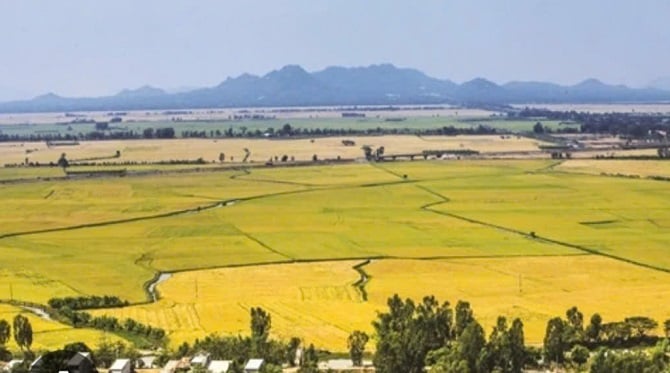
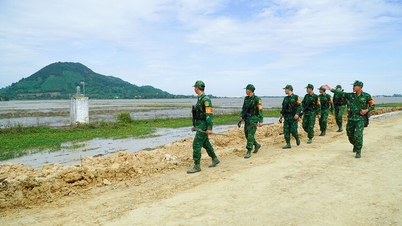
The Long Xuyen quadrangle (An Giang) is the largest rice granary in the region and the country. This is an abundant source of raw materials for the province's future biogas electricity production.
Mr. Mung also noted that the province places high demands on the capacity and experience of investors, especially the ability to ensure electricity output, exhaust gas treatment technology and input material supply chain. This is considered a decisive factor for biomass power projects to operate stably, avoiding the situation of "shelving" due to lack of fuel or unbalanced financial problems.
To create an open and transparent investment environment, the Chairman of the An Giang Provincial People's Committee has assigned the Department of Finance to coordinate in guiding and supporting investors in completing documents and legal procedures in accordance with regulations, while shortening the appraisal and settlement time to soon put projects into practical implementation.
The proactive survey of actual models and preparation of the foundation for biomass power projects shows An Giang's determination in developing renewable energy, effectively utilizing agricultural by-products, and moving towards green and sustainable growth in the coming period.
Source: https://doanhnghiepvn.vn/doanh-nghiep/an-giang-khao-sat-mo-hinh-dien-sinh-khoi-chuan-bi-cho-2-du-an-nghin-ty/20251209120911577





![[Photo] Urgently help people soon have a place to live and stabilize their lives](/_next/image?url=https%3A%2F%2Fvphoto.vietnam.vn%2Fthumb%2F1200x675%2Fvietnam%2Fresource%2FIMAGE%2F2025%2F12%2F09%2F1765248230297_c-jpg.webp&w=3840&q=75)









































![[Photo] General Secretary To Lam works with the Standing Committees of the 14th Party Congress Subcommittees](https://vphoto.vietnam.vn/thumb/402x226/vietnam/resource/IMAGE/2025/12/09/1765265023554_image.jpeg)





















Comment (0)