

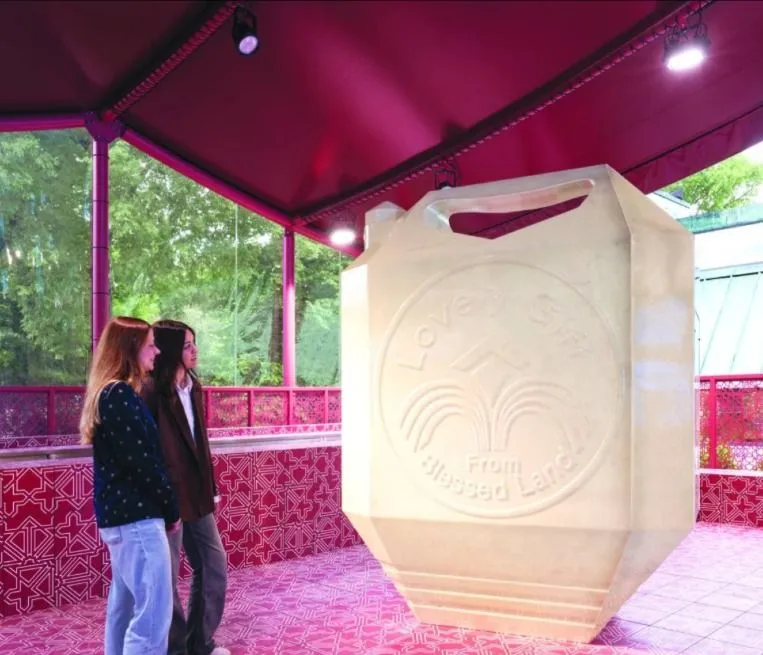
Right from the entrance, Alia Farid's Jerrican artwork creates a striking impression. The familiar water vessel from the Gulf region is magnified into a cultural symbol, reminiscent of the tradition of offering water to strangers in the harsh desert. Water is not only for drinking but also a way for Arabs to show welcome and acknowledge the presence of others.
From that small story, the exhibition expands into a "harmony" of memories of migration, displacement, and cultural exchange. The organizers aim to create an ever-changing atmosphere. That's why, instead of a static exhibition, the space continuously transforms through sound, movement, and interaction, shaped by the artworks themselves and the visitors.
What's unique is that Qatar doesn't seek to create a single, unified Arab identity. The artists participating in the exhibition come from diverse communities in the Gulf region, North Africa, and the diaspora of the Arab world. Viewers therefore encounter a wide range of emotions, from nostalgia and feelings of alienation in a foreign land to the yearning for a place to belong.
Open kitchens, fragrant aromas, the sounds of conversation, and communal meals are incorporated as part of the art form. Palestinian chef Fadi Kattan tells stories through his food, allowing each flavor to become a trace of the trade routes and human journeys that have connected the Arabian Peninsula with the Mediterranean for hundreds of years.
“From the 13th to the 15th centuries, all the spices that came to Europe passed through Arabia to reach Venice,” chef Kattan said. Qatari chef Noof Al Marri believes that cuisine has become a way to share stories between cultures and generations. Visitors are encouraged to sit down, eat, listen to music, and spend time in the space instead of just passing by. “People chat, eat, drink juice, listen to music, watch movies, and relax here, so it really is a gathering space, a space for people to meet together,” co-curator Ruba Katrib said.
Within the overall context of this year's Venice Biennale, Qatar's space felt like a gentle lull amidst political debates and edgy artistic experiments. Instead of grand messages, the exhibition chose to tell stories through everyday gestures: offering a drink, sharing a meal, or sitting together around a long table.
Qatar's establishment of a permanent national exhibition space in the Giardini district, home to some of the most prestigious galleries at the Venice Biennale, also demonstrates the Gulf nation's ambition to expand its cultural influence. But more than just a soft diplomacy strategy, this exhibition shows that art can still be a bridge connecting people through the simplest things.
The 61st Venice Biennal 2026, an international art exhibition, is themed "In Minor Keys." The exhibition runs from May 9th to November 22nd at Giardini, Arsenale, and other venues in Venice. It features participation from 100 countries, including 7 first-time attendees, among them Vietnam.
Source: https://www.sggp.org.vn/ban-hoa-am-qatar-giua-long-venice-post853016.html





















































































Comment (0)