

Symbolizing unwavering will and an indomitable fighting spirit, the Cu Chi Tunnels are an important part of the nation's glorious history.
From the heart of Ho Chi Minh City, crossing the sunny Provincial Road 15 in March 2025, reporters from the Nguoi Lao Dong newspaper traveled to the Cu Chi Tunnels – a place that, in the 20th century, was mentioned worldwide for its unique military structure.
The magical "underground village"
Established in 1948, the Cu Chi Tunnels initially consisted of short tunnels used to hide documents, weapons, and as shelters. During the anti-American war, especially in 1966 when the US used the 1st Infantry Division ("Big Red One") to carry out the large-scale operation called Crimp, which fiercely attacked revolutionary forces and base areas, the tunnels developed significantly.
Facing this offensive, cadres and soldiers and civilians steadfastly held their ground, digging tunnels, building trenches, and establishing a "ring to eliminate the Americans," determined to protect the revolutionary base with the slogan "Not an inch will be given up, not a millimeter will be surrendered." From this unwavering determination, underground, alongside the narrow rows of tunnels, a field hospital, a food depot, trenches, living quarters, a command post meeting room, and a Hoàng Cầm kitchen were formed… All blended together to create a miraculous "underground village," a testament to the indomitable will and creative intelligence of our soldiers and people.
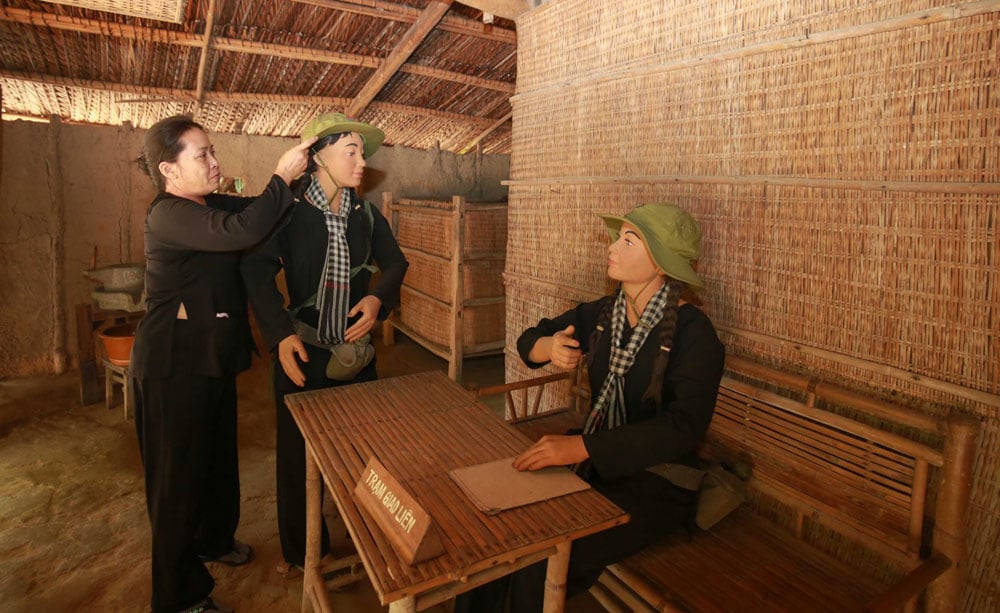
Through these visual images, visitors can clearly feel the hardship but resilience of life inside the Cu Chi Tunnels. Photo: HOANG TRIEU
Following the Crimp offensive in January 1967, the US military launched the large-scale Operation Cedar Falls with 30,000 troops, tanks, armored vehicles, artillery, and air support, aiming to "peel the earth" and destroy the tunnel system. The enemy's ambition was to neutralize the Saigon-Chợ Lớn-Gia Định Military Region Command, the leadership body of the Regional Party Committee, and the main units of the Military Region, and to destroy the base area. However, the tunnel system, with its resourceful and courageous individuals, turned that ambition into a disaster. In the Bến Dược area alone, a guerrilla unit of only nine people held out in the tunnels for many days, killing hundreds of enemy soldiers and destroying many tanks.
By this time, the tunnel system had reached a total length of approximately 250 km, comprising multiple levels and branches like a giant spiderweb underground. American General A. Nasen had to admit: "It's impossible to destroy the tunnels because they are not only too deep but also incredibly winding… Attacks by engineers are ineffective… and it's very difficult to find the tunnel entrances."
Memories of an Old Soldier
Meeting veteran Huynh Van Chia, also known as Nam Chia, the reporter was impressed by the memory of this guerrilla fighter from Trung Lap Ha commune, Cu Chi district, at the age of 79, during the resistance war against the US.
Recalling the heroic years of the resistance war, Mr. Nam Chia not only fondly reminisces about the fierce battles but also about the arduous days of digging tunnels, yet no one lost heart. He said that back then, guerrillas fought with guns while digging tunnels and planting rice and potatoes to sustain their forces.
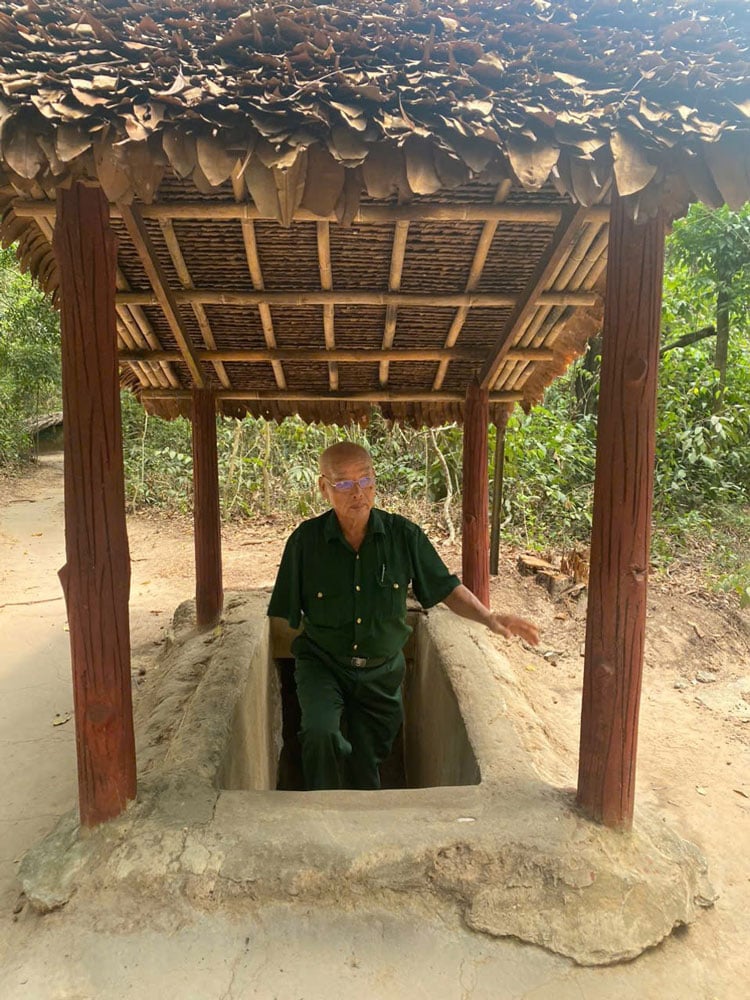
Every time he visits the Cu Chi Tunnels, Mr. Nam Chia cannot help but be moved. Photo: PHAN ANH
With only rudimentary tools like hoes and bamboo shovels, the soldiers and people of Cu Chi silently created a magnificent and unimaginable structure, a testament to the intelligence and resilience of the Vietnamese people. Each tunnel-digging team typically consisted of five people, each with a specific task such as digging, scooping soil into shovels, and transporting the soil to a location undetectable by the enemy.
The work began with digging test tunnels 1 meter wide and about 4 meters deep. From the bottom of the test tunnel, they continued digging to create passageways. There were many digging teams, each spaced 7-10 meters apart; as they dug, people followed behind to collect the excavated soil, without a moment's rest. While digging, everyone constantly pressed their ears against the tunnel walls to listen for any movement from their teammates, adjusting each pickaxe stroke to ensure the tunnels connected precisely.
"Every 7-10 meters, a test well was dug to pull up the soil, then filled back in, creating a sophisticated ventilation system. Before filling, we placed a bamboo pole in the test well to create a vent hole, ensuring air could circulate. Each meter of the tunnel was gradually expanded in this way," said a former village guerrilla fighter.
Answers to all your questions
According to historical documents, following the Tet Offensive of 1968, the battlefield situation underwent significant changes. The enemy implemented a "sweep and hold" tactic, continuously launching offensives directed towards the liberated areas of Cu Chi in an attempt to push revolutionary forces further away and create a safe zone to protect Saigon.
The tunnels were reinforced and developed, creating a firm foothold for forces approaching the suburban areas, maintaining control of the territory, and establishing a new strategic position in preparation for the later liberation of Saigon. By the spring of 1975, many large units of the 3rd Army Corps and other main and local units assembled from here to liberate Cu Chi town and the last enemy stronghold in Saigon, bringing the war against the US to a complete victory on the historic afternoon of April 30, 1975.
After liberation, Cu Chi - the land of steel and bronze - underwent a dramatic transformation, and the Cu Chi Tunnels became a Special National Monument, a significant historical site attracting millions of domestic and international tourists.
Ms. Vuong Thanh Phuong, an international tour guide at TST Tourist Company, said that many international tourists who couldn't understand how a small nation like Vietnam could defeat two superpowers, France and the United States, found the answer after visiting the Cu Chi Tunnels.
Visiting the Cu Chi Tunnels, tourists not only learn about history through books or exhibits but also hear tragic stories firsthand. In particular, the experience of crawling down the tunnels allows visitors to truly feel the hardship but resilience of the soldiers and people of Cu Chi during the fierce years of the resistance war.
"Many tourists, after experiencing it, exclaim that the Vietnamese style of warfare is truly unique," said Ms. Phuong.
The Cu Chi Tunnels were classified as a Special National Monument in December 2015. The dossier to be submitted to UNESCO for recognition as a World Heritage Site is currently being finalized by Ho Chi Minh City in coordination with central government agencies.
Live on through time
Standing amidst a land that was once a fierce battlefield, Mr. Nam Chia was deeply moved. Reflecting on the intricate network of tunnels, he said that these relics, reminders of the nation's heroic wartime, have now become a heritage. He believes that the younger generation will never forget the great sacrifices of their ancestors.
"We got through those difficult times with willpower and patriotism. Now, Cu Chi is peaceful, but the stories of the tunnels will live on forever, like an immortal epic," Mr. Nam Chia said proudly.
National wisdom guarantees ultimate victory.
In October 2022, while visiting the Cu Chi Tunnels, Prime Minister of the Republic of Cuba Manuel Marrero Cruz expressed his admiration. He said that the Vietnamese people were not prepared to confront the modern equipment of the United States, but the intelligence of the Vietnamese people ensured their ultimate victory.
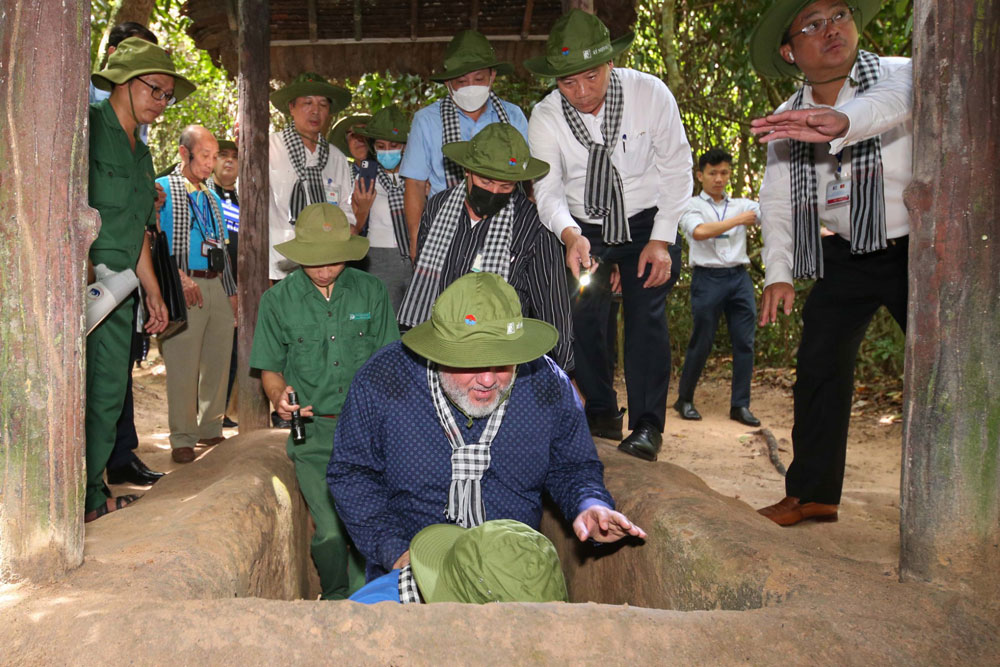
Prime Minister of the Republic of Cuba Manuel Marrero Cruz and a high-level Cuban government delegation visit the Cu Chi Tunnels. Photo: HOANG TRIEU
"Although the US dropped bombs and even chemical weapons to destroy everything on the surface, our Vietnamese brothers wrote a glorious chapter in history for all of humanity. No architect in the world could have designed a tunnel system as unique as the Cu Chi Tunnels. The Vietnamese people created a truly unique tunnel system and invented many weapons from rudimentary tools. In the hearts of the Cu Chi guerrillas, there was an absolute belief that the footprints of American soldiers could not trample this land," - Cuban Prime Minister Manuel Marrero Cruz stated.
(To be continued)
(*) See Nguoi Lao Dong Newspaper, issue dated March 17th.
Source: https://nld.com.vn/dia-chi-do-lam-nen-dai-thang-mua-xuan-1975-ban-hung-ca-cua-tinh-than-bat-khuat-196250317220756137.htm






























































































Comment (0)