There are certain dishes that don't need any fanfare to be deeply ingrained in the memories of those who were born and raised in Hanoi, like a subtle fragrance that lingers through the years. Hanoi rice rolls are one such treat.
Hà Nội Mới•15/05/2026
As a child, I often went with my grandparents to enjoy breakfast, when the air was still misty, the streets were still asleep, and only a few small food stalls were beginning to light their fires. In a quiet corner of the street, a steaming pot of pancakes emitted wisps of smoke, enveloping the tranquil space in delicate, mist-like vapors.
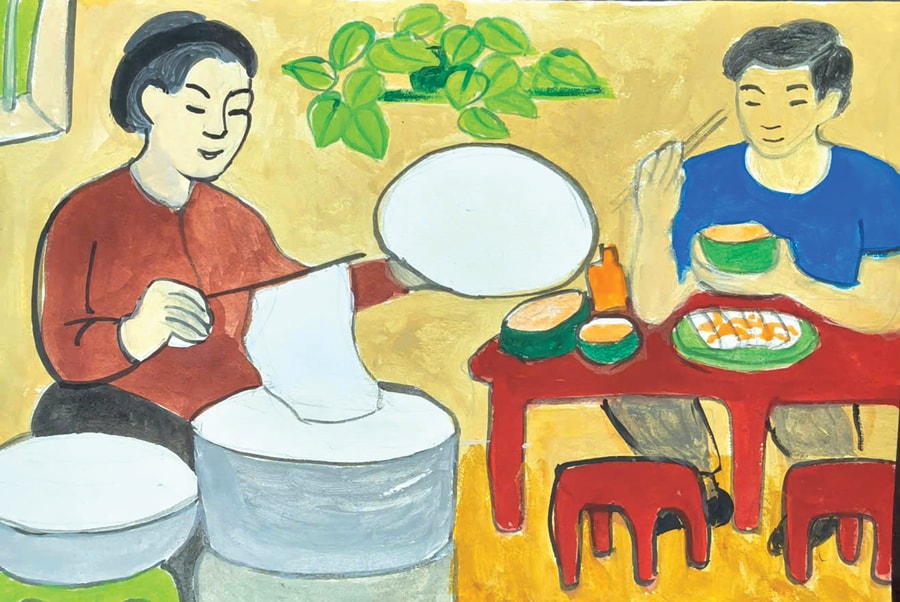
Illustration: Nguyen Sa
Rice rolls (Bánh cuốn) are a delicate dish, made through processes that require skill and patience. The rice used must be a high-quality, non-glutinous variety, neither too dry nor too sticky, soaked just enough before being ground into a watery batter. The batter should not be too thick or too thin, because even a slight deviation in the ratio will result in a thin, delicate layer of the roll.
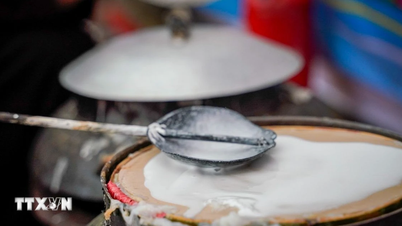
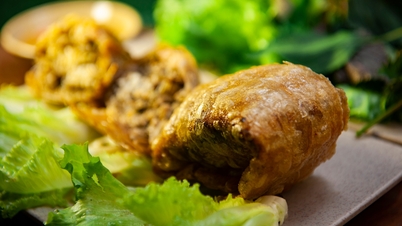
As a child, I would often intently observe how the vendor prepared the rice rolls. Before pouring the batter, she would meticulously stretch a thin cloth over the mouth of the pot, with boiling water bubbling underneath. She would scoop a ladleful of batter, gently pour it onto the cloth, and then use a small bamboo stick to spread it evenly. In just a few seconds, the batter would be cooked, becoming translucent like a thin silk cloth. Then, skillfully, she would use the thin bamboo stick to lift the rice roll and place it on a tray that had been greased. The delicate nature of the rice roll lies not only in its thinness but also in the soft sensation when eaten. The roll must be soft but not mushy, thin but not torn. When rolled up, the rice roll wraps around the filling inside, usually stir-fried minced meat with wood ear mushrooms, creating a harmonious, discreet yet incredibly satisfying whole.
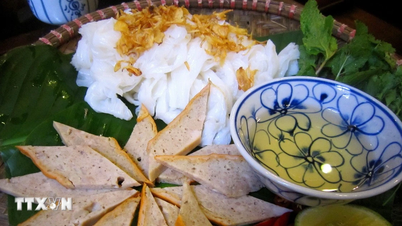
Hanoi- style rice rolls are a dish that combines many flavors, especially the dipping sauce. For the dipping sauce to be the soul of the dish, it must be made with high-quality fish sauce, skillfully mixed with a little sugar, vinegar or lemon juice, a few slices of red chili, and for a more luxurious version, a touch of water beetle essence for added aroma. All these elements blend together to create a distinctive, rich yet mild flavor.
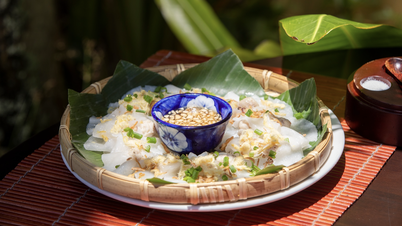
Hanoians eat banh cuon (steamed rice rolls) in a unique way. It's not rushed, not chaotic. A plate of hot banh cuon is served in the early morning mist. Diners leisurely pick up each piece, dip it into the fish sauce, and savor it. The softness of the rice roll, the crispness of the wood ear mushrooms, the rich flavor of the meat filling, the aroma of fried onions – all melt and blend together in a slow, deliberate rhythm. I've seen elderly people sitting leisurely eating banh cuon in a small corner of a restaurant, their eyes distant as if savoring a lifetime. For them, perhaps it's not just breakfast, but a habit, a part of their memories.
Occasionally, I have the opportunity to return to Hanoi after a long absence. Years have passed, the streets have changed considerably, but the old steamed rice roll stalls remain, like silent traces of Hanoi. Sitting down at a small steamed rice roll shop, I suddenly feel as if everything has reversed to the old days. Some things cannot be preserved by time, but they can be preserved through taste. Sometimes, the best dishes aren't found in fancy restaurants, but in simple street corners like these.
Amidst the moss-covered ancient streets and time-worn gray tiled roofs, the distinctive aroma of rice rolls has become a part of our memories. Hanoi's cuisine is not ostentatious, but gentle, much like the way of life of the people of Hanoi. Enjoying a dish is about learning to slow down, to feel and understand why people say Hanoi is not only beautiful in its scenery, but also evokes fond memories through its taste.





























































































Comment (0)