

Recognizing irrigation infrastructure as a crucial "shield" against the impacts of climate change, the province has prioritized investment in dike systems and sluice gates to prevent saltwater intrusion and store freshwater over the years. However, to ensure sustainable water security for production and daily life, the early completion of key projects, aiming for a fully integrated inter-regional irrigation system, is an urgent requirement in the current period.
 |
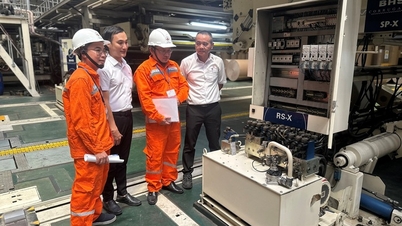
| The specialized department is surveying the An Hoa culvert project. |
Enhancing capacity to serve production and people's lives.
According to Associate Professor Dr. Lam Van Tan, Provincial Party Committee member and Director of the Department of Agriculture and Environment, thanks to timely attention and support from the Government and central ministries and agencies, the province has implemented investment in the construction of many key irrigation and water supply projects. These key projects help control salinity in coastal areas and create conditions for freshwater conversion for thousands of hectares of agricultural land in freshwater ecological zones.
As a result, the agricultural sector can diversify crops, shift the economic structure, improve land use efficiency, and easily apply new technical advancements to farming, contributing to increased production value per unit area.
Statistics show that the province's irrigation infrastructure is currently very large, with 9,797 sluice gate projects already invested in and constructed.
Of these, 646 main sluice gates play a key regulatory role, and 9,151 temporary sluice gates or gates with a gate width of less than 1.5m serve the inland network. The system of canals and ditches of all types comprises 10,193 lines with an impressive total length of over 13,160 km.
In addition, the province has a network of 683 embankment lines (with a total length of over 4,651 km) and 160.12 km of sea dikes across key areas. Notably, the province currently has 3 existing freshwater reservoirs with capacities ranging from 30,000 cubic meters to over 811,000 cubic meters, which are effectively storing water for the population during the dry season.
To further enhance its capacity to respond to extreme climate change scenarios, the province is urgently accelerating investment in the construction of two large-scale freshwater reservoirs: the Lang The reservoir (with a capacity of approximately 10 million cubic meters) and the Lac Dia reservoir (with a designed capacity of approximately 2.3 million cubic meters).
These two projects are expected to be completed by the end of 2026, creating a strategic freshwater reserve to ensure water security for production and daily life. Disaster prevention efforts are being intensified through prioritizing the handling of landslide hotspots.
A typical example is the project to reinforce the embankments on both sides of the Giao Hoa River, with a total length of 4.7km. To date, the province has put into use approximately 4.2km and is striving to complete the remaining 0.5km by August 2026 to stabilize the lives and production of people living along the riverbanks, in accordance with Decision No. 1304/QD-UBND on the emergency situation of Giao Hoa River bank erosion.
Unlocking investment resources to create a closed-loop system of infrastructure projects.
Despite the achievements already made, the province's irrigation system is still facing unprecedented challenges due to the impacts of climate change.
According to Associate Professor Dr. Lam Van Tan, monitoring the drought and saltwater intrusion situation from 2015 to the present shows that the low and unstable water flow from the upper reaches of the Mekong River has caused extremely severe and intense saltwater intrusion. Salinity in the main rivers of the province appeared about two months earlier than the average of previous years with strong intensity. The sudden increase in salinity and deeper penetration into inland areas have caused heavy damage to agriculture, livestock farming, and aquaculture.
 |
| The section of the embankment protecting the Giao Hoa riverbank in Giao Long commune has collapsed due to erosion. |
Calculations from 2016 to the present estimate the total economic damage caused by drought and saltwater intrusion across the province at over 5.5 trillion VND. Of this, the area formerly belonging to Ben Tre province suffered the most severe damage, with estimated losses exceeding 3.1 trillion VND; the area formerly belonging to Tra Vinh province suffered losses exceeding 2.1 trillion VND; and the remaining area suffered losses of 254.4 billion VND.
This reality reflects a fundamental limitation: the current irrigation system is not yet fully closed, and many large sluice gates in key areas have not been invested in comprehensively, leading to annual saltwater intrusion that directly affects the lives and production of the people.
A highlight in the efforts to close the system is the Ben Tre Water Management Project (JICA3), which utilizes ODA funding from the Japanese government with a total investment of VND 7,578 trillion.
This is a large-scale infrastructure project, focusing on the construction of four sluice gates: An Hoa, Ben Tre, Vam Nuoc Trong, and Vam Thom; important reinforced concrete sluice gates such as Thu Cuu, Cai Quao, Tan Phu, and Ben Ro; and the Tan Phu electric pumping station.
Upon completion, the project will help prevent tidal surges, respond to sea level rise, and control salinity and drainage for more than 204,270 hectares of natural land in Ben Tre ward and surrounding areas.
Regarding the An Hoa sluice gate project, the local authorities have basically completed land clearance for 62 out of 63 households and are actively working to persuade the last household to hand over the land so that the investor can start construction as planned.
Towards the goal of sustainable water security, the province continues to request the Ministry of Agriculture and Environment to prioritize investment support to complete the system of dikes and sluice gates to prevent saltwater intrusion in the sub-regions.
For the North Ben Tre sub-region, the main requirement is to complete and put into operation the sluice gate under the JICA3 project as soon as possible to ensure the freshwater supply of the Ba Lai River, creating a water source for the water treatment plant and for the people's domestic and industrial needs.
For the southern Ben Tre sub-region, the strategic objective is to accelerate the progress of the Cai Quao sluice gate and support investment in an additional 22 saltwater intrusion prevention sluice gates.
The formation of a continuous freshwater supply line from Cho Lach area through Mo Cay Bac, Mo Cay Nam to Thanh Phu will help protect the area of specialty fruit trees, key seedling production areas and ornamental flower gardens of the locality. The province plans to upgrade the sea dike system (phase II) in coastal communes such as Hiep My, Long Huu, Dong Hai... and complete flood control dikes on a province-wide scale.
This is an important roadmap that has been concretized in Decision No. 368/QD-UBND dated January 15, 2026, on adjusting the provincial planning for the period 2021-2030 and Decision No. 2708/QD-UBND dated April 20, 2026, on the landslide prevention and control plan.
With appropriate and coordinated investment from the central to local levels, the irrigation system will truly become a solid foundation to help the province proactively respond to natural disasters and ensure sustainable development for the downstream Mekong Delta region.
The irrigation system in the province plays a particularly important role in the strategy for developing agricultural production, improving the ecological environment, and protecting the living environment of the population. The focused investment in building a comprehensive technical infrastructure over the past years has created conditions to enhance the capacity for proactive irrigation, serving approximately 80% of the province's cultivated area. At the same time, this system also contributes significantly to achieving the target of the percentage of rural residents using safe drinking water, as set out in the annual plan of the agricultural sector.
Text and photos: TRAN QUOC
Source: https://baovinhlong.com.vn/kinh-te/202605/hoan-thien-he-thong-thuy-loi-bao-dam-an-ninh-nguon-nuoc-ben-vung-23e420b/
















































































Comment (0)