

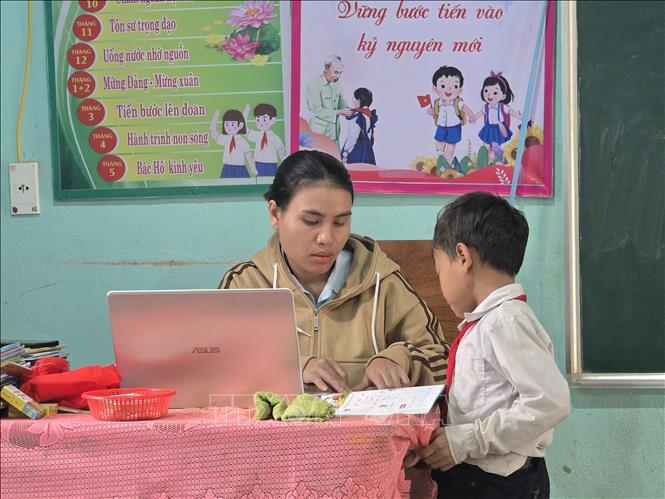
The national target program on modernization and improvement of education and training quality for the period 2026 - 2035 emphasizes four basic target groups: Gradually standardizing the preschool and general education system; forming 6 national centers and 12 regional centers to train highly skilled human resources; investing in standardizing and modernizing technical infrastructure, expanding development space for the university education system; improving the quality and capacity of teachers, education managers and learners. These are considered strategic orientations, creating a foundation for the education system in the period of strong transformation from now to 2035.
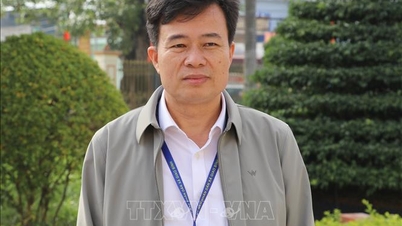
Mr. Nguyen Tran Vy, Principal of Ngoc Linh Primary Boarding School for Ethnic Minorities (Tra Linh Commune) said that currently, the current state of educational facilities is still lacking and inconsistent, especially in schools in mountainous areas. Therefore, the National Target Program needs to prioritize resources to ensure the goal of solidifying 100% of schools and classrooms; completing the network of semi-boarding schools, boarding schools and public housing for teachers in remote, isolated and border areas. Investment in facilities is not only urgent but also related to equality in access to education, shortening the gap between mountainous areas and the plains.
Conclusion 45-KL/TW, dated November 17, 2022 of the Party Central Committee on "Orientation of the National Master Plan for the period 2021 - 2030, vision to 2050" sets the goal that by 2030 Vietnam will have a number of universities in the top 150 in Asia and a number of training majors in the top 100. For key technical schools such as the University of Technology (University of Danang ), this goal is both pressure and motivation for the school to clearly define its role in the strategy of improving higher education.
Associate Professor, Dr. Nguyen Huu Hieu, Rector of the University of Technology (University of Danang) emphasized that the school focuses on fields with traditional strengths such as: mechanics, electricity - electronics, automation, materials technology, information technology, artificial intelligence, energy and environment. These fields are completely capable of approaching international ranking standards, because the characteristics of the engineering sector are many clear quantitative indicators on research, publication and technology transfer. The school also aims to become the nucleus in research - technical innovation of the entire Central - Central Highlands region. Building strong research groups, key laboratories and technology transfer centers not only serves the development goals of the region but also is the basis for each major/specialty of the school to have the opportunity to enter the regional ranking group and more broadly the top 100 in the world .
Regarding the long-term impact of the National Target Program on the university education system, according to Master Le Vu, Director of the Center for Learning Resources and Communication (University of Technical Education, University of Danang), the Program has solved the problem of fragmented resources. Key universities will become technology and practice centers (hubs). This system helps Vietnam shift from a decentralized, unconnected university model to a hub model (region - country) like developed countries like Japan, Korea, and Singapore. When resources converge, we will have enough conditions such as modern labs, R&D centers, and digital systems to train leading experts and scientists in key fields such as semiconductor microchips, AI, and biotechnology that are globally competitive.
In addition, the Program also creates regional spread and balance. Accordingly, 12 regional centers will play an important role, contributing to local economic development, ensuring that human resources everywhere have the opportunity to access high-quality education without having to flock to large cities. In the long term, the Program will shift higher education from a quantity-based training model to training according to the orders of the digital economy and circular economy. Modern technical infrastructure will be the launching pad for universities to not only be places of teaching but also become real innovation centers.
The enthusiastic opinions of Da Nang voters show great expectations for a synchronous, substantial and sustainable investment program for education. Da Nang voters hope that the National Target Program to modernize and improve the quality of education and training in the 2026 - 2035 period will be a "push" to strongly unlock resources, contributing to realizing the national education modernization strategy in the new era.
Source: https://baotintuc.vn/thoi-su/bao-dam-viec-dau-tu-hien-dai-hoa-giao-duc-quoc-gia-thuc-su-di-vao-chieu-sau-20251202172826357.htm



![[Photo] National Assembly Chairman Tran Thanh Man receives First Vice Chairman of the Federation Council of the Federal Assembly of the Russian Federation](/_next/image?url=https%3A%2F%2Fvphoto.vietnam.vn%2Fthumb%2F1200x675%2Fvietnam%2Fresource%2FIMAGE%2F2025%2F12%2F02%2F1764648408509_ndo_br_bnd-8452-jpg.webp&w=3840&q=75)
![[Photo] Worshiping the Tuyet Son statue - a nearly 400-year-old treasure at Keo Pagoda](/_next/image?url=https%3A%2F%2Fvphoto.vietnam.vn%2Fthumb%2F1200x675%2Fvietnam%2Fresource%2FIMAGE%2F2025%2F12%2F02%2F1764679323086_ndo_br_tempimageomw0hi-4884-jpg.webp&w=3840&q=75)































































Comment (0)