

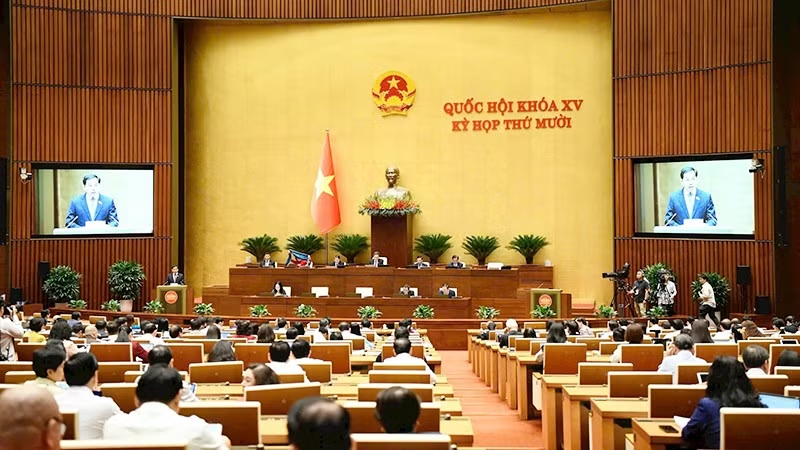
Therefore, environmental protection is not just an item on the agenda, but is truly a matter of life and death, affecting the lives and livelihoods of millions of people and directly impacting the pace of development and quality of life of the entire society.
The gray area between bright colors
The parliamentary discussion at the Tenth Session of the 15th National Assembly on the Report of the Supervisory Delegation and the draft Resolution of the National Assembly on the results of the thematic supervision on "The implementation of policies and laws on environmental protection since the Law on Environmental Protection 2020 came into effect" attracted the attention of a large number of people nationwide. The Supervisory Delegation acknowledged that the promulgation and implementation of policies and laws on environmental protection since the Law came into effect have achieved many positive and important results, contributing to the successful achievement of socio -economic development goals and targets, ensuring national defense, security, foreign affairs, social welfare, and international integration.
However, why is it that despite the 2020 Environmental Protection Law, with its many progressive new provisions and widespread implementation, shortcomings and problems persist, and environmental issues are becoming increasingly complex and even severe? Could it be that there is a gap between the written intentions and practical actions that will not be easily bridged anytime soon?
In practice, amidst the bright colors, a gray area remains: the environment in many places is deteriorating, and air and water pollution are becoming increasingly complex. As an example, National Assembly representative Thach Phuoc Binh (Vinh Long) frankly pointed out: “Environmental pollution control has progressed but is not sustainable. While urban waste collection is at 97%, only 18% of wastewater is treated, and nearly 60% of waste is still buried, mainly in rural areas and small towns. Many landfills that have been in operation for decades, such as Nam Son ( Hanoi ), Khanh Son (Da Nang), and Tan Long (Dong Thap), remain environmental hotspots.”
Many National Assembly deputies have identified a common problem: the main "bottleneck" lies in the implementation phase. Many major policies, though seemingly "smoothly implemented" at the central level, are stalled, delayed, or suffer from a lack of personnel, funding, and even accountability upon reaching local authorities.
Removing bottlenecks at the grassroots level
The 2020 Environmental Protection Law has significantly decentralized authority to local governments: from environmental licensing and waste management to pollution monitoring. However, enforcement capacity in many areas still lacks professionalism and modernity; local officials also lack proper training. Analyzing this issue, National Assembly Deputy Nguyen Thi Thu Ha (Quang Ninh) stated: "This requires us to elevate environmental protection efforts and improve mechanisms and policies in the coming period."
Many localities still maintain the mindset of "economic development first, environmental issues second," and the serious deterioration of environmental infrastructure remains a major concern. Monitoring reports clearly indicate that some localities prioritize attracting investment while neglecting environmental protection. As a result, many polluting projects are slow to be addressed, waste sorting at source is implemented superficially, lacking supervision and "not truly decisive": only about 18% of total urban wastewater is collected and treated, with the remainder mainly discharged directly into the environment. Meanwhile, inspection, monitoring, and enforcement of violations have not met requirements, and penalties for some acts of environmental pollution are low, lacking sufficient deterrent effect, and the people themselves bear the consequences.
National Assembly Deputy Chu Thi Hong Thai (Lang Son) stated: “In reality, waste sorting at source has been implemented quite aggressively in many localities. However, during the processing, most waste is still collected together, leading to a situation where even if people sort waste at source, it does not yield practical results. Many businesses and waste collection units are still limited in their investment in technology and techniques.” This reality reflects the inadequacy between advanced policies and the implementation capacity of local facilities. When processing infrastructure is outdated, all efforts at sorting, recycling, or developing a circular economy remain only on paper. Some delegates believe that the principle of “the polluter, the cause of the incident, and the environmental degradation must pay for the damage, remediation, and treatment” has not been thoroughly applied. Some delegates even frankly suggested publicly disclosing the list of 38 seriously polluting facilities that have not been definitively dealt with – considering it a “measure of responsibility” of the local authorities.
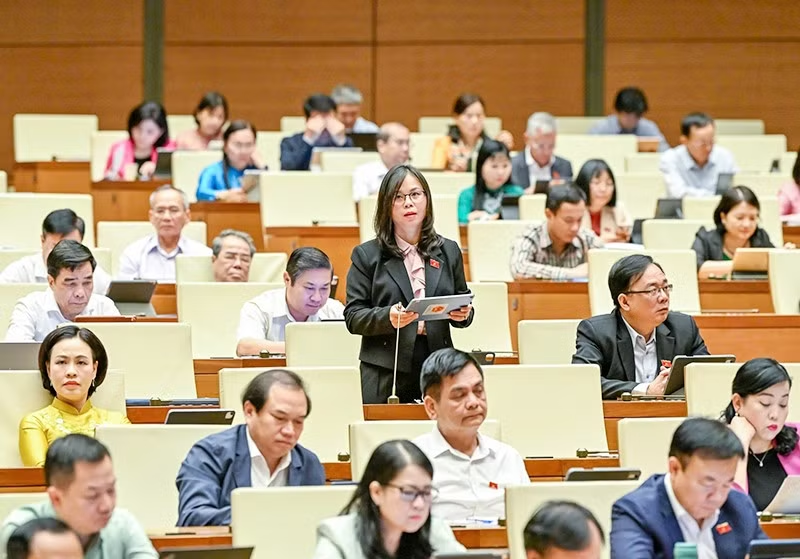
A persistent weakness is the lack of public access to environmental information. At the commune and ward levels, information on water quality, air quality, and waste disposal is almost never publicly updated. A current difficulty is that many localities lack environmental data portals, limiting independent monitoring by citizens, the Fatherland Front, or social organizations.
One of the solutions mentioned by Minister of Agriculture and Environment Tran Duc Thang in his explanation is to build a domestic carbon trading platform, to be piloted starting from the end of 2025; to operate a national registration system for greenhouse gas emission quotas and carbon credits connected to the international system; to establish an online greenhouse gas inventory reporting system for businesses; and to complete the operation of the national environmental database information system, ensuring integration, interconnection with the national database, and real-time sharing from the central level to the commune level.
Strictly adhere to the regulations.
Some have suggested incorporating environmental indicators into the assessment of the competence of leaders, considering it a mandatory criterion in evaluating public investment and socio-economic management. When green criteria are linked to the competence of officials, accountability becomes tangible, avoiding the situation where "everyone shares some responsibility but no one takes primary responsibility." Simultaneously, the public disclosure of lists of polluting facilities, inspection results, and remediation progress should become mandatory regulations. Information transparency is not only a management tool but also a positive pressure to compel local authorities to act.
One of the recommendations of the Supervisory Delegation is to “strengthen and diversify resources for environmental protection.” Localities need to be allocated budgets commensurate with their tasks, ensuring that spending on the environment is “not less than 1% of the total State budget expenditure” and gradually increases each year. Some National Assembly deputies proposed that the National Assembly “raise the minimum level to 1.2% of the total State budget expenditure from 2027,” to help localities have resources to invest in infrastructure for waste and wastewater treatment. Along with that, the management apparatus must be streamlined according to the two-tier local government model (province-commune), with dedicated environmental protection officers in each sector and unit.
Putting into operation a national environmental information system and database, integrating publicly available environmental quality maps for the community, is an urgent requirement. Local authorities must play a leading role in updating data, deploying automatic monitoring stations, and sharing real-time information on air, water, and waste quality. This will enable citizens to monitor the government, provide the press with a basis for timely reporting, and ensure businesses comply with regulations transparently.
Environmental protection is the responsibility of the entire society; therefore, the movement for all citizens to participate in environmental protection, waste generation, sorting, and treatment needs to be launched and implemented more strongly at the grassroots level, specifically through self-governing environmental movements, green commune/ward models, or recycling cooperatives... At the same time, local authorities need to proactively address pollution "hot spots," especially in craft villages and industrial clusters interspersed with residential areas. The relocation, remediation, and enforcement of polluting facilities must be carried out in accordance with the law, without avoidance for the sake of local interests.
Deputy Speaker of the National Assembly Le Minh Hoan suggested that "the Government should pay close attention to and promptly direct the issuance and implementation of documents specifying the Law on Environmental Protection and related laws in accordance with the National Assembly's Resolution. The implementation of some policies in the Law needs to be quickly verified and effectively implemented in practice." And when each locality considers environmental protection as a crucial foundation for sustainable development, will the will and determination will transform into concrete, practical actions, spreading to the community and individual households.
After nearly five years of implementing the 2020 Environmental Protection Law, more than 500 guiding documents have been issued nationwide, including over 30 documents at the government, ministerial, and sectoral levels – contributing to the concretization of the sustainable development perspective across all three pillars: economy, society, and environment.
Source: https://nhandan.vn/bao-ve-moi-truong-khong-the-cham-tre-hon-post924457.html







![[GALLERY] Witnessing the first landing of an Italian F-35B fighter jet on a highway.](https://vphoto.vietnam.vn/thumb/402x226/vietnam/resource/IMAGE/2026/05/24/1779625960562_f-35b-della-marina-militare-2-jpg.webp)




















































































Comment (0)