

Over the years, Vietnam has achieved significant progress in job creation, reducing unemployment rates, and increasing incomes. However, reality also reveals numerous challenges: the number of informal jobs remains high, the quality of employment is not high, and the income of a segment of the workforce is still precarious, especially in the context of global economic fluctuations.
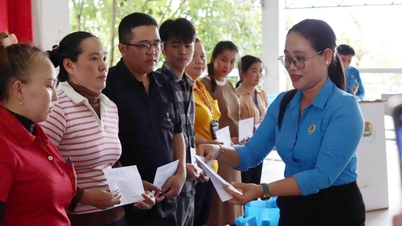
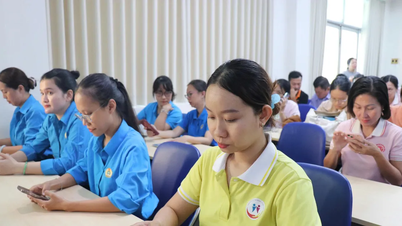
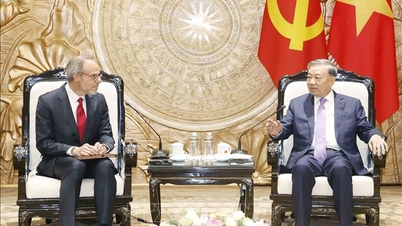
During his visit and meeting with workers in Ho Chi Minh City on April 27th, General Secretary and President To Lam directed practical issues related to workers: creating stable jobs and better incomes; a safer working environment; more convenient housing and schools; closer access to healthcare services; and a richer cultural and spiritual life. General Secretary and President To Lam also requested that trade unions be closer to workers, understand them better, speak on their behalf, and effectively protect their legitimate rights and interests. Trade unions must be present promptly when workers face difficulties, illness, unpaid wages, job losses, work accidents, or other life events.
These directives require a shift from a mindset focused solely on "job creation" to one focused on "developing a modern, flexible, and sustainable labor market." In this market, workers should not only have jobs but also clear contracts, stable incomes, safe working conditions, and opportunities for skill development. This is the foundation for building a progressive and equitable society.
In modern labor relations, dialogue and collective bargaining are not only tools but also core mechanisms for balancing the interests of workers and employers. Where dialogue is conducted regularly and negotiations are substantive, disputes are less frequent, the working environment is stable, and labor productivity is enhanced. Therefore, strengthening effective and substantive dialogue and collective bargaining by trade unions is a very appropriate and correct requirement. This should focus on the most practical issues for workers, such as wages, working hours, occupational safety, and benefits. The results of negotiations must genuinely improve the working conditions and living standards of workers.
Furthermore, trade unions need a strong transformation. First, they must improve the capacity of union officials, especially in negotiation skills, legal knowledge, and problem-solving abilities. Union officials must truly be representatives, knowing how to listen, and speaking on behalf of workers in a persuasive and responsible manner. Second, unions need to be more proactive in organizing regular dialogues, not waiting for disputes to arise before intervening. Dialogue must become a regular activity with a program, specific content, and monitoring of implementation results. Third, collective bargaining needs to be linked to labor productivity and production and business efficiency. When workers' rights are protected, they will be more committed to the enterprise. And, enterprise development will create conditions for improving workers' income and welfare. This is a "win-win" relationship that needs to be fully understood.
In the new context, protecting workers cannot be achieved merely through slogans but must be done through effective mechanisms, with dialogue and collective bargaining as the cornerstone. The message from General Secretary and President To Lam is a strong reminder: trade unions must truly innovate and act for workers in the most practical way. When workers' rights are guaranteed, and when harmonious, stable, and progressive labor relations are built, that will be the solid foundation for sustainable socio-economic development.
Source: https://www.sggp.org.vn/bao-ve-nguoi-lao-dong-bang-co-che-thuc-chat-post850589.html




























































































Comment (0)