

According to CNN, mindfulness is one of the most popular concepts in the healthcare industry today.
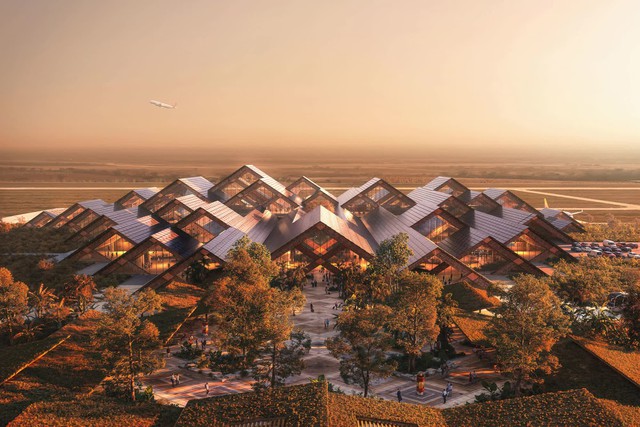
This drawing shows the exterior of the future Gelephu International Airport. Photo: BIG-Bjarke Ingels Group
Following that trend, Bhutan, located in the far east of the Himalayas, is exploring the idea of building a new mindfulness city. Gelephu, in southern Bhutan near the border with India, has been chosen as the site for the mindfulness city, although details about the project are still limited.
Architectural firm Bjarke Ingels Group has unveiled the design for Gelephu Airport, providing details about Gelephu and the city's overall vision to date. The renderings reveal a series of architectural elements including rhombus-shaped wooden structures, all modular, making future updates or expansions of the airport easier.
Even on a fine day, airports can be stressful for travelers due to delays, lost luggage, missed flights, and long lines. So how can an airport implement a concept like mindfulness?
"A new airport in a happy country"
According to Ingels, Bhutanese architecture consistently incorporates natural elements into its designs and embodies Bhutan's long-term goal of "building a happy nation," meaning prioritizing the well-being of its residents as a measure of quality of life.
"The airport is the first and last impression a traveler gets at a destination. The airport architecture will feature modular block timber frames offering flexibility and scalability, much like a stylized mountain range in the distance. All block timber components are carved and colored using traditional Bhutanese craftsmanship. The architecture maintains tradition but is avant-garde, forward-looking, and preserves traditional values," Ingels said in a statement.
The designers said the airport, like the country's overall architectural model, would incorporate negative carbon footprint and utilize solar panels on the roof to generate energy.
Gelephu International Airport is expected to cover an area of 731,946 square feet, with approximately 123 flights per day.
This number may seem insignificant compared to major airports like London Heathrow or New York JFK, but it's a huge figure for landlocked Bhutan, which only welcomed 316,000 tourists in 2019.
Currently, all foreign visitors to Bhutan choose flights to Paro International Airport (PBH), near the capital Thimpu. Due to Paro's geographical location between two Himalayan peaks, strong monsoon winds, and lack of runway lighting, only a few small planes can fly to or from the airport each day, all of them short flights from nearby Asian cities such as New Delhi and Bangkok.
Gelephu City already has a small domestic airport. This location was chosen for the new international airport because its flat terrain means there will be space for longer runways that can accommodate larger aircraft.
Its convenient location near India also makes Gelephu a strategic location for rail and road routes.
The Gelephu Mindfulness City (GMC) is a promising project for Bhutan's future.
"The airport in this city is essential to the success of the GMC, to becoming a business hub, and also a vital transportation route for Bhutan's national security, especially for a landlocked country," King Jigme Khesar Namgyel Wangchuck said in a statement.
With a population of approximately 750,000, Bhutan has long been a pioneer in "high-value, low-impact" tourism. Visitors to the country pay a sustainability fee of $100 per day. This money is used to fund healthcare, education , and other public services in Bhutan.
Prime Minister Tobgay emphasized that the money collected from the aforementioned fees will be used to invest in projects protecting Bhutan's natural environment, providing free education and healthcare for the people, thereby contributing to the country's sustainable development.
Bhutan has not yet announced an official opening date for Gelephu International Airport.
Source: https://toquoc.vn/bhutan-dau-tu-san-bay-moi-phat-trien-du-lich-20250317111354884.htm






























































































Comment (0)