


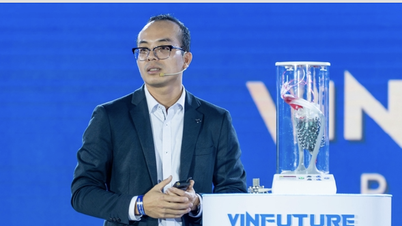
Professor Venkatesan Sundaresan shared with reporters on the sidelines of VinFuture Science and Technology Week (Photo: VinFuture).
That is the technology of asexual reproduction through seeds (Synthetic Apomixis).
In the context of complex climate change and increasing pressure on food security, creating crop varieties that are both high yielding and resilient is not enough.
The biggest challenge lies in how to maintain those superior characteristics over generations without forcing farmers to spend money on buying new seeds each season.
Speaking to reporters on the sidelines of VinFuture Science and Technology Week, Professor Raphaël Mercier (France), Dr. Imtiyaz Ahmad Khanday (India) and Professor Venkatesan Sundaresan (USA) shared about this revolutionary research project.
The F1 seed paradox and the cost problem
For a long time, farmers have been familiar with using F1 hybrid seeds for high yield and good resistance to pests and diseases (hybrid vigor). However, the biggest disadvantage of hybrid varieties is genetic instability.
Professor Raphaël Mercier explains: "When crossing the parent plants, we get the F1 generation with extremely superior traits. But if farmers take the seeds of the F1 plant and sow them in the next crop (creating F2), these good traits will be separated and lost. Yields will drop dramatically. That is why farmers are forced to buy new F1 seeds after each crop at an expensive cost."
This is a major barrier for developing countries and smallholder farmers, making it difficult for them to access advanced agricultural achievements.
When plants clone themselves
To solve this problem, a team of scientists has developed a technology that allows synthetic asexual reproduction through seeds.
Unlike tissue culture (which produces identical seedlings but is difficult to preserve, transport and expensive), this technology allows plants to self-clone during the seed production process.

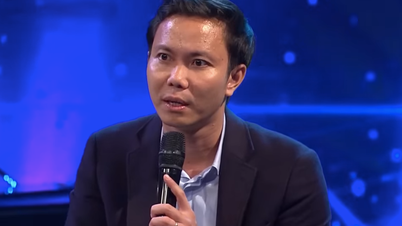
Dr. Imtiyaz Ahmad Khanday shared at the event (Photo: VinFuture).
"We identified two key genes. First, we disabled the gene that causes meiosis (gene mixing). Second, we activated a gene that helps form a zygote without fertilization. With the help of CRISPR gene editing technology, we 'turned' sexual reproduction into asexual reproduction," said Professor Venkatesan Sundaresan.
As a result, seeds obtained from generation F1 will develop into offspring (F2, F3, Fn...) with the same genetic makeup as the mother plant.
"This helps to 'fix' hybrid advantages. Farmers only need to buy seeds once and can save them for the following seasons while the yield and resistance remain intact," Professor Raphaël Mercier emphasized.
Opportunities for Vietnamese agriculture
Vietnam is the world's leading rice exporter, facing dual challenges: Climate change and emission reduction requirements (such as the 1 million hectare high-quality rice project). Professors say this technology is completely suitable and has great potential for application in Vietnam.
"Our research was initially successful on rice plants. Therefore, this technology can be directly applied to existing rice lines in Vietnam," said Dr. Ahmad Khanday.
He stressed that this technology is “democratized” and aimed at the benefit of small-scale farmers. When people do not have to worry about the burden of annual seed costs, they will be able to cultivate with peace of mind and take advantage of rice varieties that are more resistant to salt and drought.
"Sustainable agriculture means producing the same (or higher) output using fewer resources. If this technology helps increase productivity by 30% on the same land area, the same amount of water and fertilizer, that is the pinnacle of sustainability," Professor Mercier affirmed.
The future from basic science
Although the technology is still in the prototype stage and needs time to be widely commercialized, scientists affirm that the theoretical foundation is solid. Currently, the technology is being expanded to corn, wheat and barley.
In particular, Professor Raphaël Mercier said that these basic research results are currently in open source form. "Vietnamese scientists can completely read the research work and apply it immediately. We look forward to opportunities to cooperate with the Vietnam National Academy of Agriculture and domestic scientists to put this technology into practice," he shared.
This work is a clear demonstration of the importance of basic science. From the initial idea in 1994, through 15 years of sustained collaboration between independent laboratories, the "dream of the century" of fixing hybrid vigor has now taken shape, promising to open a new era of global food security.
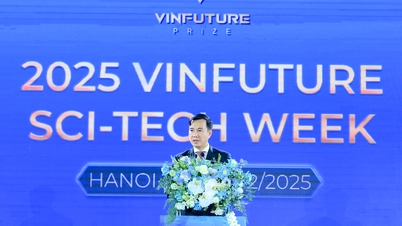
VinFuture 2025 Science and Technology Week, taking place from December 2 to December 6 in Hanoi
With the theme “Together we grow - Together we prosper”, this year’s series of annual international events continues to affirm VinFuture’s mission in connecting knowledge, arousing the desire to serve and elevating Vietnam’s position as a center for promoting science and innovation in the world.
The week includes 7 main activities: inspirational speeches, Science for Life talks; VinFuture future exploration dialogue series; The Touch of Science exhibition, VinFuture award ceremony; exchange with the VinFuture 2025 award winners; VinUni - Leadership Forum: Higher Education Innovation Conference.
The highlight of the event was the VinFuture 2025 Awards Ceremony, which took place on the evening of December 5 at the Hoan Kiem Theater (Hanoi). This is an event to honor outstanding scientific works that have had a positive and sustainable impact on millions, even billions of people around the world.
This year, the award will be given to works that bring the value of "Together we grow - Together we prosper" to humanity, as the theme has set out, affirming VinFuture's mission of honoring intelligence, spreading humanity and serving life.
Source: https://dantri.com.vn/khoa-hoc/bien-giac-mo-the-ky-thanh-hien-thuc-va-co-hoi-cho-nong-dan-viet-nam-20251202091735103.htm



![[Photo] Parade to celebrate the 50th anniversary of Laos' National Day](/_next/image?url=https%3A%2F%2Fvphoto.vietnam.vn%2Fthumb%2F1200x675%2Fvietnam%2Fresource%2FIMAGE%2F2025%2F12%2F02%2F1764691918289_ndo_br_0-jpg.webp&w=3840&q=75)
![[Photo] Worshiping the Tuyet Son statue - a nearly 400-year-old treasure at Keo Pagoda](/_next/image?url=https%3A%2F%2Fvphoto.vietnam.vn%2Fthumb%2F1200x675%2Fvietnam%2Fresource%2FIMAGE%2F2025%2F12%2F02%2F1764679323086_ndo_br_tempimageomw0hi-4884-jpg.webp&w=3840&q=75)

































































Comment (0)