

 |
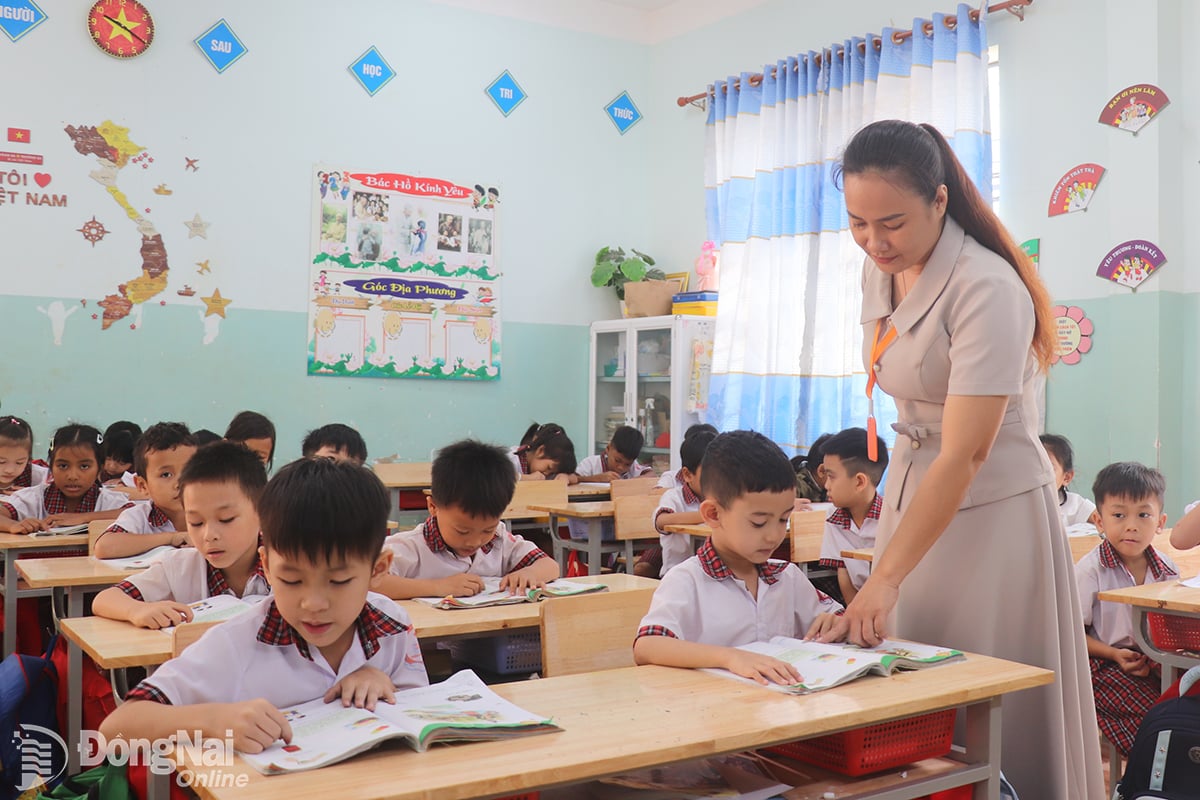
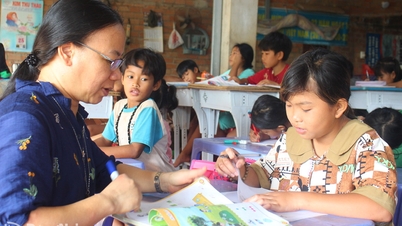
| Teachers at Hai Ba Trung Primary School (in Phu Nghia commune) instruct students during a Vietnamese language class. Photo: Hai Yen |
Thanks to that, work related to the education sector is carried out relatively systematically, professional activities in schools are well maintained, ensuring quality.
When education managers are on secondment
Teacher Nguyen Van Tai, Vice Principal of Nguyen Trai Secondary School (in Phu Nghia Commune) has worked in the education sector for 23 years, including 12 years as a school manager. Such a long time working closely with the locality has helped Mr. Tai not only have a firm grasp of the management and professional work of the secondary school level but also understand the local educational context. Therefore, right from the first days of operating the 2-level local government model, Mr. Tai has participated in supporting the Department of Culture and Society (under the People's Committee of Phu Nghia Commune) with a number of contents related to the field of education.
| Phu Nghia commune, Dong Nai province was established on the basis of arranging the entire natural area and population of Phu Van, Duc Hanh and Phu Nghia communes (formerly belonging to Bu Gia Map district, Binh Phuoc province). The commune has a population of about 34 thousand people, of which more than 11,300 are ethnic minorities (accounting for 33.54%). |
When the province had a policy of seconding school management staff to work at the Commune People's Committee, Mr. Tai was the first choice of the Phu Nghia Commune People's Committee in this secondment list. Because Nguyen Trai Secondary School where Mr. Tai works is small (only over 350 students), Mr. Tai holds the position of Vice Principal, so currently, in addition to his work at the Commune People's Committee, Mr. Tai still supports the school Principal in management and professional work at the school.
Mr. Tai said: “12 schools including kindergarten, primary school, and secondary school in Phu Nghia commune have a total scale of more than 5,500 students (including: more than 1,000 kindergarten students, more than 3,000 primary school students, and more than 1,500 secondary school students). The compact scale is basically convenient for management work. Personally, thanks to my long time working in the education sector, I have a lot of experience in management work. When I was assigned to the commune People's Committee, I received the attention of the commune leaders and the close coordination of the specialized departments and offices, so I was quite favorable in approaching and performing the tasks of a commune-level education officer.”
In addition to some advantages, like many current commune and ward education officials, Mr. Tai himself also encountered many difficulties. That is, Mr. Tai only has experience in secondary school but has to advise on management and professional work at both preschool and primary school levels. Therefore, for each issue related to these two levels of education, he has to consult a number of leaders managing preschools and primary schools in the area and also experts from the Department of Education and Training of Bu Gia Map district in the past. On the other hand, Mr. Tai also proactively contacted experts and leaders of specialized departments of the Department of Education and Training directly to receive guidance and answer specific questions. Thanks to that, the work of advising on the field of education in Phu Nghia commune was carried out smoothly, correctly and on the right issue.
Putting educational activities into order
As a remote commune with a large proportion of ethnic minority students (accounting for about 37.4% of the student population), many schools in Phu Nghia commune have performed well in professional work in recent years, including training excellent students.
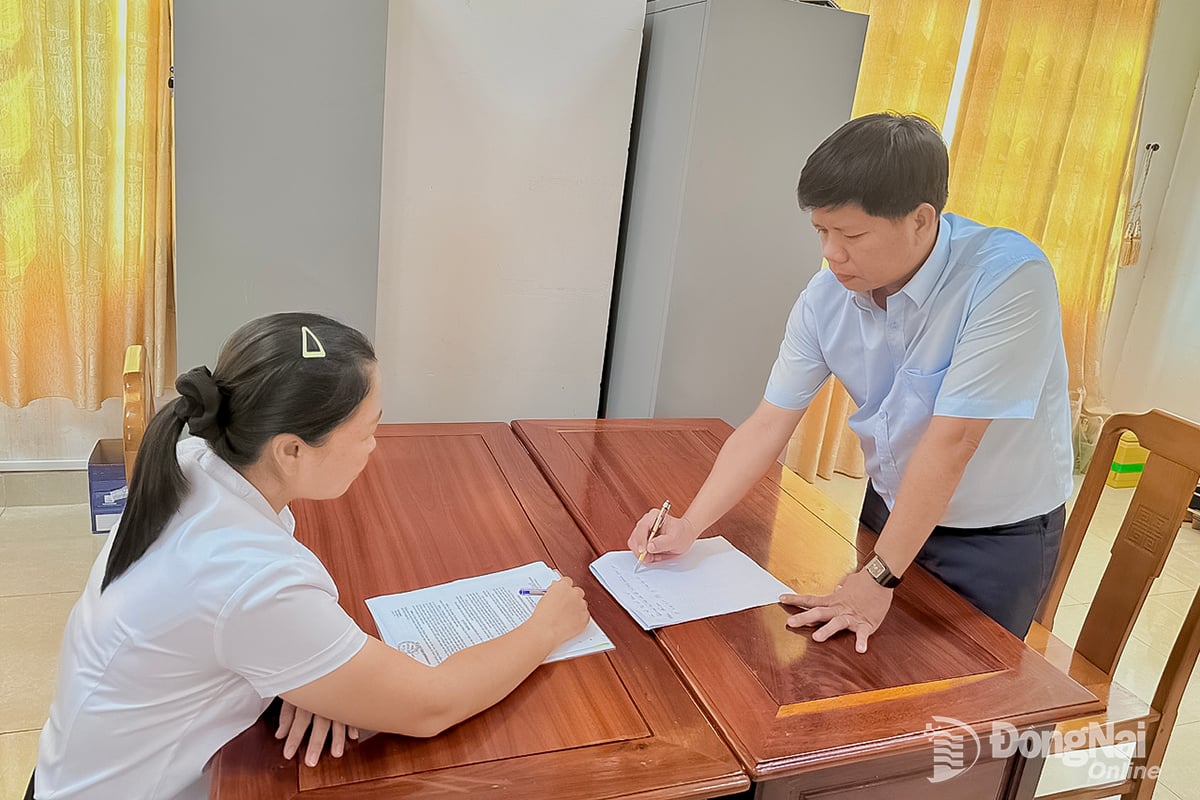 |
| Teacher Nguyen Van Tai, a civil servant assigned to the education sector, Department of Culture and Society, People's Committee of Phu Nghia commune, discusses work with colleagues. Photo: CT.V |
For example, Phu Nghia Secondary School has a student population of over 460, enrolling students in 5 villages of the old Phu Nghia commune, including 4 ethnic minority villages. The proportion of ethnic minority students in this school is over 42%, mainly the Stieng ethnic group. Despite many specific difficulties, Phu Nghia Secondary School still focuses on the key task: nurturing excellent students. Thanks to that, every year, the school has many students who win provincial-level excellent student awards and pass the entrance exams to Binh Long Specialized High School and Quang Trung Specialized High School.
Principal of Phu Nghia Secondary School Le Van Thanh said: “When implementing the 2-level local government model, Phu Nghia commune has seconded education officials, so the direction work related to the education sector of the commune is quite smooth; the school's activities are stable. We expect Dong Nai province with larger resources to invest in the school in terms of: staff, facilities (teaching equipment according to the 2018 General Education Program, especially subject classrooms). At the same time, organize more conferences and seminars for managers and key teachers to learn from experience, innovate in management thinking, teaching methods to improve quality, narrow the gap between rural - urban, remote and central areas".
According to Mr. Thanh, according to the 2025-2026 school year plan of the Department of Education and Training, this school year, the secondary school will not organize a provincial-level excellent student competition. However, the school will still create conditions to further nurture students with outstanding abilities and talents so that they have better conditions to develop, thereby contributing to training talents for the locality and the province.
Sharing high expectations for the education sector of Dong Nai province, Mr. Pham Van Luyen, Principal of Hai Ba Trung Primary School (in Phu Nghia commune) expressed: The province will have policies to recruit and arrange enough teachers for schools; have policies to attract, treat, support housing/travel to retain and attract good teachers to disadvantaged areas. Invest in synchronous infrastructure: build new, repair classrooms, functional rooms, libraries, toilets to meet standards such as: central area; improve lighting systems, fences, security cameras, fire prevention and fighting to meet standards. Fully equip modern equipment such as: computers, strong internet connection, interactive boards, digital teaching equipment to narrow the digital gap; invest in online learning platforms, digital records, digital management to help schools approach the smart school model of industrial provinces. Support funding for organizing extracurricular activities, STEM, experiences - helping students in remote areas have equal learning conditions; Invest in kitchens, boarding rooms, and care staff to ensure safety and improve the quality of student care.
"We also hope the province will have a separate project for disadvantaged areas, ensuring stable budget allocation and avoiding scattered and fragmented investment," Mr. Luyen shared.
After nearly half a year of operating the 2-level local government apparatus, educational activities in Phu Nghia commune have remained stable and in order. Teachers and people expect and trust that Dong Nai province, with its position as an industrial province and the 4th largest economy in the country, will have appropriate investments to promote educational development in remote areas, contributing to training quality human resources to serve the development of the province and the whole country.
Hai Yen
Source: https://baodongnai.com.vn/moi-nong/202512/biet-phai-can-bo-quan-ly-truong-hoc-sang-xa-cau-chuyen-tu-phu-nghia-ebc0873/































































Comment (0)