

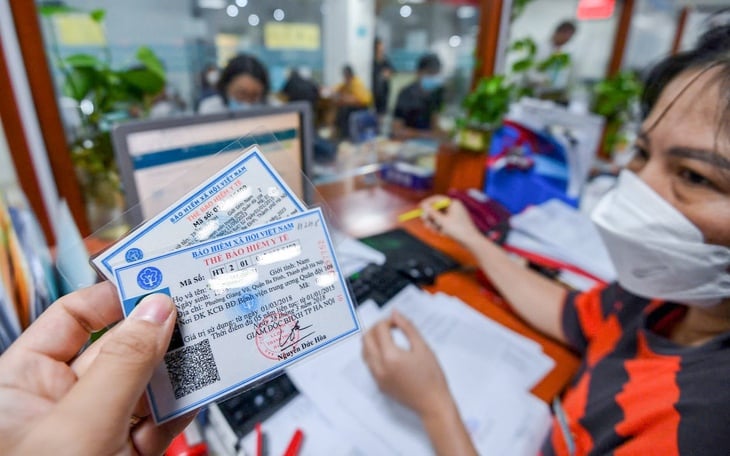
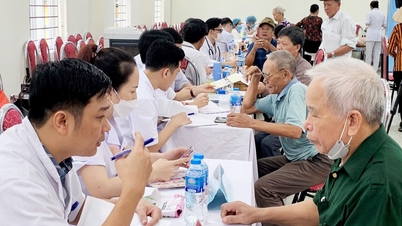
Nationwide, more than 95.5 million people participate in health insurance - Illustration photo: NAM TRAN
Increase because 10-year insurance premium has not increased?
According to the Ministry of Health 's report, in 2024, the whole country will have more than 95.5 million people participating in health insurance (HI) with a total revenue of 145,504 billion VND. The health system recorded 183.6 million medical examinations and treatments, an increase of 5.6% compared to 2023.
On average, each year about 40 million people go to the doctor with health insurance, each person uses the service 4.5 times. Total expenditure for health insurance examination and treatment is more than 139,000 billion VND, an increase of more than 18,000 billion VND compared to the previous year.
Deputy Minister of Health Vu Manh Ha said that to effectively implement the free hospital fee policy, it must be based on a solid foundation of the health insurance fund, combined with the state budget and socialized resources.
The goal is to pay for basic and essential health services, thereby minimizing the financial burden on people, especially vulnerable groups, low-income people and policy beneficiaries.
Therefore, according to Deputy Minister Ha, free hospital fees must go hand in hand with universal health insurance coverage so that the whole society can "share the cost" with the sick.
Regarding the roadmap for increasing health insurance contributions, Ms. Tran Thi Trang, Director of the Health Insurance Department, Ministry of Health, said that for 10 years, the health insurance contribution rate has not changed, even though the scope of benefits has been expanding, the disease model has shifted to chronic diseases with high treatment costs, and the need for medical examination and treatment has continuously increased.
"If the contribution rate is not adjusted, the fund will hardly have enough resources to cover the arising costs. Increasing the contribution rate is mandatory to maintain and expand benefits for the people," Ms. Trang analyzed.
However, she affirmed that "the adjustment will be carried out according to a reasonable roadmap, suitable to the payment capacity of people, businesses and the budget, avoiding creating sudden pressure. When mobilizing additional financial resources, the policy design must ensure that it does not affect the rights of patients."
"When the health insurance fund is strong enough, then we can maximize the benefits in the free hospital package," said Ms. Trang, adding that in most countries that apply a free hospital policy, people still have to co-pay at a certain level to ensure reasonable and responsible use of services.
Currently, the authorities are studying international experience, choosing a model that is suitable for the socio- economic conditions, the structure of medical costs and the service needs of the Vietnamese people. All will be carefully analyzed before completing the project.
"This is a large, complex project, and we are just at the beginning. We need to continue to seek opinions from ministries, experts and relevant parties," said Ms. Trang.

Social Insurance officers in Hanoi advise participants on health insurance and retirement benefits - Photo: HA QUAN
Proposal to increase health insurance according to roadmap
According to the proposal of the Ministry of Health, the roadmap for implementing the basic free hospitalisation policy for all people will be implemented in stages. The 2026-2027 period will prioritize increasing the rate and level of health insurance payments. From 2026, people will be given free periodic health check-ups or screenings at least once a year according to each priority group.
This phase also increases health insurance payments for drugs, medical equipment and medical examination and treatment techniques, and adjusts health insurance contributions from 2027 to about 5.1%, with a budget to support policy beneficiaries.
In the period of 2028-2030, the target is to reduce out-of-pocket expenditure to ≤30%, expand health insurance payment for drugs, medical equipment, and technology; pilot cost-effective screening for 2-3 diseases; pay for disease prevention services from the Health Insurance Fund to cover over 95% of the population; increase the contribution rate from 2030 to 5.4% and test supplementary health insurance, diversifying benefit packages.
After 2030, aim for universal health insurance. The scope of hospital fee exemption will be expanded in the basic service package; screening for 3-5 common diseases; the contribution rate will increase to 6% from 2032. At the same time, complete the basic health care system and the smart, multi-layered, multi-package health insurance payment system.
Accordingly, the current health insurance contribution rate is at 4.5% of the basic salary. According to Ms. Trang, the roadmap for increasing health insurance will be implemented appropriately, avoiding affecting people, businesses... At the same time, the Ministry of Health still maintains the policy of supporting health insurance contributions for vulnerable groups and students to ensure health care for people.
Health insurance premiums do not increase, but revenue does increase.
Over the past 10 years, health insurance premiums have remained at 4.5% of the base salary, but health insurance revenue has increased from 1,150,000 - 1,210,000 in 2015 to 2,340,000 VND/month, so insurance revenue has also increased.
Another requirement when wanting to increase insurance premiums, experts say that it is necessary to clarify to reduce cost losses, avoiding the insurance fund becoming a fund that "everyone wants to spend but no one can manage".
For example, reducing costs of duplicate testing, reducing unnecessary service prescriptions, saving on lost costs of medicine and supplies, and facilitating services so that cardholders can have more convenience when going to the doctor.
When insurance premiums increase, not only people have to increase spending, but businesses/employers also increase spending, because businesses pay a large proportion of health insurance/social insurance costs for employees, so experts say there needs to be a roadmap for businesses, especially businesses with many employees, to avoid "shock" when increasing spending on this expense.
Source: https://tuoitre.vn/bo-y-te-de-xuat-nang-muc-dong-bao-hiem-y-te-len-5-1-6-luong-co-so-nhung-se-theo-lo-trinh-20251202110508731.htm


![[Photo] National Assembly Chairman Tran Thanh Man receives First Vice Chairman of the Federation Council of the Federal Assembly of the Russian Federation](/_next/image?url=https%3A%2F%2Fvphoto.vietnam.vn%2Fthumb%2F1200x675%2Fvietnam%2Fresource%2FIMAGE%2F2025%2F12%2F02%2F1764648408509_ndo_br_bnd-8452-jpg.webp&w=3840&q=75)

























































![[Photo] General Secretary To Lam and his wife attend the 50th Anniversary of Laos National Day](https://vphoto.vietnam.vn/thumb/402x226/vietnam/resource/IMAGE/2025/12/02/1764644139308_1.jpeg)



























Comment (0)