

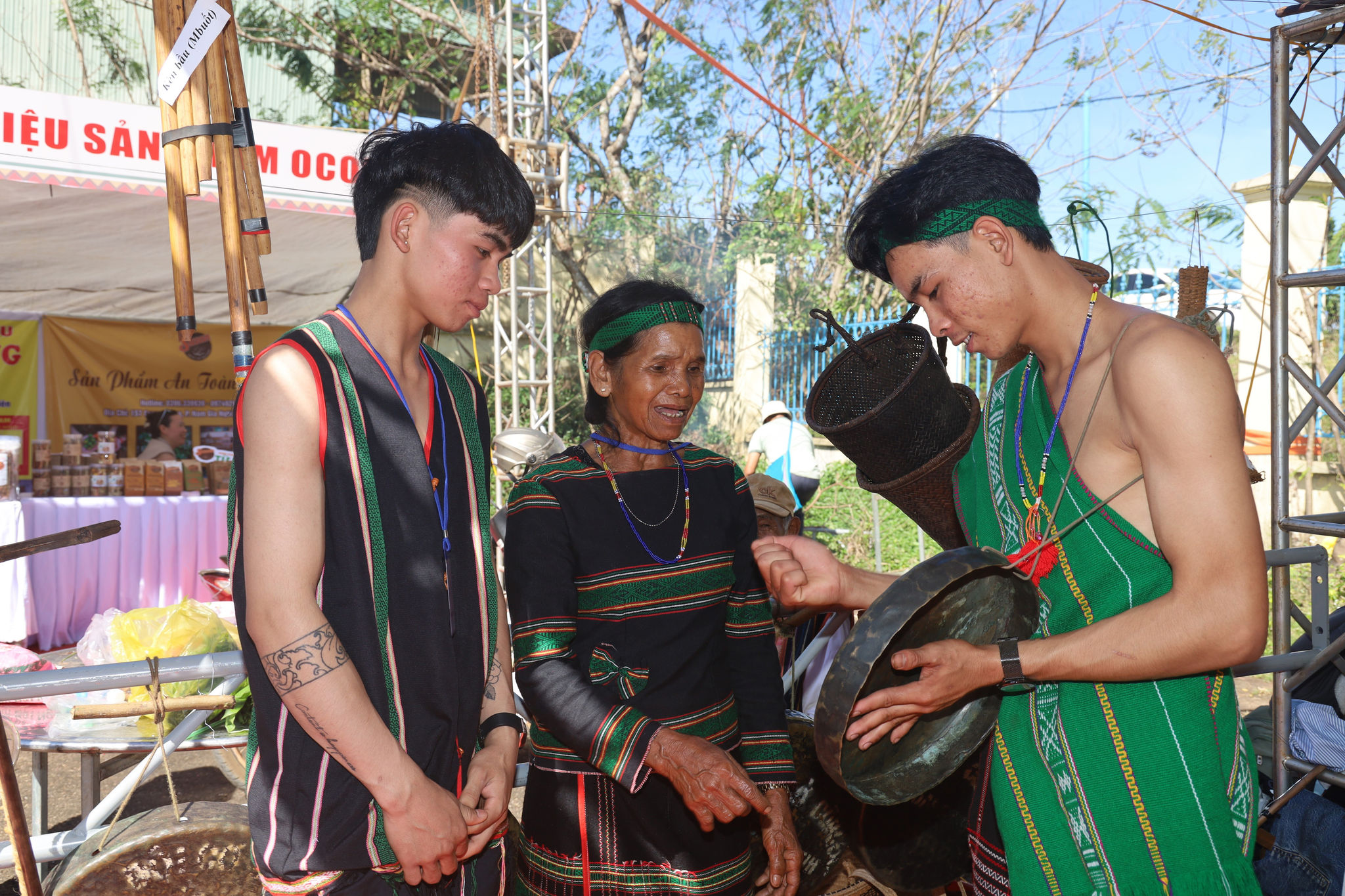
As the sound of gongs faded away in the village.
Late in the afternoon in Bu Kóh village (Tuy Đức district), the sound of gongs still resonates in the courtyard of artisan Thị Thái's longhouse. But the M'nông woman says that the sound of the gongs is very different now than it used to be. Gone are the nights when the villagers gathered around the fire, and gone are the days when young people enthusiastically learned each gong rhythm. "In the past, whenever there was a festival, the whole village would gather. The elders would play the gongs, the young people would perform the xoang dance, and the children would run around. Now, many children hold their phones more than they hold gong mallets," Mrs. Thị Thái said slowly.
Even in her sixties, she diligently preserves her family's precious gongs, participates in local cultural activities, and teaches the younger generation in the village. For her, gongs are not just the sounds of festivals, but also the "soul" of the village, a repository of memories and the identity of the M'nong people through generations.
In recent years, the lives of people in ethnic minority areas have changed significantly. Roads are more convenient, many families have smartphones and the internet, allowing for faster access to information and new trends. Young people in the villages also have more opportunities for education, work, and wider social interaction than before.
However, along with these changes comes the concern of many artisans as traditional cultural spaces are becoming increasingly scarce. Community gatherings are becoming less frequent, young people have many new interests, while learning to play gongs, sing folk songs, or practice traditional crafts requires perseverance and passion.
Preserving the "soul" of culture amidst the modern pace of life.
Not only in Tuy Duc, but many ethnic minority villages in the province are also facing similar changes. In Quang Tan commune, artisan Dieu Khon still regularly participates in teaching gong playing to young people in the village whenever the locality organizes it. He says that life is much better now than before; people know how to do business , use smartphones, and update information through social media. But what worries him most is that the younger generation is spending less and less time on traditional culture. "If we don't preserve it, our children and grandchildren will forget the sound of our ethnic group's gongs," Mr. Dieu Khon said.
Driven by this concern, many artisans quietly go from village to village, from youth groups to community centers, to encourage participation in gong-playing lessons. Some voluntarily bring their gongs to community centers to provide free instruction. Others patiently teach children the rhythm of the gongs after school. Many localities also collaborate with schools to open classes to teach gong playing, folk songs, and traditional dances to students in ethnic minority communities.
Despite the challenging conditions, the artisans still see it as a way to preserve the "soul" of their culture amidst the ever-changing modern pace of life. According to many artisans, it's encouraging that there are still many young people who love the sound of the gongs and are interested in learning about their ethnic culture. Some, after attending training classes, are able to perform in local festivals, gradually developing a sense of pride in their ethnic identity.
Amidst the hustle and bustle of modern life, villages are transforming day by day. But in some corners of these villages, artisans like Mrs. Thi Thai and Mr. Dieu Khon quietly preserve the rhythm of the mountain gongs. For them, preserving the sound of the gongs is not just about preserving a cultural form, but also about preserving memories, roots, and the soul of the village amidst the constant changes of modern life.
We are getting old, and we fear that in the future, fewer and fewer people will know how to play the gong.
Artisan Thi Thai.
Source: https://baolamdong.vn/buon-lang-doi-thay-and-tieng-long-nghe-nhan-442441.html

























































































Comment (0)