

However, the application of AI places high demands on pedagogical guidance and the proactive attitude of learners.
Personalized review support and smart learning materials development.
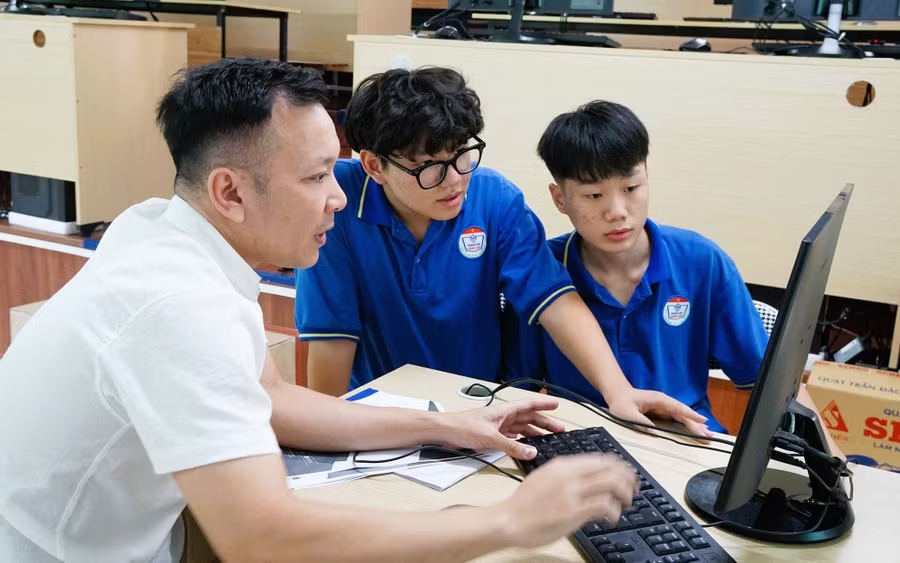
The high school graduation exam under the 2018 General Education Program has entered its second year. According to Mr. Nguyen Xuan Khiem, M.Sc. - Member ofthe FPT Schools Technology Council, Head of the Natural Sciences Department at FPT School Hai Phong, the biggest challenge for both teachers and students is not the lack of materials, but how to effectively handle the massive and diverse source of materials and exam questions from provincial Departments of Education and Training and schools nationwide.
If we only teach in the traditional way of assigning assignments, collecting papers, and correcting them, it will be difficult to optimize the abilities of each student. Integrating artificial intelligence (AI) into teaching and exam preparation is a solution to this challenge.
Sharing the school's experience and methods, Mr. Nguyen Xuan Khiem, M.Sc., informed about two approaches to application: systematizing and personalizing exam preparation; and guiding students to use NotebookLM in their studies.
By systematizing and personalizing exam preparation, the school has built an automated web-based system for assigning and grading assignments. The core difference is that after submission, AI acts as a "pedagogical assistant," helping to analyze the results in detail.
The system not only provides correct/incorrect answers but also identifies each student's strengths and weaknesses in each knowledge area (like a digital learning journal). From there, the AI accurately suggests knowledge gaps that need to be filled, helping students avoid focusing on areas they are already proficient in and concentrate on areas where they are weaker.
Using the NotebookLM application for learning, the school guides students to use Google's "AI Notebook" tool to store and manage study materials. Here, students can also create diverse learning materials through the Studio feature and test their knowledge with interactive questions. This transforms the review process from "passive reading comprehension" to "active interaction," helping students master knowledge in the most scientific way.
According to Mr. Trang Minh Thien, a teacher at Nguyen Viet Dung High School ( Can Tho City), during the review period before the high school graduation exam, the application of technology and artificial intelligence is opening up many effective ways to support both teachers and students.
First, teachers can build a smart learning resource library using tools like Gemini and NotebookLM to upload teaching materials, textbooks, and notes. AI will help teachers summarize complex topics, quickly create quizzes based on the lesson content, and build daily review schedules and track student learning progress through the Gemini application.
In addition, tools like Canva Magic Design or Napkin AI help transform dry theoretical knowledge into mind maps and vivid illustrations, thereby increasing students' ability to remember.
AI can also be used by teachers to build question banks based on exam matrices, categorized by levels of knowledge, comprehension, and application; create multiple versions of the exam; automatically generate answers, solutions, scoring rubrics, and analyze the frequency of appearance of different question types.
 INT illustration.
Avoid dependence on AI.
For AI to be truly effective without diminishing learner engagement, several important considerations are necessary during its use.
According to teacher Trang Minh Thien, teachers need to guide students on how to formulate prompts that ask the AI to explain why it chose a particular answer, instead of simply searching for ready-made answers. Students need to develop critical thinking skills when faced with results provided by the AI.
AI should only be viewed as a supporting tool, not the ultimate source of answers. Students should be reminded to absolutely not share sensitive information such as phone numbers, home addresses, bank accounts, or files containing personal data on public AI platforms.
More importantly, a balance needs to be maintained between online learning and in-person interaction. While technology is very convenient, teachers and students need to maintain face-to-face discussions. Human interaction helps relieve the psychological pressure of exams – something that AI currently cannot completely replace.
To ensure that technology truly becomes a lever for learning rather than a source of dependence, Master's student Nguyen Xuan Khiem frequently reminds students of the following principles:
First, define AI's role as a "tool" rather than a "doer." If students misuse AI to solve problems and simply copy the results without critical thinking, they will gain no knowledge benefit. The goal of using AI is to "understand how to do it," not to "get the answer."
Secondly, always verify the results. Any information or solution provided by AI needs to be cross-referenced with textbooks, teacher lectures, or other official sources. Cultivating the habit of verification helps students not only solidify their knowledge but also develop critical thinking skills – a crucial competency in the 2018 General Education Program.
Thirdly, attention should be paid to information security and academic ethics. During interactions in the digital environment, students are guided on how to protect their personal data. At the same time, storing their learning progress on the system helps them see their actual progress, thereby fostering self-discipline and honesty in their studies and exams.
“Applying artificial intelligence to high school exam preparation offers many benefits such as personalizing learning, increasing revision efficiency, saving time, and improving the quality of teaching. However, AI only truly delivers its value when teachers play a guiding role, students maintain a proactive learning spirit, and the use of technology is always accompanied by critical thinking, digital ethics, and information security awareness. If implemented correctly, AI will become an “intelligent learning assistant,” supporting rather than replacing, contributing to improving the quality of education in the digital age,” Mr. Trang Minh Thien noted.
Source: https://giaoducthoidai.vn/but-pha-mua-thi-nho-tro-ly-ai-post778825.html






























































































Comment (0)