
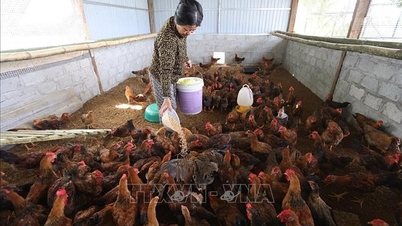
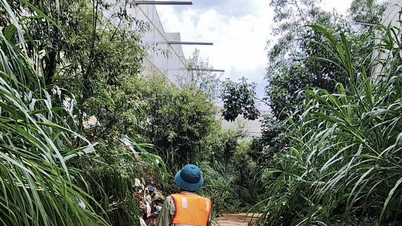
Over the past period, the city has allocated significant resources to support the construction of housing for ethnic minority communities. Photo: T.CÔNG
Many obstacles remain.
After the merger, Da Nang city has 37 communes inhabited by ethnic minorities and mountainous areas, including 28 communes in particularly difficult Zone III, with approximately 164,095 ethnic minority people living there. This is an area with significant disparities in infrastructure, livelihoods, and access to public services.
According to Mr. Dang Tan Phuong, Deputy Director of the Department of Ethnic Minorities and Religion, the living conditions and production of ethnic minority people are basically stable and gradually improving. The city government is continuing to focus resources on sustainable development in ethnic minority and mountainous areas. During the 2021-2025 period, the city provided housing support to 873 households through the National Target Program for socio -economic development in ethnic minority and mountainous areas, with a total budget of over 38.4 billion VND. However, many mountainous localities still face a high risk of landslides, making it difficult to stabilize the population in the long term.
According to Doan Van Thong, Secretary of the Party Committee and Chairman of the People's Council of Kham Duc commune, it is necessary to specifically classify the conditions of each region to develop appropriate policies, because a general approach cannot be applied to mountainous areas. Some mountainous communes have steep terrain, frequent landslides, and limited arable land, making them much more difficult than areas with valleys or flat terrain.
More worryingly, in many mountainous communes, landslides after heavy rains have made it impossible to build houses or production areas. Meanwhile, people cannot expand production into natural forests due to forest protection regulations.

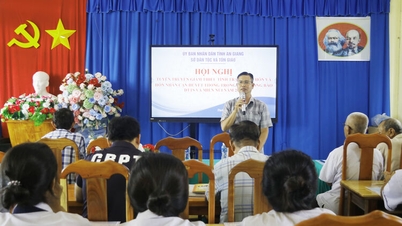
Mountainous regions still need more specific policies to stabilize livelihoods and narrow the gap with other areas. Photo: T.CÔNG
According to Mr. Doan Van Thong, land is becoming scarce, and people are also facing a reduction in their means of production. Therefore, it is necessary to study policies that provide more stable and long-term support for forest keepers, combined with developing livelihoods under the forest canopy such as medicinal plants, ginseng, and other crops.
Regarding the elimination of temporary housing, priority should be given to arranging and relocating residents to safe areas before investing in new housing. In reality, there have been cases where houses were built only to be demolished again due to landslides, causing overlaps and wasting resources. Without a stable and safe place to live, achieving sustainable housing is very difficult.
More specific policies are needed.
Discussing policies for mountainous areas and ethnic minority regions, the Party Secretary and Chairman of the People's Council of Ben Hien commune, Dinh Van Huom, stated that current policies do not fully encompass the actual needs of ethnic minorities. "We need to re-examine how policies are formulated to ensure the common rights of ethnic minorities, instead of primarily focusing on poverty criteria. In reality, in many localities, there is a tendency towards comparison, with many ethnic minority households not classified as poor still facing significant hardship," Mr. Huom said.
According to Mr. Huom, many policies currently still focus on supporting poor households, while there are not many specific policies dedicated to ethnic minorities. After the merger, the review and integration of policies are still slow. The biggest difficulties currently remain residential land and agricultural land.
There is a need to shift strongly from social welfare support to sustainable livelihood support, building production models large enough to create marketable products. In particular, in localities with hydropower plants, it is necessary to study mechanisms for allocating a portion of revenue to reinvest in the livelihoods of people in the project areas.

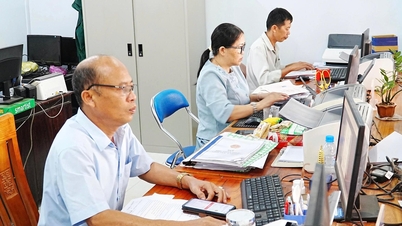
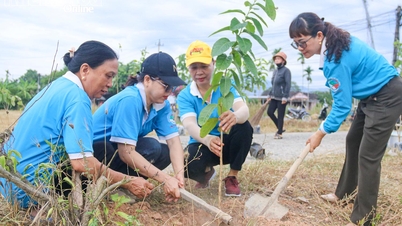
Support mechanisms need to be synchronized to create a boost that helps people stabilize their homes and production facilities. Photo: T.CONG
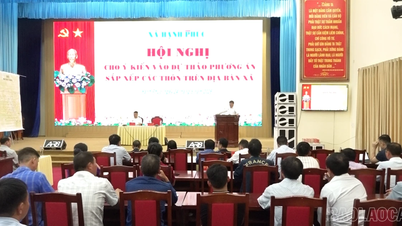
Regarding development policies for mountainous areas, in a recent working session between the Ethnic Affairs Committee of the City People's Council and the Department of Ethnic and Religious Affairs, Vice Chairman of the City People's Council Doan Ngoc Hung Anh acknowledged that, after the merger, the scale of mountainous areas and ethnic minority communities in Da Nang is very large, requiring a change in management thinking and policy development. The city will accelerate the review, amendment, and integration of policies related to mountainous areas. This includes not only reviewing resolutions specifically for mountainous areas, but also considering policies in many other fields such as education , land, public investment, health, and poverty reduction.
Accordingly, the focus will gradually shift from direct support to sustainable livelihood support, finding effective models and creating stable markets for the people. In addition, inter-sectoral coordination mechanisms will be strengthened because current issues in mountainous areas are simultaneously related to education, land, investment, culture, and national defense and security.
The city is further researching specific policies for ethnic minorities, especially for influential figures, training local ethnic minority officials, teachers, and healthcare workers in mountainous areas, and policies to ensure long-term settlement. Mountainous regions cannot be approached with only short-term support; a stable foundation for long-term population, livelihoods, and human resources must be created to narrow the development gap between regions.
Source: https://baodanang.vn/can-chinh-sach-dac-thu-cho-mien-nui-3337715.html































































































Comment (0)