

The issue of population aging and health care for the elderly is one of the issues that National Assembly deputies are interested in discussing at the parliament on the morning of December 2, when giving comments on the Resolution on breakthrough policy mechanisms in the work of protecting, caring for and improving people's health and investment policy for the National Target Program on health care, population and development for the period 2026-2035.
Emphasizing that Vietnam will become a country with an aging population by 2036 while State resources are limited, delegates said that there needs to be a mechanism to mobilize social resources to participate in taking care of the elderly.
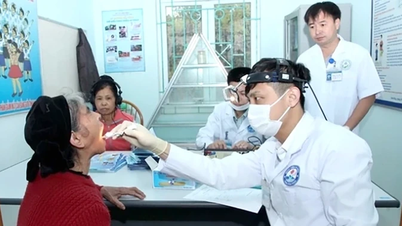
According to delegate Tran Thi Hien (Ninh Binh delegation), Vietnam entered the population aging phase since 2011, and is expected to become an aged population by 2036 and a super-aged population by 2049. This puts great pressure on the budget and social resources in health care, social security and infrastructure for the elderly, especially the system of professional nursing facilities. While public investment resources are limited, promoting socialization and attracting private investment in elderly care services is an urgent requirement.
However, delegate Hien said that the draft Resolution on breakthrough policy mechanisms in the work of protecting, caring for and improving people's health has not clearly shown breakthrough solutions to address bottlenecks to implement Resolution 72 on developing elderly care facilities and encouraging the private sector to participate. In the national target program, although there is Project 4 on developing social assistance facilities, there are still many points that are not compatible with the planning and socialization policy.
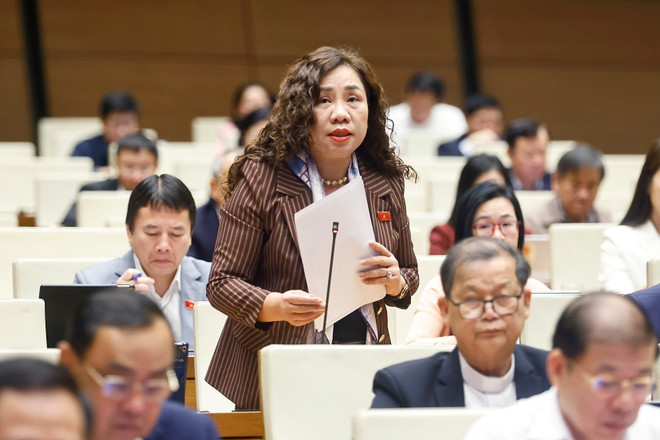
Specifically, according to the appendix of the national target program, new social protection facilities only meet 30% of the demand; the public system has only 46 elderly care facilities out of a total of 425 protection facilities, accounting for nearly 11%. Many localities do not have specialized facilities for elderly care. Sub-project 1 under project 4 of the national target program aims to build 60 new facilities by 2030 and 70 facilities by 2035. However, according to the planning of the social assistance facility network, by 2030, at least 90 elderly care facilities (public and non-public) are needed. Therefore, delegate Tran Thi Hien said that a breakthrough mechanism is needed to attract social resources to develop about 30 more facilities in the next 5 years.
Regarding investment capital mobilization, delegate Tran Thi Hien commented that the ratio of other legally mobilized capital of only 594 billion VND (0.67%) is too low compared to the requirements. According to the delegate, to unblock social resources, it is necessary to deal with bottlenecks in land and finance. Specifically, nursing facilities provide long-term care and rehabilitation for the elderly but are not considered medical facilities to enjoy land incentives. If the locality does not arrange suitable clean land funds, it will be difficult to attract investment. Professional nursing facilities require large capital, long payback periods, and specialized equipment, so they need preferential credit policies, interest rate support, and corporate income tax.
Delegate Tran Thi Hien proposed considering recognizing nursing homes with the functions of medical examination and treatment, long-term care, and rehabilitation as medical facilities to enjoy incentives in terms of land, tax, and finance. In addition, it is necessary to supplement research activities, perfect the mechanism to attract social resources to develop nursing homes; perfect technical standards; and pilot a model of semi-boarding care for the elderly.
Also interested in this content, delegate Nguyen Van Manh ( Vinh Phuc delegation) said that Vietnam is among the countries with the fastest aging rate in the world. The Party has issued many resolutions such as Resolution 21 and Resolution 72 requiring an increase in birth rate, reduction of gender imbalance at birth, adaptation to aging, and improvement of population quality.
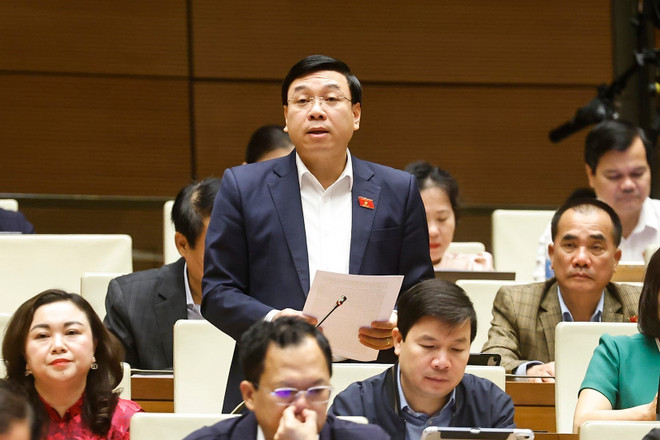
However, Mr. Manh commented that the investment level for these contents in the national target program is not commensurate. In the 2026-2030 period, the central budget allocated 68,000 billion VND but only about 6,000 billion VND (8.9%) for sub-projects directly related to population and development. This makes it difficult to achieve the program's goals, while the draft Population Law identifies population as the most important factor.
Accordingly, delegate Nguyen Van Manh proposed increasing investment in population and development issues, ensuring the implementation of the goals of Resolution 20, Conclusion 149 and Resolution 72.
Specifically, Resolution 72 requires each province/city to have at least one geriatric hospital or general hospital with a geriatric department. However, this content has not been specified in the national target program. Delegates suggested rebalancing the capital source to implement this goal, in the context of limited funding, it can be piloted in some localities.
Resolution 72 requires a breakthrough mechanism to mobilize all resources, develop private healthcare and large-scale hospitals. However, the current program mainly relies on the state budget with 99.33%, other capital only 0.67%.
“Without a strong enough mechanism to attract social resources, the program will find it difficult to achieve its goals and will not be in line with the spirit of Resolution 72. I propose adding solutions to increase socialization in investment in developing the health system, especially geriatric facilities,” said delegate Nguyen Van Manh.
Regarding elderly care, delegate Duong Khac Mai (Lam Dong delegation) focused on the institutional element of social security, especially health insurance for the elderly. Agreeing with the policy of paying 100% of medical examination and treatment costs for the elderly aged 75 and over, the delegate proposed to extend support to the age group of 70 to better suit the health situation of Vietnamese people, when healthy life expectancy is only 68 years.
According to Delegate Duong Khac Mai, taking care of the health of the elderly is not only a social security policy but also an investment in sustainable development. “The elderly are a force that has devoted their whole lives to their families and society. Ensuring they receive proper care demonstrates the morality and responsibility of the State,” said Delegate Duong Khac Mai./.
Source: https://www.vietnamplus.vn/can-co-che-dot-phat-de-thu-hut-nguon-luc-xa-hoi-trong-cham-soc-nguoi-cao-tuoi-post1080549.vnp

![[Photo] Parade to celebrate the 50th anniversary of Laos' National Day](/_next/image?url=https%3A%2F%2Fvphoto.vietnam.vn%2Fthumb%2F1200x675%2Fvietnam%2Fresource%2FIMAGE%2F2025%2F12%2F02%2F1764691918289_ndo_br_0-jpg.webp&w=3840&q=75)
![[Photo] Worshiping the Tuyet Son statue - a nearly 400-year-old treasure at Keo Pagoda](/_next/image?url=https%3A%2F%2Fvphoto.vietnam.vn%2Fthumb%2F1200x675%2Fvietnam%2Fresource%2FIMAGE%2F2025%2F12%2F02%2F1764679323086_ndo_br_tempimageomw0hi-4884-jpg.webp&w=3840&q=75)











![[Video] Urgently preparing for the inauguration and groundbreaking ceremony of projects to welcome the 14th National Party Congress](https://vphoto.vietnam.vn/thumb/402x226/vietnam/resource/IMAGE/2025/12/02/1764691316170_dung00-16-00-06still005-jpg.webp)










































































Comment (0)