

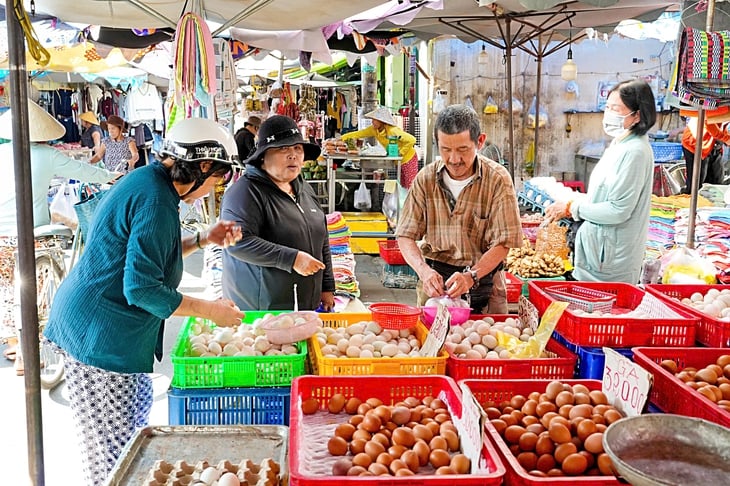
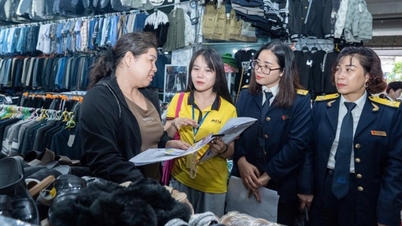
Traders at Phu Trung market (Tan Phu ward, Ho Chi Minh City) - Photo: HUU HANH
Speaking with Tuoi Tre , National Assembly delegate of Ho Chi Minh City Nguyen Hoang Bao Tran, Deputy Director of the Ho Chi Minh City Department of Science and Technology, said that amending tax policies, including tax policies for business households, needs to ensure consistency, comprehensiveness and classify target groups to support the most vulnerable business people.
Business households are the most vulnerable group.
* Do the draft tax laws amended at this National Assembly session really provide policies to support business households and enterprises, Madam?
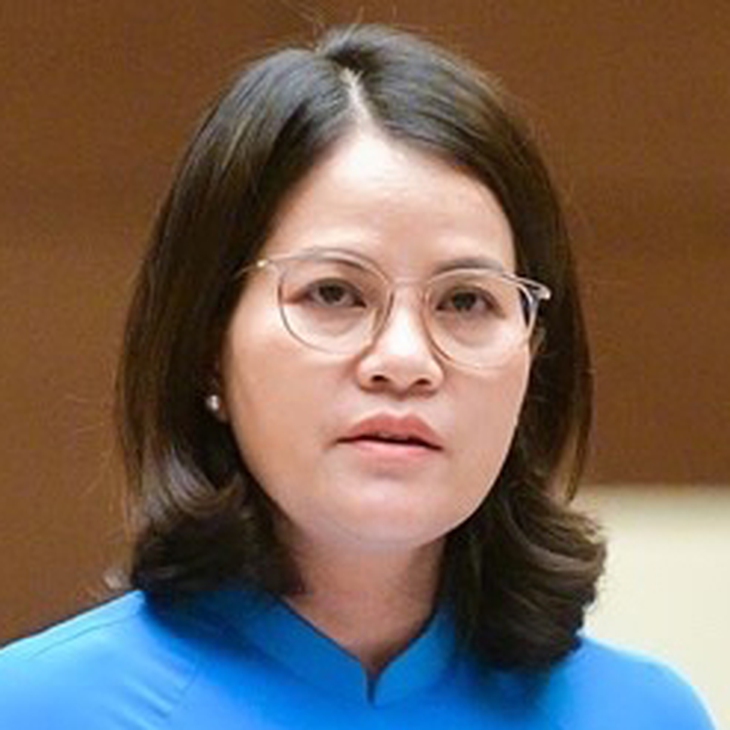
National Assembly Delegate of Ho Chi Minh City Nguyen Hoang Bao Tran, Deputy Director of Ho Chi Minh City Department of Science and Technology
- The draft tax laws this time have shown efforts to reform the tax system but still create concerns and worries for small business households and individuals when the process of converting to enterprises is not yet clear.
Many new regulations mainly strengthen management and collect taxes correctly and fully, while mechanisms to motivate conversion, such as tax incentives in the initial phase, reducing compliance costs or supporting accounting and invoices, and the problem of handling backlog goods before applying new policies still cause people a lot of confusion.
In reality, most business households and freelancers have unstable incomes, no savings, and their incomes are greatly affected by inflation and are very sensitive to economic fluctuations, so the ability to "grow up" into businesses is very difficult. Therefore, to achieve the reform goal, the draft needs to add specific support policies to help them have confidence and conditions for sustainable transformation.
* As she once stated at the National Assembly forum, tax laws do not have a clear mechanism to exempt, reduce or defer taxes, especially in cases affected by natural disasters.
pandemic...?
- Paying taxes is the duty of every citizen and business, but taxes also have a distribution function, creating fairness in society. For people affected by natural disasters and epidemics, there needs to be an appropriate exemption and reduction mechanism.
After the disaster, many small businesses such as restaurants, grocery stores, technology cars... have to recover from a very low number; income may return to the tax threshold but not enough to accumulate to stabilize. If they have to recover and pay taxes right away, they will easily become exhausted.
Therefore, it is necessary to stipulate a minimum tax exemption or reduction for 3 years for severely affected groups, helping them have time to stand firm and proactively restore their livelihoods, especially in the context of Vietnam's frequent natural disasters.
* Why is it necessary to have policies to support business households, small traders and small businesses, madam?
- Business households, small traders and small business owners account for a fairly high proportion. After all, most of them are also working for a living to create income for themselves and their families, not to create large sources of added value, create sources of profit, and accumulate high profits.
in society
Therefore, it is necessary to have policies to support business households, small traders and small traders because they are the most vulnerable group to economic fluctuations, natural disasters, epidemics and inflation. Income is unstable, input costs are increasing rapidly, while they lack savings and do not have access to capital like businesses.
Without timely support, many households will have to scale down or stop doing business, leading to the loss of livelihoods for millions of workers. Support policies will help them survive, recover and continue to contribute to local economic growth.
Hard management is not possible for all
* In your opinion, is it appropriate to apply the method of calculating tax on revenue after abolishing lump-sum tax when many fields have very low profit margins on revenue?
- Applying the revenue-based tax calculation method and eliminating lump-sum tax is a step forward in transparency, but it is not necessarily suitable for reality. The Ministry of Finance has also made adjustments and considered raising the tax threshold to suit current price fluctuations and living standards.
In fact, most small businesses easily "exceed the threshold" even though their actual profits are very low or even have no profit because they have not calculated the salaries they receive. For industries with high input costs such as food, groceries, and personal services, revenue does not reflect the true income, so calculating taxes based on revenue can easily cause them losses.
Therefore, this policy needs to be calculated more flexibly, taking into account industry characteristics and actual costs to ensure fairness and feasibility.
* According to the drafting agency, a large number of business households have large revenues but have not fully declared them, causing large losses, so it is necessary to adjust tax regulations so that the State does not lose tax revenue, madam?
- Adjusting tax policies for tighter management is necessary. However, we cannot apply rigid management methods to all for a small group. Most business households and small traders have unstable incomes, high costs and are vulnerable, so if the new regulations are too cumbersome, they will face difficulties (over 5 million households).
It is important that the policy must classify the right subjects: strictly manage the large revenue, high-risk group, but at the same time create conditions and reduce the burden for the small business group to ensure fairness and efficiency.
feasible
* So how can tax laws and policies both support business households and promote business households to become enterprises and avoid tax losses?
- To both support small businesses and promote them to become enterprises, three key solutions are needed. First, design a flexible tax mechanism and conversion incentives, exempt or reduce taxes for the first 2-3 years for households newly converted into enterprises.
Along with that, it is necessary to classify objects and manage them according to risks, tighten the belt with large-revenue households, and simplify procedures for small households. And the development of tax policies needs to be synchronized in support and digital transformation, along with accounting advice, electronic invoices, access to capital and support for recovery after natural disasters and epidemics, so that they can develop sustainably.
* Delegate Tran Hoang Ngan (HCMC):
Research on reducing or even exempting taxes for craft villages
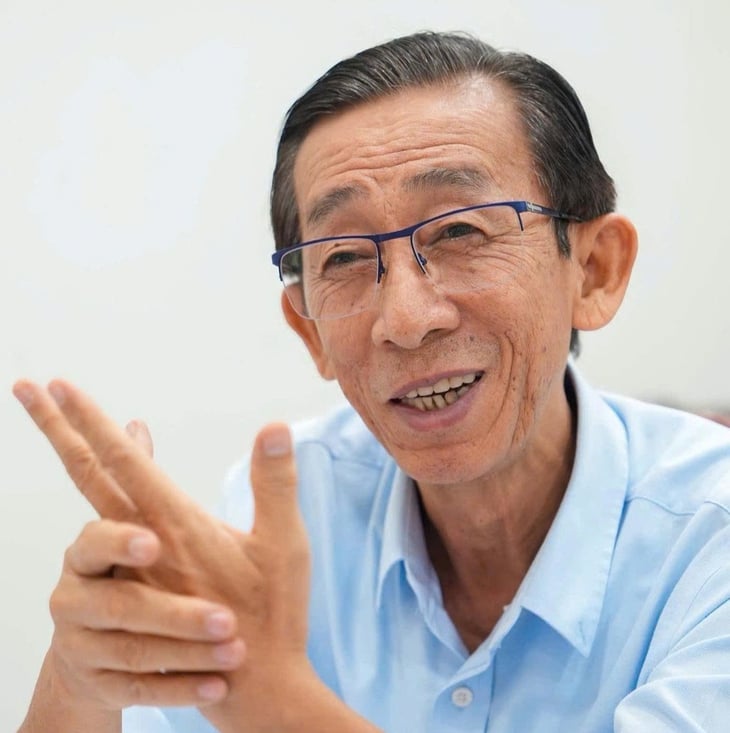
Delegate Tran Hoang Ngan (HCMC) - Photo: H.HANH
The Ministry of Finance's announcement that it will propose raising the tax threshold for business households from VND200 million to VND500 million/year shows its boldness and listening to public opinion and National Assembly delegates.
I think this proposal is "sensible" but whether it is "reasonable" or not requires time, survey, and statistics through this stage.
However, in the transition period from lump-sum tax to household tax declaration for businesses, the issue of how much tax is collected should not be emphasized.
The most important thing is to help business households professionalize their accounting books, thereby contributing to financial transparency for themselves and their families. Along with that, the Government needs to continue to listen and in the long term, divide each type of business and revenue to have an appropriate level of revenue.
In addition, for traditional craft villages - where the majority of workers are elderly, it is also necessary to study to consider tax reduction, or even tax exemption. Because these craft villages are places to preserve and promote the culture and tourism of the locality in particular and the whole country in general. Therefore, it is necessary to study to create tax revenue from tourism, not from traditional craft villages.
* Delegate Hoang Van Cuong (Hanoi):
500 million VND/year is still low
The Ministry of Finance's proposal to raise the threshold for non-taxable revenue for business households to 500 million VND/year shows that it is receptive to and listens to the opinions of voters and people. However, in the long term, it is necessary to separate each type of business, clearly determine what percentage of revenue income accounts for to calculate the appropriate threshold.
For service businesses that do not have to spend on raw materials, the revenue threshold needs to be raised to 500 million VND/year. But for manufacturing and service businesses that have raw material costs, the revenue threshold needs to be at 1 billion VND/year. For businesses that only sell goods, are agents... with very low profit margins, the revenue threshold needs to be raised to 1.5 billion VND/year.
* Delegate Tran Van Lam (Bac Ninh):
It is necessary to classify industry groups as a basis for tax calculation.
The level of 500 million, 700 million or 1 billion VND must be based on calculated data for each different industry, field and location, because different industries will have different profit margins and price differences.
It is not possible to detail each industry but it is necessary to classify each group with the difference in selling price and buying price at a different rate. For example, the retail consumer goods industry will have a different difference than the service industry or other industries.
For example, for a consumer goods retail business, with a profit margin of 5%, the tax threshold of 500 million VND/year or more will not be suitable compared to service businesses with higher profit margins.
Therefore, classifying each group to determine the price difference ratio, estimate the average cost and profit of each industry to serve as the basis for determining the starting point for tax calculation.
* Delegate Nguyen Nhu So (Bac Ninh):
Consider the 15% tax rate
In addition to raising the taxable revenue threshold for business households, I think it is necessary to classify each taxable subject because the profit margin of each business sector is different, instead of applying it uniformly, it will not be appropriate. The division of product groups is flexible and suitable to the actual income and profit of each sector.
Although determining the tax base for each group is complicated, if a general rate is applied, businesses such as grocery retailers or food businesses may be at a high rate.
If the revenue is above the threshold of 500 million to 3 billion VND/year, in case the cost can be calculated, the business household is allowed to pay tax at a rate of 15% of income (revenue - cost) which is not appropriate.
Because it is very difficult to do business to achieve a profit of 20%, and taxing 15% will cause difficulties for businesses and directly affect consumers. Therefore, this content needs to be carefully considered.
Source: https://tuoitre.vn/can-giam-ganh-nang-thue-cho-ho-kinh-doanh-20251201230805442.htm

![[Photo] Worshiping the Tuyet Son statue - a nearly 400-year-old treasure at Keo Pagoda](/_next/image?url=https%3A%2F%2Fvphoto.vietnam.vn%2Fthumb%2F1200x675%2Fvietnam%2Fresource%2FIMAGE%2F2025%2F12%2F02%2F1764679323086_ndo_br_tempimageomw0hi-4884-jpg.webp&w=3840&q=75)


![[Photo] Parade to celebrate the 50th anniversary of Laos' National Day](/_next/image?url=https%3A%2F%2Fvphoto.vietnam.vn%2Fthumb%2F1200x675%2Fvietnam%2Fresource%2FIMAGE%2F2025%2F12%2F02%2F1764691918289_ndo_br_0-jpg.webp&w=3840&q=75)
































































Comment (0)