

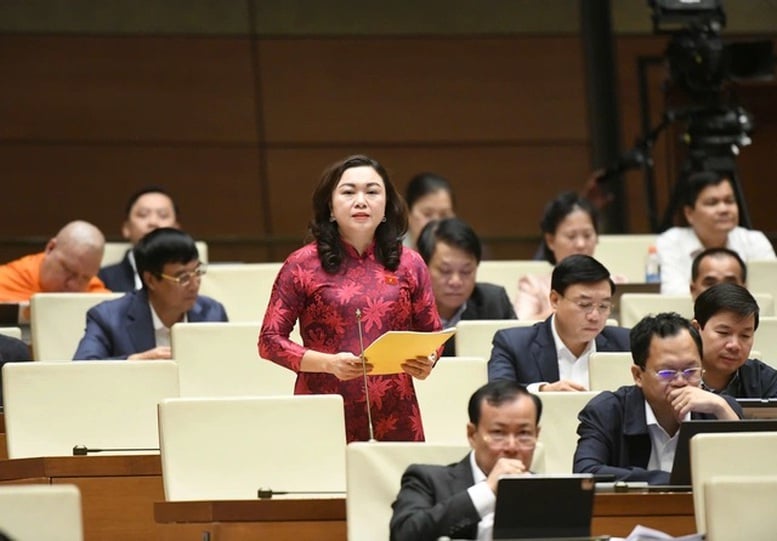
Delegate Dang Thi Bich Ngoc ( Phu Tho Delegation) proposed to include in the draft Resolution breakthrough and specific policies to train, foster, and attract doctors to work in mountainous, remote, isolated, and border areas.
Proposal to add specific policies by region and by job position
Giving opinions on the salary and allowance policies for medical staff in the draft Resolution on breakthrough mechanisms and policies in protecting, caring for and improving people's health, delegate Dang Thi Bich Ngoc (Phu Tho Delegation) proposed to include in the draft Resolution breakthrough and specific policies to train, foster and attract doctors to work in mountainous, remote, isolated and border areas.
The delegate analyzed that in recent times, many commune health stations in particularly difficult areas do not have a permanent doctor or only have one doctor who has to take on many jobs. Current mechanisms and policies are not strong enough to attract and retain qualified doctors to work and stay long-term at the grassroots health system, especially in remote, isolated and difficult areas.
“To make a breakthrough, in the coming time, it is necessary to have policies to attract specific human resources according to regions; have training and development mechanisms, focusing on developing local human resources (ethnic minorities), or implementing specific training programs in the form of "hand-holding" for medical staff in remote areas, remote areas, and areas with difficult ethnic minorities," said delegate Dang Thi Bich Ngoc.
Delegate Pham Thi Kieu (Lam Dong Delegation) was concerned about the issue of salaries and allowances for human resources in the health sector (Article 3) and said that allowing doctors, preventive medicine doctors, and pharmacists to be ranked from level 2 of their professional titles when recruited is completely appropriate, timely, and has a direct effect in attracting and retaining high-quality human resources.
For the policy to be fully effective, delegates suggested that the Drafting Committee consider expanding the beneficiaries of this policy to nursing bachelors with advanced professional qualifications and highly skilled medical technicians in specific technical fields such as diagnostic imaging and testing, positions that are in serious shortage and play an essential role in modern medical examination and treatment activities.
Delegate Ha Sy Huan (Thai Nguyen Delegation) proposed to clarify the concept of “special subjects” in Clause 4 to unify the policy application. The delegate also suggested to study and supplement incentive and reward mechanisms linked to work performance, especially for specific and high-pressure fields such as emergency, resuscitation, and disease prevention to encourage the sense of responsibility and dedication of medical staff.
Many opinions suggest improving the mechanism of allowances, training and monitoring of implementation.
Sharing the same view on this issue, delegate Duong Khac Mai (Lam Dong Delegation) highly appreciated the provisions in the draft, especially the provision of salary classification from level 2 for doctors immediately upon recruitment in Clause 1; the provision of 100% preferential allowance for highly specialized fields such as emergency resuscitation, forensic medicine, psychiatry, pathology in Clause 2; and the provision of a minimum preferential allowance of 70% and a maximum of 100% for the team directly working in the profession at commune-level health stations and preventive medicine in Clause 3.
“These are very appropriate policies that directly impact the retention of medical staff, a key factor determining the quality of the health system,” said Delegate Duong Khac Mai.
Expressing his agreement and strong support for the National Assembly's consideration of promulgating a Resolution on a number of breakthrough mechanisms and policies for the protection, care and improvement of people's health, delegate Nguyen Tam Hung (Ho Chi Minh City Delegation) said that this is a correct policy, of long-term strategic significance, ensuring social security in accordance with the Party's policies and guidelines and in line with the development orientation of people as the center and subject of development.
Referring to the specific issue of salary and allowance regime for medical staff in Article 3, the delegate suggested that the Drafting Committee consider adding professional responsibility allowances according to each working position, not only according to the specialty. The reason is that at the grassroots medical level and in resuscitation and anti-poisoning units, work pressure, on-duty intensity and occupational risks are very high, but if responsibility allowances are not stipulated, it will be difficult to ensure retention and create sustainable career motivation. This is a decisive factor for the strategy of developing medical human resources - the biggest challenge today.
Regarding specialized training in the health sector in Article 4, delegate Nguyen Tam Hung suggested considering adding the requirement to recognize Vietnam's specialized training certificates and diplomas according to appropriate international standards to facilitate the integration of medical human resources, attract talents and ensure the competitiveness of Vietnam's medical human resources in the future. This also contributes to promoting medical training institutions to innovate and improve quality.
While the Resolution assigning the Government to ensure the budget and assigning the provincial People's Committees to prioritize clean land for medical facilities is very correct, delegate Nguyen Tam Hung stated that in order for the Resolution to be binding and limit the slow implementation in practice, it is recommended to consider adding regulations on annual periodic reporting on the progress of ensuring land and premises for medical facilities, and reporting to the provincial People's Council. When there is a quantitative monitoring mechanism, the Resolution will truly operate effectively and control bottlenecks in land procedures, capital, and premises.
Hai Lien
Source: https://baochinhphu.vn/can-thao-go-cac-vuong-mac-ve-luong-phu-cap-de-giu-chan-nhan-luc-y-te-tuyen-co-so-102251202101053297.htm
![[Photo] National Assembly Chairman Tran Thanh Man receives First Vice Chairman of the Federation Council of the Federal Assembly of the Russian Federation](/_next/image?url=https%3A%2F%2Fvphoto.vietnam.vn%2Fthumb%2F1200x675%2Fvietnam%2Fresource%2FIMAGE%2F2025%2F12%2F02%2F1764648408509_ndo_br_bnd-8452-jpg.webp&w=3840&q=75)












































































Comment (0)