

VNA reporters will conduct a series of 3 articles that will review the hydropower system from development thinking to operational tools; in-depth perspectives from experts on operational efficiency, existing limitations and solutions for optimal operation of hydropower resources, ensuring dam safety in the current extreme climate change; and at the same time, preparing for the future through pumped storage hydropower and risk management systems.
Lesson 1: From thinking to operating tools
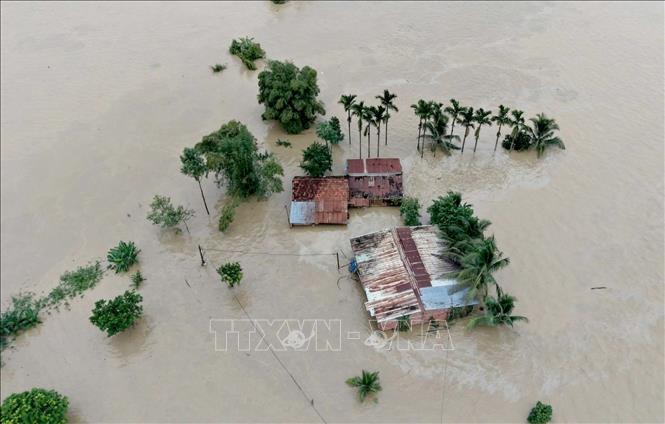
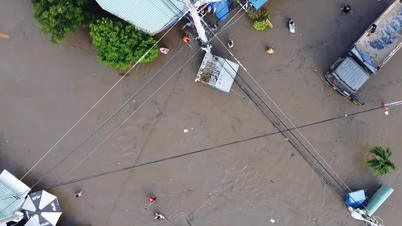
The recent historic floods in the Central and Central Highlands have exposed serious limitations of Vietnam’s hydropower system, especially in small and medium-sized reservoirs. In the context of mountainous terrain, short catchments and fast flow rates, hydropower reservoirs often have to respond immediately to floods and rains, while operating tools and supporting data are lacking. This leads to the risk of sudden flood discharge, directly affecting downstream areas and causing loss of life and property.
Vietnam has a terrain of many rivers and mountains, and has developed a hydropower system for many decades, with the total current capacity approaching the exploitation limit.
At the National Assembly discussion session on November 28, delegate Trinh Xuan An ( Dong Nai Province Delegation) emphasized the need to comprehensively review small hydropower plants and flood discharge procedures, to avoid the situation of "correct procedures but serious consequences".
Data from the National Electricity System and Market Operation Company Limited (NSMO) - Ministry of Industry and Trade showed unprecedented pressure on the system: On November 20, up to 93/122 reservoirs nationwide had to discharge water, pushing the total discharge capacity to more than 16,400 MW, equivalent to 84% of the total hydropower capacity of the entire system.
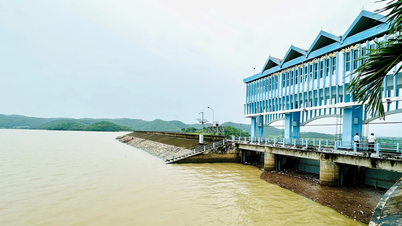
A typical example is Song Ba Ha reservoir, which in just 48 hours had to receive nearly 2 billion cubic meters of water - dozens of times the useful capacity of the reservoir. Under such conditions, flood discharge is no longer an option but the only solution to ensure dam safety.

The biggest bottleneck now is that flood storage capacity runs out at the end of the rainy season, when reservoirs are filled to capacity in preparation for the dry season. Operational procedures built on years of statistical values become outdated when rainfall exceeds “historic peaks”.
Delegate Trinh Xuan An emphasized that national master plans, industry plans and local plans need to be designed according to new risk management thinking, using the latest extreme data to build defense structures, instead of relying solely on traditional statistical models.
Irrigation expert Nguyen Tai Son analyzed that the terrain characteristics of the Central Highlands - Central Highlands are narrow, steep and have short basins, making the construction of large reservoirs almost impossible. Floods come down quickly, while the flood-cutting capacity of reservoirs is limited. This means that the more small hydropower plants there are, the higher the risk of "flood accumulation" and small reservoirs cannot bear the pressure, forcing them to release in an immediate response.
Another problem is the decentralization of operations: the Ministry of Agriculture and Environment directly operates four large irrigation reservoirs, the Ministry of Industry and Trade advises on the operation of about 30 large hydroelectric reservoirs, and hundreds of small reservoirs are assigned to the Provincial People's Committee for decision.
Many localities lack specialized technical staff and modern simulation tools, leading to a lack of data and a lack of people capable of analyzing the data.
Pressure to generate electricity has made many reservoirs reluctant to release water early to create capacity to receive floods, fearing a lack of water for electricity production. Professor Nguyen Quoc Dung, Vice President of the Vietnam Association of Large Dams and Water Resources Development, warned: “We cannot just ‘look at the sky and the earth’ and then make an operation decision.”
The current warning system is still fragmented, lacking a unified information channel from the central level down to the villages. The most important questions - when the flood will come, how much flow, and if released, how far downstream will be flooded - still have no systematic answers.

Deputy Prime Minister Tran Hong Ha, in a meeting to respond to storm No. 15, requested a review of the responsibility of reservoir owners, inter-reservoir procedures, and especially the responsibility of media warnings.
The recent floods also show that relying on old processes can lead to unpredictable consequences. When the reservoir capacity is full, investors still prioritize power generation efficiency, hesitate to lower the water level to welcome the flood, creating a "double danger" situation: floodwaters rush downstream while the reservoir is no longer able to regulate. This is clear evidence that the project is just the shell, while the operating "brain", including data, forecasting models, technical analysis and management responsibilities, determines the safety and efficiency of the hydropower system.
To adapt to extreme climate, experts propose building an inter-regional monitoring system, integrating data on flow, rainfall, reservoir capacity and hydrological mathematical models, operating as a “technical brain” capable of supporting decision-making. This means shifting from single hydropower management to synchronous risk management, including environmental factors, protective forests, water security and especially people's safety.
Lessons from this year’s flood season show that if a strong enough command system is not built, any process, no matter how correct, can still lead to unacceptable consequences. This poses an urgent need for investment in technology, improving professional capacity and transparency in operational management, especially for small reservoirs that make up the majority of Vietnam’s hydropower system.
Part 2: Expert perspective after extreme flood season
Source: https://baotintuc.vn/kinh-te/cap-thiet-ra-soat-he-thong-thuy-dien-bai-1-tu-tu-duy-den-cong-cu-van-hanh-20251207085410673.htm
































































































Comment (0)