

In late April and early May, the weather at the 923rd Regiment's airfield was experiencing localized heat, and all unit preparations were carried out urgently. At the pre-flight briefing, after hearing reports from various departments such as meteorology, staff, military training, political affairs, airfield technical and logistics, aviation engineering, communications and radar, etc., on the good preparation work, Colonel Tran Thanh Hai, Commander of the 923rd Regiment, proceeded to assign specific and detailed tasks to the flight commander, each pilot participating in the flight, and ground personnel. Although the briefing lasted only about 30 minutes, each task was fully and scientifically implemented by the Regiment's leadership and commanders.
 |
| Pilots of the 923rd Regiment train in the flight simulator. |
In particular, the Regimental Commander emphasized that implementing standardized procedures on the ground will be the foundation for the unit to implement standardized procedures in the air. Therefore, each component needs to focus their thoughts, prepare thoroughly, and coordinate closely; strictly obey the orders of the flight commander, the navigation crew, and airport regulations. For pilots, it is required that they have good basic maneuvers and are proficient in using cockpit equipment; in case of unforeseen circumstances or bad weather, they must calmly report and handle the situation promptly and accurately. In addition, pilots must thoroughly inspect the aircraft both before and during flight, and strictly adhere to the safety procedures and measures of the flight plan...
In flight training, in addition to adhering to the three flight phases (preparation, practice, and post-flight debriefing) and the four aviation technical phases (pre-flight preparation, pre-flight preparation, between flights, and post-flight debriefing), the Regiment also fully implements the sequential steps, from issuing flight instructions, developing flight plans, preparing for flight, practicing flight, and conducting flight debriefing. The Regiment consistently upholds the guiding principles and ideology in flight training, emphasizing that "all victories in the air originate from the ground," to educate and build strong political resolve, clearly defining the motivations and responsibilities of pilots and other personnel involved in mission execution.
To successfully execute a flight, pilots must study and thoroughly understand the content, sequence, technical principles, and execution methods; the limitations of engine use, fuel systems (red, lubricating, fuel, etc.). In addition, pilots must coordinate closely with instructors, flight crew, flight commanders, and navigators; study maps, calculate data, handle unforeseen situations, and skillfully use escape and search and rescue equipment, as well as flight safety measures. Afterward, they will practice in the cockpit, fly in the training simulator, and spend considerable time practicing maneuvers and coordination commands on the flight course. During training, flight commanders will present various airborne and ground scenarios to "test" the pilots' reflexes and response abilities; check their flight mission, flight techniques, and handling of unforeseen circumstances. Only those with satisfactory results or better are allowed to participate in flights. At the same time, pilots must also be well-prepared psychologically and physically to meet the demanding requirements of the mission.
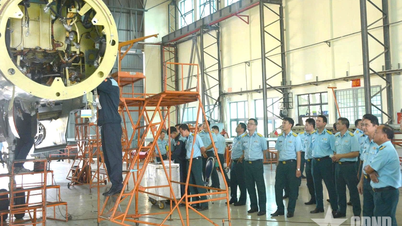
Regarding the maintenance components when performing aviation technical tasks, the standardization and uniformity are also clearly demonstrated. Lieutenant Colonel Nguyen Anh Ngoc, Head of Technical Department of Regiment 923, said: “For technical officers and personnel when operating aircraft, they always strictly adhere to aviation technical regulations, perform the tasks correctly and completely, check according to the hierarchy, accurately assess the technical condition of each system, and carefully register and record everything before the pilot takes over the aircraft.”
Besides adherence to regulations on the ground, this aspect must be even more clearly demonstrated during flight. Lieutenant Colonel Tran Thinh To Nguyen, Head of Political Affairs of Regiment 923, shared: “In the air, we always strictly adhere to flight discipline, such as: flight plan data, not exceeding the permitted speed and altitude, performing maneuvers correctly, obeying flight command orders and guidance from the navigator... At the same time, pilots flying in the front cockpit, rear cockpit, or in formation must coordinate closely and meticulously with each other; just one signal from one person is immediately understood by the other, allowing for timely and accurate execution.”
The standardized and unified approach from the ground to the air not only helps all personnel uphold a sense of responsibility and self-discipline in learning, research, and carrying out their work correctly and completely, but it is also a crucial factor in the Regiment's building of a strong, comprehensive, "exemplary and outstanding" unit, successfully completing flight training missions and ensuring flight safety.
Source: https://www.qdnd.vn/quoc-phong-an-ninh/xay-dung-quan-doi/chinh-quy-tu-mat-dat-den-bau-troi-1038526

















































































Comment (0)