

Over 30 years of struggling to make a living.
After several attempts to arrange a meeting, we finally had the chance to accompany Mrs. Thu on her "boat market" trip up the Long Dai River. As usual, Mrs. Thu woke up at 4 a.m. to prepare goods for her trip to Truong Son. The Long Dai riverbank at Hien Ninh market (Truong Ninh commune) was still pitch dark. Flashlights flickered, illuminating the styrofoam boxes and sacks of goods being hastily loaded onto the boats. The sound of engines broke the silence before dawn.
The aluminum-hulled boat, less than ten meters long, was packed with goods: fish, fresh meat, ice, rice, salt, vegetables, sweets, children's clothes, flashlight batteries, cold medicine, medicated oil, soap, shampoo… Whatever the villagers needed, Mrs. Thu tried to bring along. “We have to leave early to get to the village before noon. The water is strong this season, so if we go slowly, the villagers will have to wait,” Mrs. Thu said, then steered the boat away from the dock.
 |
| Ms. Thu's "boat market" docks at Hoi Ray village, waiting for people to come and buy goods - Photo: PP |
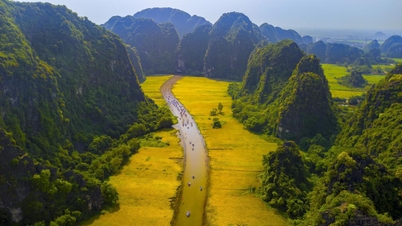
In the summer, the Long Dai River flows a deep blue amidst the vast forest. On both banks are majestic limestone mountain ranges and dense, ancient forests. In some sections, the water swirls violently at the foot of the rocky rapids, causing the boat to rock violently, the engine's roar echoing through the mountains and forests.
Sitting at the bow of the boat, Mrs. Thu recounted: She has been working as a "boat market vendor" since 1992. At that time, while accompanying her husband to Truong Son to buy honey, she witnessed the impoverished lives of the local people and discussed with her husband the idea of buying a boat to bring goods up to sell to the people in the upstream area of the Long Dai River.
Before 2000, when the western branch of the Ho Chi Minh Trail was not yet completed, the only way to reach the border commune of Truong Son was by boat along the Long Dai River. At that time, Mrs. Thu's shipments not only stopped at Hoi Ray and Nuoc Dang but also crossed the Tam Lu waterfall to reach deeper into the Truong Son region.
Initially, she only brought a small amount of rice, fish sauce, salt, and necessities. Gradually, a "boat market" formed, closely associated with the Long Dai River for over 30 years. Except for days of dangerous floods, she travels up and down the river almost every day, becoming a bridge for trade between the lowlands and the highlands.
Riverside markets
After more than 5 hours upstream, the boat docked at Nuoc Dang village. Earlier, Mrs. Thu had also stopped to deliver goods to the forest protection stations along the river. Hearing the sound of the boat engine from afar, the Bru-Van Kieu people from their stilt houses on the mountain slopes began to come down to the riverbank.
They brought dried bamboo shoots, honey, and agricultural products to trade on the shore. Children chattered excitedly, running after the adults, crowding around the boat waiting to buy ice cream and milk tea. Within minutes, a small "market" had formed at the water's edge. Some bought rice, others meat and fish. Some chose plastic sandals, sun-protective gloves. Others inquired about cold medicine for their children. Bru-Van Kieu women in their traditional brocade clothing stood around the boat, buying and selling while chatting animatedly.
There was no noisy bargaining because the sellers and buyers had known each other for a long time. Some people who were short on money were allowed to take their goods first and pay later, during the new harvest season of the planted forest. Mrs. Thu carefully opened her small notebook and recorded the amount owed after each familiar name.
 |
| People choose items according to their family's needs - Photo: PP |
Today, Mrs. Hoang Thi Vieng from Nuoc Dang village bought 200 grams of pork to cook porridge for her 6-month-old granddaughter. “Without Ms. Thu, life would be very difficult. We lack everything here, and transportation is hard. During periods of heavy rain and flooding, boats couldn't reach our homes, and many families had to eat bland food for a whole week because of a lack of salt,” Mrs. Vieng said.
At the market, the most sought-after item is ice. On hot summer days, people buy ice to drink with herbal tea after working in the fields or harvesting forest products. Children love ice cream and bubble tea. Mrs. Thu opens the Styrofoam cooler, taking out ice cream cones and bubble tea packets to give to the children eagerly waiting.
In a place almost completely isolated from the outside world , the "boat market" not only brings goods but also news from the lowlands. Hearing the sound of boats docking, Ms. Dang Thi Lan hurried down to the riverbank even though she didn't intend to buy anything. She only wanted to ask if her two children, who were studying at the Quang Ninh Ethnic Boarding School, had come home for summer vacation. When she learned that her children hadn't returned, she ran into the house to get some bunches of ripe bananas and asked Mrs. Thu to take them down to her children.
The "market" in Nuoc Dang village only lasts about 30 minutes before the boat continues on to Hoi Ray village. There, Mrs. Thu anchors her boat at two points, Hoi and Ray, for people to buy and sell goods. Although the time is short, it's always lively and bustling. Many people not only come to buy goods but also place orders in advance for items Mrs. Thu can bring the next day.
The man who keeps the rhythm of trade between the vast forests.
Around noon, as the cargo on the boat gradually decreased, the hold was filled with agricultural products and forest produce from the local people. It was peanut harvesting season, so sacks of peanuts filled the boat. "I take them downstream to sell and deduct the cost from the price to help the locals. I accept whatever amount is given because it's very difficult to sell agricultural products here," Mrs. Thu shared.
Mr. Ho Van Ba, head of Hoi Ray village, said that for many years, the people here have considered Ms. Thu as a member of their family. "Thanks to Ms. Thu's boat market, the villagers are much less burdened. Whatever is available in the lowlands, the villagers also have it. Even if there are rare items that the villagers need, she tries her best to find and buy them to bring up here," Mr. Ba said.
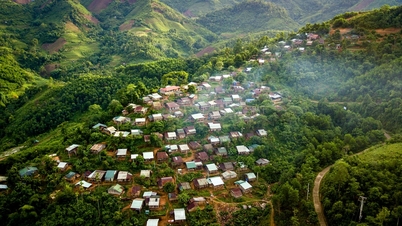
The villages of Hoi Ray and Nuoc Dang (Truong Son commune) are home to over 300 Bru-Van Kieu ethnic minority people. Located deep along the Long Dai River, the villages are isolated, with transportation primarily by river. Currently, the area lacks access to the national power grid and mobile phone service. The villagers' trading activities depend heavily on "boat markets" from the lowlands. Besides supplying necessities, these "boat markets" also purchase and sell agricultural products for the villagers. There are currently about two "boat markets" operating on the Long Dai River.
After the last market day ended, Mrs. Thu moored her boat by the shore, cooked instant noodles for us to have for lunch, and then rested for a few minutes before heading back downstream. Around 2 PM, the boat left Hoi Ray and Nuoc Dang. Going downstream was easier than going upstream, but in many sections the water still flowed swiftly, swirling like white foam.
The woman, nearly 60 years old, still held the steering wheel firmly, her eyes fixed on the river. She said that after more than 30 years navigating the Long Dai River, she knew every bend and rocky bank, but the dangers never ceased. “The scariest thing is the sudden downpour that causes the water to rise rapidly, making it very easy to hit submerged rocks. Three years ago, my boat hit a rock and punctured the bottom. Luckily, I managed to reach the shore in time and escaped,” she recounted.
According to Ms. Thu, the income from these trips is only enough to cover her family's living expenses. What has kept her dedicated to the "boat market" profession for over 30 years is not only the means of livelihood but also the affection she feels for the Bru-Van Kieu people in the Truong Son mountain range. "Once you get to know them, you miss them after a few days off," she said with a gentle smile.
As evening fell, the boat gradually disappeared downstream, leaving behind two isolated villages nestled in the vast forest. The sound of the boat's engine continued steadily on the expansive Long Dai River. Tomorrow, and for many days to come, Mrs. Thu will continue her journey, carrying goods, news, and the breath of the lowlands up to the Truong Son Mountains.
In a place without roads, markets, electricity, or telephone signals, that small "boat market" quietly maintains the rhythm of trade for the villages along the Long Dai River, where the Bru-Van Kieu people still wait for the familiar sound of boat engines echoing daily along the riverbank.
Phan Phuong
Source: https://baoquangtri.vn/phong-su-ky-su/202605/cho-thuyen-tren-dong-long-dai-bc145ed/



































































Comment (0)