


Negative impact on growth potential.
The United States has imposed tariffs, particularly retaliatory tariffs, at a minimum of 10% and potentially 46% on Vietnam. If negotiations fail after 90 days, this retaliatory tariff policy will negatively impact Vietnam's growth potential and macroeconomic stability in multiple aspects.
The most direct and noticeable impact is the decline in the competitiveness of Vietnamese goods in the US market. High-value export items such as electronics, machinery, textiles, footwear, and wood products will be severely affected by increased import costs into the US. This makes Vietnamese goods more expensive compared to similar products from countries not subject to tariffs or with lower tariffs. As a consequence, Vietnamese businesses may lose market share, face fierce competition, and be forced to reduce production or even cease operations, leading to job losses. The decline in both exports and imports will create greater difficulties in achieving the set growth targets.
Furthermore, Vietnam faces the combined impact of global fluctuations, including escalating trade wars between major economies and the risk of economic recession. These factors have already and will continue to reduce global trade growth and international investment. Previously, Vietnam benefited from international investors shifting their capital flows to avoid risks from international geopolitical tensions; however, if subjected to high tariffs from the United States, this advantage will significantly diminish. With its high degree of economic openness, Vietnam's ability to sustain economic growth will be directly affected.
This also leads to reduced budget revenue and job opportunities. When export businesses face difficulties, Vietnam's import and export tax revenue will also be negatively affected. Businesses forced to cut production or close down will reduce opportunities to create new jobs and may lead to increased unemployment, especially in labor-intensive industries such as textiles and footwear. Export businesses employ up to 30% of Vietnam's workforce, so any decline in this sector has a significant impact on the domestic labor market and consumption.
Besides the decline in growth capacity from foreign trade, it is also necessary to pay special attention to the risk that businesses from countries subject to higher tariffs will continue to shift to Vietnam to perform the final stages of processing in order to "borrow origin" and export to the United States. This not only increases the pressure of the trade deficit between Vietnam and the United States, but also negatively impacts Vietnam's legitimate exports, potentially leading to further trade sanctions, an influx of cheap goods from other countries into Vietnam, and significant competitive pressure on domestic businesses.
Countermeasures to mitigate the risk.
First, Vietnam promptly expressed its willingness to negotiate and proposed a temporary suspension of reciprocal tariffs to conduct bilateral dialogue and negotiations with the United States, a very positive move. The Vietnamese government also quickly proposed a 0% tariff rate for all bilateral import and export goods, demonstrating its proactive approach and desire to resolve the issue effectively. This helped Vietnam become one of the first countries to initiate bilateral negotiations within the 90-day period of the reciprocal tariff suspension. During negotiations, Vietnam needed to be transparent with information based on trade data; the comparison of arguments and clarification of figures on trade surpluses and the origin of goods was crucial.
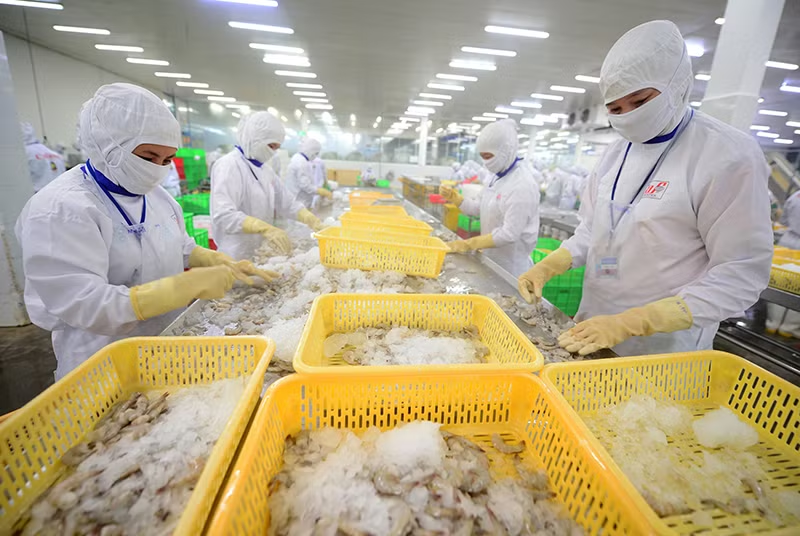 |
Workers at Cafatex Seafood Joint Stock Company (Hau Giang province) process seafood for export to the United States. Photo | TRAN TUAN |
If necessary, Vietnam could consider making selective concessions in opening its market and reducing trade barriers for the United States, in exchange for corresponding tariff concessions. Vietnam needs to emphasize the potential for cooperation in areas where the United States has strengths and significant needs, such as high technology and service industries, especially digital services. Facilitating investment and development by US businesses in these areas could help reduce the bilateral trade deficit and create new growth drivers for Vietnam.
Secondly, Vietnam emphasizes the importance and consistent commitment to reforming the investment and business environment to be transparent, free, and equitable, creating favorable conditions for foreign investors and businesses in general, and the United States in particular, to operate in Vietnam. This policy not only addresses direct concerns related to non-tariff barriers but also helps to strengthen and build trust, creating a favorable basis for future trade negotiations and other bilateral relations. Therefore, during negotiations, Vietnamese government delegations should not act alone but should strengthen coordination with domestic and US business and industry associations to unify working methods and garner support from the business community and various other interest groups related to trade in general and Vietnam-US relations in particular.
Thirdly, Vietnam has also participated in and coordinated with ASEAN countries and communities to have a common voice and seek international support. This is a correct approach because strengthening links with ASEAN countries to have a common voice and jointly address increasingly complex intra- and extra-regional trade and investment issues is extremely important, especially since most countries in the region are also heavily affected by the possibility of high retaliatory tariffs from the United States. In addition, Vietnam needs to seize more opportunities to expand and diversify trade and investment relations with other territories, as well as maximize the benefits from signed FTAs, thereby supporting the business community in seeking cooperation opportunities and exporting to potential markets, reducing dependence on a single traditional market.
Fourth, the government has also quickly prepared fiscal and monetary policy space to support struggling businesses and implemented social security support measures for workers who have lost their jobs or experienced reduced income when necessary. In response measures and support solutions, focus should be placed on enhancing the internal competitiveness of the economy and supporting businesses in adapting to the new situation, including improving the business environment, reducing transaction costs, promoting innovation, developing high-quality human resources, and supporting businesses in digital transformation. Support policies should pay particular attention to industries directly affected by US tariff policies, helping them find new markets, improve production transformation capabilities, and diversify products.
Following Prime Minister Pham Minh Chinh's decision to establish a government negotiating team on trade issues with the United States, on April 23, Minister of Industry and Trade and head of the government negotiating team Nguyen Hong Dien held a telephone conversation with U.S. Trade Representative Jamieson L. Greer to officially launch negotiations on bilateral economic and trade issues between Vietnam and the United States.
It is evident that proactiveness, flexibility, demonstrating the role of a responsible partner, strengthening international linkages, enhancing internal competitiveness, and ensuring macroeconomic stability and social welfare are key factors that have enabled Vietnam to mitigate the risks of high retaliatory tariffs imposed by the United States, while minimizing negative impacts on businesses and the economy, and seizing opportunities to promote the development of a self-reliant, self-sufficient, diversified, and multilateral economy in the context of volatile global trade. Close coordination between the Government, businesses, and relevant stakeholders is crucial for Vietnam to overcome these challenges and maintain sustainable growth in 2025 and beyond.
Source: https://nhandan.vn/chu-dong-linh-hoat-ung-pho-post880187.html















![[Video] Weather forecast for tonight and tomorrow, May 25, 2026: Widespread heatwave intensifies in Northern and Central Vietnam.](https://vphoto.vietnam.vn/thumb/402x226/vietnam/resource/IMAGE/2026/05/24/1779627756334_thumb-dem-png.webp)

































































Comment (0)