

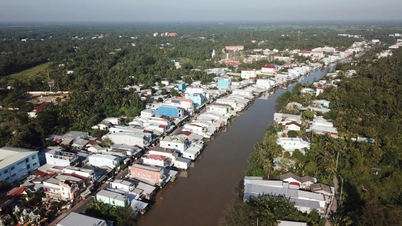
According to the Southern Institute of Water Resources Planning, the water level in the Mekong Delta region in August is forecast to be quite high and has an upward trend. The authorities recommend that it is necessary to proactively plan drainage, pump to prevent flooding, and protect production when there is heavy rain coinciding with high tides.
 |
| Water levels are expected to rise in the coming time. |
Water levels tend to rise
According to the relevant authorities, in July, two storms (number 2 and number 3) appeared in the East Sea, causing heavy rain in the lower Mekong River basin, especially storm number 3. The accumulated rainfall in July in the basin was high, ranging from 100-500mm. This was the main factor causing floods on the Mekong River mainstream to increase sharply, especially in late July.
In July, the Tonle Sap reservoir capacity was quite high and tended to increase quite strongly with an average intensity of 0.40 billion m3/day. At Tan Chau and Chau Doc stations, water level changes were strongly affected by the tidal regime and upstream floods.
Flood water levels are quite high and tend to increase with an average intensity of 2.5 cm/day. Inland water levels are also quite high and fluctuate strongly with the tide, at a level higher than the average of many years.
According to forecasts, there will be two high tides in August. The first will be in mid-August and the second will be in late August. The Southern Institute of Water Resources Planning said that the water level in the Mekong Delta in August is forecast to be quite high and has an upward trend.
By August 31, the flood level on the Mekong Delta mainstream in the upstream area is forecast to reach its highest level of 3.2m at Tan Chau (approximately the average of many years; 0.8m higher than the same period in 2024), 3m at Chau Doc (0.18m higher than the average of many years; 0.5m higher than the same period in 2024).
In the central area, the water level is forecast at 1.88m in Can Tho (0.23m higher than the average of the same period in many years; approximately the same period in 2024), 1.83m in My Thuan (0.31m higher than the average of the same period in many years; approximately the same period in 2024).
In addition, in the upper inland areas, the highest water level in August was about 0.4-0.5m higher than the same period in 2024, generally higher than the average of many years. In the middle area, the highest water level in August was approximately the same and not much lower than the same period in 2024, much higher than the average of many years.
In coastal areas, the highest water level in August is much lower than the same period in 2024 because the forecast high tide in 2025 is low, higher than the average of many years.
Proactive solutions to protect agricultural production
In 2025, the plan to sow the Summer-Autumn crop in the Mekong Delta is about 1.45 million hectares, approximately the sowing area in 2024. It is estimated that by early August, about 50% of the Summer-Autumn rice area will be harvested. The plan to sow the Autumn-Winter crop in 2025 is 691,000 hectares, 3% lower than the sowing area in 2024.
Up to now, over 307,600 hectares have been planted, completing 45% of the plan. Assessment of the safety level of the embankment system in the flood-prone areas of the upper and middle regions of the Mekong Delta corresponding to the highest flood level in August reaching 3.2m in Tan Chau shows that the entire flood control system for the whole year (production of 3 crops Winter-Spring, Summer-Autumn and Autumn-Winter) is safe.
For the August flood control system (producing 2 crops Winter-Spring and Summer-Autumn, currently the Summer-Autumn crop has about 59% of the sown area not harvested), there are about 88 boxes at risk of being affected, with a total area of about 21,933 hectares.
To respond to and minimize damage caused by floods, the Department of Irrigation Construction and Management recommends that localities focus on reviewing weak embankments and have plans to reinforce and upgrade them promptly. For the Summer-Autumn rice fields that are ready for harvest, early harvesting is urgently needed.
Sowing the Autumn-Winter crop should only be done in areas with a safe perimeter system. For irrigation sub-regions with low embankment elevations in coastal areas and Can Tho City, it is necessary to closely monitor rain forecasts and tidal developments to have timely drainage plans and prepare pumping plans in case of flooding.
According to the Department of Crop Production and Plant Protection, the province is in the peak planting season, concentrated in the communes of Trung Ngai, Cai Nhum and the remaining areas of the communes of Trung Thanh, Tan Long Hoi, Nhon Phu, Binh Phuoc , Cang Long, An Truong, Nhi Long, Thanh Hai, Thanh Phu...
To protect the production of this Autumn-Winter rice crop, Mr. Le Van Dung - Deputy Director of the Department of Agriculture and Environment said that he has directed localities to review the dyke and irrigation systems, quickly repair weak and degraded areas, and urgently complete irrigation works and dykes to ensure agricultural production.
At the same time, the Irrigation Department also closely monitors and promptly informs about developments in water resources, weather, floods, and high tides so that localities and farmers can proactively and effectively implement measures to protect rice production.
With the results of the risk assessment affecting production, according to Mr. Pham Van Manh - Deputy of the Southern Institute of Water Resources Planning, because the flood on the Mekong mainstream and the headwaters of the Mekong River is rising quite strongly, the forecast of the highest water level at Tan Chau station on August 20 can reach 3m, on August 31 can reach 3.2m equivalent to the average flood peak of the same period in many years.
The high early season floods will likely affect some Summer-Autumn crop production areas within the low-elevation August flood control enclosures and production areas outside the enclosures.
Localities need to pay close attention and proactively develop plans and timely response solutions. The weather is becoming increasingly erratic, so localities need to closely monitor forecast information from organizations such as MRC, the National Center for Hydro-Meteorological Forecasting, the Provincial Hydro-Meteorological Station, the Mekong Delta water resource forecast of the Southern Institute of Water Resources Planning... to promptly develop appropriate response plans.
Article and photos: NGUYEN KHANG
Source: https://baovinhlong.com.vn/kinh-te/202508/chu-dong-phong-ngua-ung-pho-mua-lon-trieu-cuong-bao-ve-san-xuat-de7154e/

![[Photo] Urgently help people soon have a place to live and stabilize their lives](/_next/image?url=https%3A%2F%2Fvphoto.vietnam.vn%2Fthumb%2F1200x675%2Fvietnam%2Fresource%2FIMAGE%2F2025%2F12%2F09%2F1765248230297_c-jpg.webp&w=3840&q=75)


















































![[Photo] General Secretary To Lam works with the Standing Committees of the 14th Party Congress Subcommittees](https://vphoto.vietnam.vn/thumb/402x226/vietnam/resource/IMAGE/2025/12/09/1765265023554_image.jpeg)



























Comment (0)