

In an open and inspiring atmosphere, scientists shared their very ordinary but meaningful journeys - from childhood memories associated with agriculture , local experiences that shaped their passion for discovery, to how they gradually brought breakthroughs such as asexual reproduction, nitrogen fixation or drought-resistant crops from the lab to serve the community as well as inventions that have helped save millions of lives. The discussion also expanded to the context of Vietnam, where agriculture plays a pivotal role and is a space rich in potential to apply innovative solutions in many fields.
Vietnam's own indigenous bacterial system

Participating in Session I are the winners of the VinFuture Prize with groundbreaking research in the field of agriculture. They are María Esperanza Martínez-Romero - Winner of the Special Prize for Scientists from Developing Countries, with important advances in microbial ecology and symbiotic nitrogen fixation in the tropics. Professor Venkatesan Sundaresan, Professor Raphaël Mercier, Dr. Emmanuel Guiderdoni, Dr. Imtiyaz Khanday, Dr. Delphine Mieulet - Winners of the Special Prize for Scientists with Outstanding Achievements in New Fields, with innovations in the development of asexually reproduced hybrid rice varieties - a step forward that could contribute to improving global food supplies.
Professor María Esperanza Martínez-Romero (Mexico), who was honored with the Special Prize for Scientists from Developing Countries, made an impressive appearance in the hall wearing a Vietnamese conical hat. She shared that it was her first time coming to Vietnam but everything was wonderful for her, including the VinFuture award. Her childhood dream was to become an Elephant Conservationist and work in Africa. However, when she studied bacteria, she realized that it was also a way to express her love for animals, because from there, Professor María Esperanza Martínez-Romero could find bacteria that are beneficial for the development of animal species.
The story of scientific research with Professor María Esperanza Martínez-Romero unfolds in a simple, sincere way, from the story of her childhood, to the process of embarking on the journey of researching and making important discoveries for the agricultural industry.
Sharing about her research, Professor María Esperanza Martínez-Romero said that plants interact with diverse microbial communities. These symbiotic microorganisms benefit the host plant. In particular, nitrogen-fixing bacteria, typically Rhizobium, play an important role in promoting plant growth and productivity. Unlike many previous methods that relied on model Rhizobium strains or commercial preparations from temperate regions, Professor Esperanza Martínez-Romero focused on isolating native strains adapted to soil and crop conditions in the tropics, thereby contributing an important foundation for understanding microbial ecology and symbiotic nitrogen fixation mechanisms. She discovered and described many new Rhizobium species, contributing to microbial taxonomy and understanding of plant-microbe interactions in agriculture. Her early discovery of Rhizobium tropici opened up entirely new avenues of research into nitrogen-fixing bacteria adapted to tropical environments. Her work had a profound impact on the field of microbial ecology through its emphasis on microbial diversity, symbiosis beyond legumes, and practical applications in resource-limited settings.
Professor María Esperanza Martínez-Romero’s research combines microbial ecology, genomics and taxonomy to isolate and characterize novel bacterial species, specifically adapted to local soil and crop conditions. Describing microbial diversity and function in diverse farming systems and agricultural practices has improved scientists’ ability to select more appropriate microbial strains for a variety of soils, cropping systems and farming methods, thereby helping plants better absorb nitrogen and other essential nutrients.
These Rhizobium strains can be used as bio-inoculants to improve local soils and enhance crop yields. The application of carefully researched and tailored strains for specific cropping systems is expected to reduce the amount of additional inorganic fertilizers. In the context of climate change, these bio-fertilizers can help increase crop resilience and contribute to ensuring food security for humanity.
Professor María Esperanza Martínez-Romero said she looks forward to the opportunity to cooperate with Vietnamese scientists, especially young students, to build Vietnam's own indigenous bacterial system, bringing practical benefits to Vietnam's agricultural sector.
Hybrid rice varieties from asexual seeds for fields in Vietnam

From another perspective, the scientists honored with the Special Prize for Research in Emerging Fields Professor Venkatesan Sundaresan (USA), Professor Raphaël Mercier (Germany), Dr. Emmanuel Guiderdoni (France), Dr. Imtiyaz Khanday (USA) and Dr. Delphine Mieulet (France) brought to light their journey of developing asexually reproduced hybrid rice varieties. The work helps maintain hybrid vigor in subsequent plantings, creating high-yielding seeds at lower costs, thereby contributing to improving food security for millions of people.
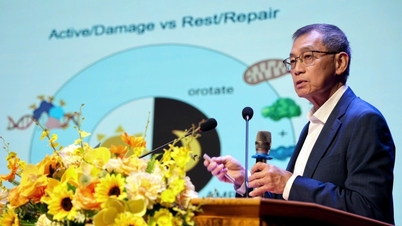
Professor Raphaël Mercier, Director of the Department of Chromosome Biology at the Max Planck Institute for Plant Genetics, Germany - a leading figure in molecular genetics, said that 15 years ago, he and his colleagues studied some types of plants that reproduce asexually in nature. These are some types of plants that do not need fertilization or pollination to produce seeds like dandelions. Its petals help disperse seeds. The study of this mechanism came entirely from the process of observing nature. After that, he realized that this research could be useful for agriculture.
Asexual reproduction is based on mitosis, which does not include meiosis and fertilization as traditional but "transforms the meiosis division process into a simpler process" to create 2 copies of genes. F1 hybrid plants are strong, there is no need to control the quality of the parent plants, only the quality of the hybrid.
Specifically, when crossing the parent plants, we get the F1 generation with extremely superior traits. But if the farmer takes the seeds of the F1 plant and sows them in the next crop (creating F2), these good traits will be separated and lost. Productivity will drop dramatically.
That is why farmers are forced to buy new F1 seeds after each crop season at an expensive cost. This is a big barrier for developing countries and small-scale farmers, making it difficult for them to access advanced agricultural achievements.
Asexual reproduction allows the preservation of desirable characteristics and the rapid generation of pure lines, which can be used for many crops, helping farmers. With the research of “clonal seeds” that can be applied to all types of crops, it allows to increase the yield by 20-30% for any crop.
Professor Raphaël Mercier hopes that asexual seed technology will be widely applied, including in organic farming. He also expressed hope that, through the VinFuture 2025 Science and Technology Week, his research and that of his colleagues can attract the attention of Vietnamese scientists, thereby opening up a direction for research cooperation in selecting suitable hybrid rice varieties for cloning by asexual seed method for fields in Vietnam.
In the hall, many students raised questions about commitment and passion in scientific research. Researchers all shared the same opinion: Although the road is long and arduous, the greatest joy lies in the moment of seeing knowledge from the laboratory transformed into real benefits for the people. Therefore, when a student asked what kept them going, Professor Venkatesan Sundaresan (USA) answered: “Science is not only about intelligence, but also about responsibility to the community”.
Fail early, grow faster

Session II opened another slice of science serving humanity: The fight against dangerous diseases of the era. Sharing with young Vietnamese people at the exchange, Professor Mary-Claire King (USA) shared her inspiration for research and innovation, especially with young women. She was awarded the VinFuture 2025 Special Prize for Female Scientists for her discovery of the BRCA1 gene related to the risk of breast and ovarian cancer, laying the foundation for genetic testing, screening programs and personalized treatment. The location of the BRCA1 gene on chromosome 17q21 in 1990 - before the human genome was decoded - was considered a historic milestone, confirming the genetic nature of cancer risk and changing the approach to prevention and treatment worldwide .
Professor Mary-Claire King (USA) said that she has been doing science for more than 50 years, but when looking back on her journey, she realized that every 10 years there are breakthroughs in science and technology.
According to her, people who do scientific research work very hard, must accept failure and always accept it with the most positive attitude. "The sooner you fail, the faster you develop and succeed - that is how science chooses the right path," said Professor Mary-Claire King.
Professor Mary-Claire King shared that in her research career, every time she had an idea or a research direction, many people would look at it and say it was absurd, very absurd. But then the research was published, there were people who followed it, and many people then followed suit. Those who criticized it quickly came back and said they knew the idea would be successful. Therefore, believe in yourself.
Professor Maura L. Gillison (USA), one of the four scientists who won the VinFuture Prize 2025, shared that she herself had always wanted to become a doctor and had been a resident physician. But because she wanted to help more people, she pursued clinical research in molecular biology.
Professor Gillison also admitted that her research had received a lot of skepticism from outsiders, even from colleagues, who thought it was absurd. She said that at one point her superiors had to give her half of their salary to cover her living expenses, encouraging her to continue pursuing her research.
Responding to a female student's question, "Should women pursue scientific research?", Professor Gillison affirmed that women can do any job if they want to. According to her, gender bias in scientific research and careers is currently only the thoughts of a few individuals.
For Dr. Aimée R. Kreimer (USA) - co-winner of this year's Main Prize, gender bias in scientific research is a dangerous mindset, a barrier to human progress. Throughout her years of scientific research, she did not conduct independent research, but always worked in groups with colleagues, in order to take advantage of the strengths of each scientist in each small problem, so that the research work goes quickly, far and has clear results.
The “Meeting with the 2025 VinFuture Prize Winners” not only strongly inspires the value of science but also encourages the young generation to dare to dream, step out of their comfort zone and contribute to the benefit of the community. This is the spirit that the VinFuture Prize wishes to spread – science serving humanity, for a better life.
Source: https://baotintuc.vn/giao-duc/chu-nhan-giai-thuong-vinfuture-2025-truyen-dam-me-nghien-cuu-khoa-hoc-cho-gioi-tre-20251206200921090.htm























































































Comment (0)