

 |
Jannik Sinner has suffered a series of defeats recently. |
Jannik Sinner is no longer the young player who sparks curiosity. He is a Grand Slam champion, a former world number one, and considered a pillar of the new era. Therefore, his elimination in the Australian Open semifinals and subsequent loss in the Doha ATP 500 quarterfinals is not simply a matter of winning or losing. It reveals a sense of instability that Sinner himself acknowledges: he is in a "low point."
The problem isn't that he lost two games. The problem is his on-court image. Sinner looks heavier, less sharp, and lacks the energy that helped him dominate opponents in the past two brilliant seasons.
Physical fitness and behind-the-scenes disruptions
Since the rivalry with Carlos Alcaraz became a central focus of men's tennis, Sinner understood that he needed more than just technical skill. He needed the physical fitness to play intense five-set matches. The improvement in the Italian player's muscle mass and endurance was clearly evident. Sinner was no longer the slender young man he was a few years ago.
But that journey wasn't seamless. The positive clostebol test at Indian Wells in 2014 led to changes in the team. Sinner parted ways with fitness coach Umberto Ferrara and physiotherapist Giacomo Naldi. Marco Panichi and Ulises Badio were then added, only to leave again before Wimbledon 2025. Ferrara returned before the US Open.
These fluctuations created instability in the preparation process. At the most recent Australian Open, Sinner experienced physical problems in the third round, suffering cramps in the hot weather. In the semi-finals, he lost to Novak Djokovic and was no longer as fresh as in previous encounters. For a player who had dominated Djokovic many times recently, that defeat had a significant psychological impact.
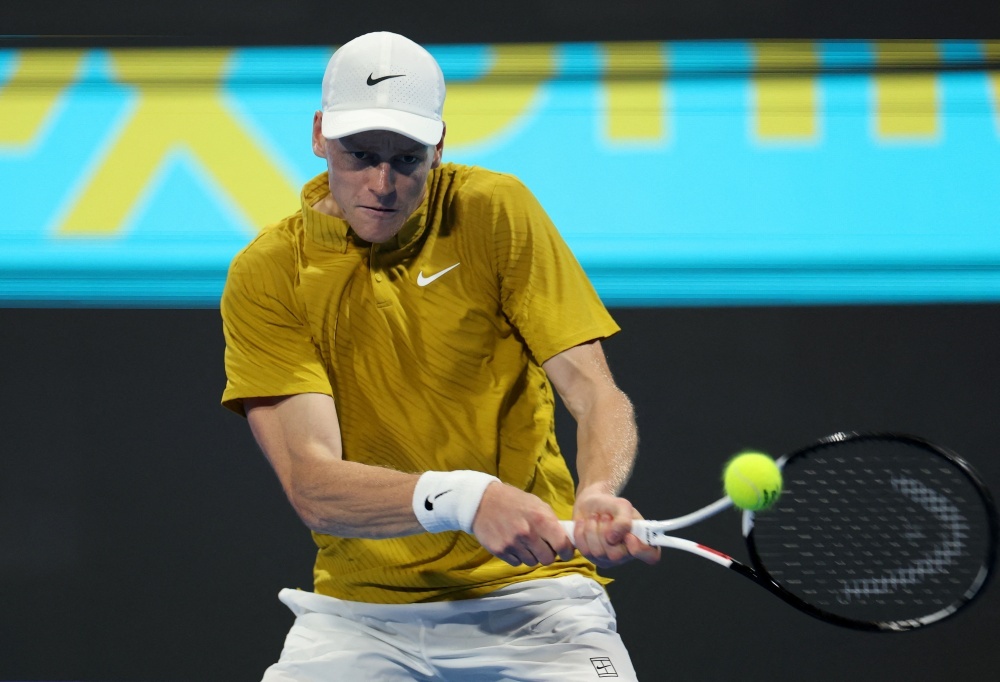 |
Following the defeat in Doha, Sinner insisted he was "fine" and did not see it as a sign of fatigue. |
After his loss in Doha, Sinner insisted he was "fine" and didn't see it as a sign of fatigue. However, top-level tennis isn't measured solely by subjective feelings. The difference can lie in a few percent of stamina, a few slower movements. As the competition at the highest level intensifies, these small details matter greatly.
The pressure named Alcaraz
While Sinner's form has slowed, Carlos Alcaraz continues to rise. The Spaniard maintained his high level of performance, particularly with his victory at the Australian Open, a tournament Sinner had dominated for the previous two seasons. Losing the world number one ranking to Alcaraz only increased the pressure.
The rivalry between the two wasn't just about the rankings. It was a battle of image, about the future of men's tennis. Every title Alcaraz won directly impacted Sinner's standing. And when his main rival showed no signs of slowing down, any small setback for him was magnified.
In the major finals of 2025, Sinner lost to Alcaraz in Rome, Roland Garros, Cincinnati, and the US Open. Although he had defeated his opponent at Wimbledon, that losing streak left a lasting mark. When a player repeatedly loses to the same opponent at crucial moments, confidence inevitably erodes.
Sinner responded by seeking new solutions. He talked a lot about becoming "more unpredictable." He focused on improving his net play, adjusting his serve, and adding more attacking options. But stepping outside his comfort zone always comes with risks. During the experimental phase, performance can fluctuate.
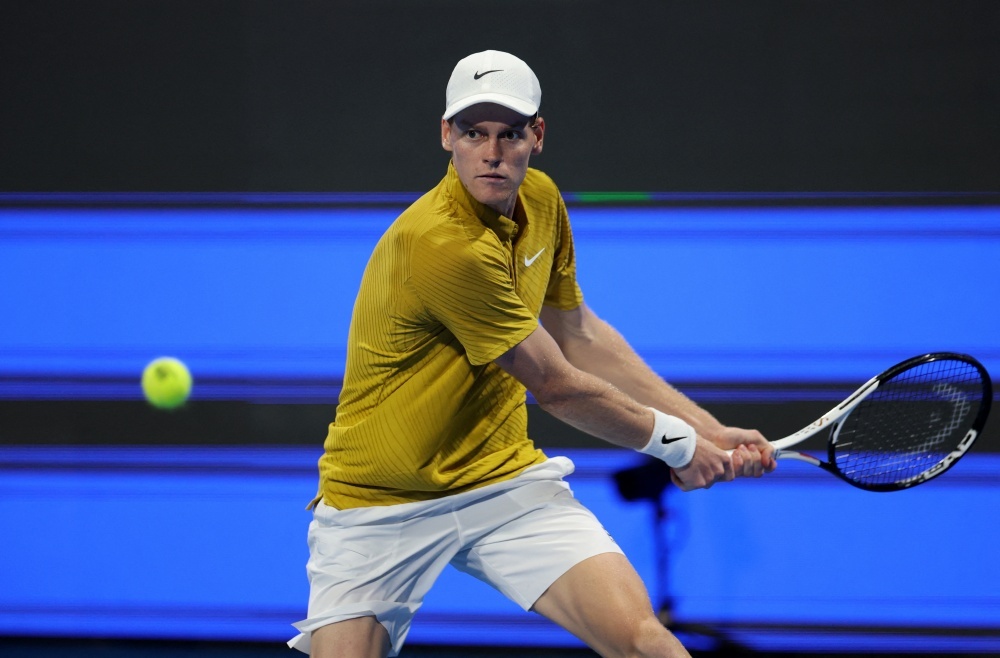 |
Sinner admitted he was trying to add "a few new things," but it wasn't always smooth sailing. |
The defeat against Jakub Mensik in Doha showed that those adjustments haven't been as effective as desired. Sinner admitted he's trying to add "a few new things," but it's not always smooth sailing. At the highest level, changing the structure of the game isn't as simple as adjusting a technical detail. It requires time and patience.
Against this backdrop, the coaching staff is once again being discussed. There were rumors about the possibility of Carlos Moya or Juan Carlos Ferrero joining Sinner's team, but no changes have occurred. Darren Cahill continues to work with him, Simone Vagnozzi remains the head coach, and agent Alex Vittur plays a key strategic role.
Many Italian experts believe that a change could bring a breath of fresh air. However, changing due to public pressure is not necessarily the solution. Sinner is at a sensitive stage: he is no longer a breakout player aiming to cause an upset, but a champion who must defend his position.
Two consecutive defeats haven't changed him. But they serve as a reminder that maintaining peak performance is harder than conquering it. Sinner had two near-perfect years. Now, he must prove that this "low point" is only temporary.
For a player who has won numerous Grand Slams and once held the top ranking, any crisis, if it arises, isn't about short-term results. It's about how he reacts. If Sinner can regain his balance between physical fitness, tactics, and mental strength, the race with Alcaraz will be a long one. Otherwise, the gap will only widen.
Top-level tennis waits for no one. And the question "What's wrong with Sinner?" will only be fully answered by his next titles, not by reassuring words after each loss.
Source: https://znews.vn/chuyen-gi-dang-xay-ra-voi-sinner-post1630210.html































































































Comment (0)