

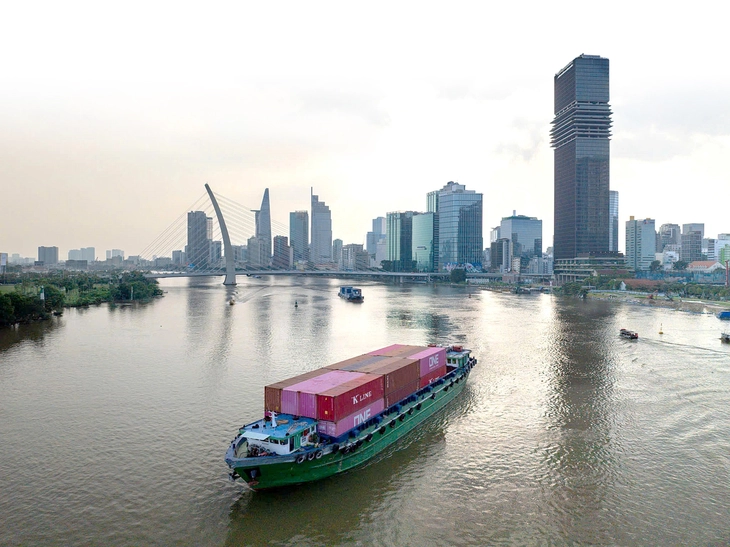
Ho Chi Minh City is the country's major economic center - Photo: VAN TRUNG
Many opinions yesterday, December 8, at the National Assembly pointed out that the establishment of a special mechanism is not only to remove existing difficulties and obstacles, but also has strategic significance to model a new urban development approach that is more effective, more sustainable, and suitable to the requirements of the next development stage for the three cities.
In particular, creating a breakthrough mechanism for Hanoi in implementing projects, ensuring feasibility and building a smoothly developing capital, greener, cleaner, more efficient. From there, reducing pressure on neighboring localities, increasing regional connectivity and creating a common development momentum for the whole country.
In particular, increasing the autonomy of Ho Chi Minh City and Da Nang in choosing investment methods, selecting strategic investors and taking advantage of flexible public-private partnership (PPP) models. These are important conditions for Ho Chi Minh City to maintain its leading position and Da Nang to become a new growth pole of the Central region, spreading to neighboring localities.
"HCMC cannot wear the same institutional shirt"
Delegate Hoang Van Cuong (Hanoi) stated that Ho Chi Minh City has long been a major economic center of the country, a dynamic and creative region, a place to break through new management institutions and then expand nationwide. After merging with Binh Duong and Ba Ria - Vung Tau, the potential and position of Ho Chi Minh City is now even stronger.
Therefore, he pointed out that "a large entity like Ho Chi Minh City cannot wear the same institutional coat" like other localities in the country, but needs a separate, broader institution, creating a separate space for Ho Chi Minh City to freely create and develop.
He suggested three points to note when revising Resolution 98. First, it is necessary to review and remove all regulations that make it impossible to implement special mechanisms. He immediately pointed out the first clause that stipulates that the City People's Council has the right to use the local budget to perform a series of tasks, but it is attached to the condition of "compliance with the provisions of the law".
He pointed out, "If we do that, the above mechanisms do not need to ask for anything, because we will just do what the law stipulates."
Second, he proposed that the draft not list but only stipulate principles and criteria and then assign the City People's Council to decide on the list of projects that need priority to attract strategic investment.
Along with that, it is necessary to add to the draft new resolution a provision that in case there is a need for special regulations different from the provisions of current law, the City People's Council can issue a resolution and report to the Government to submit to the National Assembly Standing Committee for consideration and report to the National Assembly at the nearest session. If there is this mechanism, Ho Chi Minh City will truly have creative space, a new management mechanism and will truly become an "institutional laboratory" for the whole country.
Delegate Duong Khac Mai (Lam Dong) also cited the summary report on the implementation of Resolution 98, which pointed out that many issues still require central consultation due to being bound by current legal regulations, leading to the loss of many breakthrough opportunities and slowing down the development process of the city.
From there, he suggested that it is necessary to study fundamental amendments and remove the contents that are creating "bottlenecks" in the implementation of Resolution 98.
In particular, the National Assembly has assigned the task of forming an international financial center in this locality, so the mechanism must be open, so that "there is enough transparency inside and enough space outside" to be able to build and develop. "Any content that needs to be specific and different from the provisions of current law should be stipulated right in this resolution," Mr. Mai proposed.
Of course, according to him, expanding the mechanism requires a monitoring mechanism so that everything is controlled and adjusted promptly. "If that is the case, the city will truly become a place to test the institution, thereby helping us perfect the institution to replicate it in a way that is suitable to the conditions of each locality in the country for mutual development," Mr. Mai added.
Delegate Nguyen Van Loi (Head of the National Assembly Delegation of Ho Chi Minh City) expressed his agreement on the need to decentralize more strongly to localities, especially localities qualified to organize and implement large projects.
Regarding investment decentralization and investment attraction, he proposed to assign localities, specifically the People's Council and People's Committee, to decide on all intra-regional projects, especially strategic infrastructure investment, and ask the central government for connecting infrastructure.
Similarly, free trade zones should also empower localities to decide on project establishment, appraisal, and organization, as long as they are included in the planning and regulations on investment decentralization and anti-corruption should be strictly implemented.
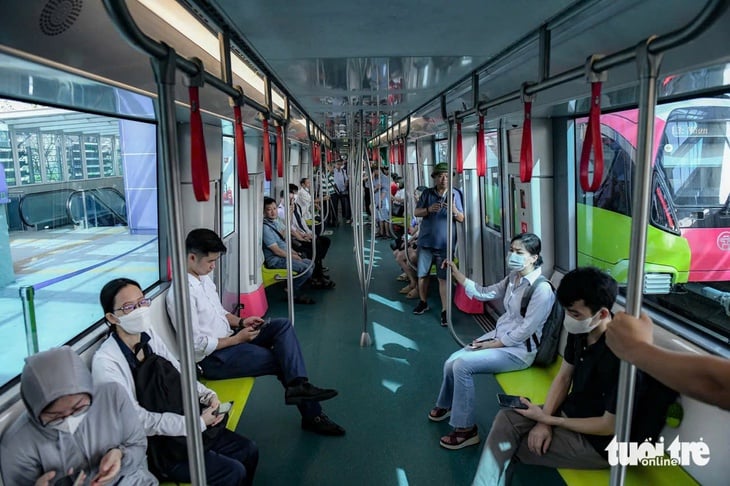
Hanoi is investing in more Metro lines to reduce traffic jams and dust - Photo: TTO
Hanoi strives to be on par with capitals of regional countries
Regarding the draft resolution on piloting a number of specific mechanisms and policies to implement major projects in the capital, delegate Le Huu Tri (Khanh Hoa) stated that the National Assembly's consideration aims to create a legal basis for the capital to promptly remove obstacles and clear institutional bottlenecks.
At the same time, mobilize and effectively use resources to promote the capital to develop rapidly, sustainably and modernly, soon becoming a driving force to promote the development of the Red River Delta, the key economic region of the North and the whole country. Strive to develop on par with the capitals of developed countries in the region.
At the same time, thoroughly resolve issues of traffic congestion; urban order; build green, clean, beautiful, civilized urban areas; handle environmental pollution, water pollution; flooding in urban and suburban areas, contributing to realizing the vision of developing the capital by 2045.
He suggested that a thorough review is needed to ensure principles, only regulating a number of specific, outstanding, appropriate and truly necessary policy mechanisms to implement important large projects in the capital. These mechanisms must be under the authority of the National Assembly but have no laws to regulate or are different from the provisions of current laws.
Along with that, it is necessary to carefully review and evaluate the impact of the mechanism. Issue regulations clearly defining the responsibilities of each level, especially the responsibilities of the head in leading, directing, organizing, implementing, inspecting and checking the implementation of mechanisms and policies.
Delegate Nguyen Huu Thong (Lam Dong) also said that allowing new investment projects to renovate works to handle urgent problems such as traffic congestion, flooding, environmental pollution, and urban order, which are considered chronic diseases and "specialties" of Hanoi, is necessary.
He emphasized that the implementation under the public investment mechanism is urgent and the urgent construction order is to meet the practical requirements of Hanoi at present. If there is no breakthrough legal mechanism to speed up the implementation of investment preparation procedures according to regulations, social costs will continue to increase, directly affecting the lives of millions of people in the capital, reducing urban competitiveness in the long term.
However, in order for this mechanism to be highly effective, in the implementation organization, he proposed adding regulations towards expanding the mechanism to mobilize the private sector into urgent projects, allowing the application of specific and shortened forms of public-private partnership for projects to handle traffic congestion, flooding, and environmental pollution. "Hanoi is a locality with great potential for socialization, if exploited well, it will significantly reduce the burden on the budget," Mr. Thong said.
Regarding the draft resolution on Da Nang development, delegate Nguyen Tam Hung (HCMC) said that after the merger, Da Nang will have the largest area in the country among the central urban groups, and the pressure to connect East - West and North - South requires a breakthrough in infrastructure.
Therefore, he fully supports allowing Da Nang to decide on planning and technical indicators other than national standards in the TOD area, as well as allowing multi-functional development on station land, retaining 100% of TOD revenue to reinvest in urban railway.
This is a mechanism in line with international practice, creating momentum for the formation of new growth poles. However, he noted that it is necessary to add requirements to ensure adequate technical and social infrastructure and control population density to avoid spontaneous development.
He strongly supports the mechanism that allows the simultaneous establishment of tasks and detailed planning, one-time consultation and allows investors to participate in planning once selected. This mechanism helps Da Nang speed up planning, shorten project preparation time, reduce administrative costs and attract strategic investors.
* Delegate TRINH XUAN AN (Dong Nai):
Proposal to have a separate law for Ho Chi Minh City
Regarding the amendment and supplementation of some articles of Resolution 98, I strongly agree with the delegate's opinion that perhaps it is time to have a law here and the delegate used the term "super urban law". With "super urban law" it may be difficult so I propose having a separate law on Ho Chi Minh City.
Hanoi has its own Capital Law. As for Ho Chi Minh City, the locomotive of the whole country, especially now with its super large scale, it should have its own law. At the same time, it should integrate the contents of the current special mechanism, thus solving the fundamental problem and giving the city a wide space to develop.
* Delegate TRINH THI TU ANH (Lam Dong):
Right direction
The free trade zone in Ho Chi Minh City is a "test of institutional thinking" in the context of the country's search for new growth drivers. In terms of management thinking, the nature of the free trade zone is to create a new institutional operating rhythm. The reality in Shanghai, Singapore or Busan all shows the ability of the management apparatus to respond to the rhythm of the global market.
In which, the local autonomy must be designed to be higher than usual, ensuring that decisions keep up with the speed of trade, finance, logistics - areas that fluctuate by the day, even by the hour. Therefore, the draft granting authority to the Ho Chi Minh City People's Committee is the right direction, in line with practical requirements and international practices.
Proposing specific policies for high-speed railway projects
Minister of Construction Tran Hong Minh has submitted to the National Assembly a proposal to supplement mechanisms and policies applicable to the North-South high-speed railway project. The Government has proposed specific policies for the project related to site clearance and will continue to review other policies.
The policy proposed by the Government is to separate the compensation, support, resettlement and relocation of power projects of 110kV or higher into independent projects, with funding allocated from the budget. During the time the National Assembly is not in session, the National Assembly Standing Committee will be authorized to consider and decide on supplementing and adjusting specific mechanisms and policies for investment methods to promptly implement the project.
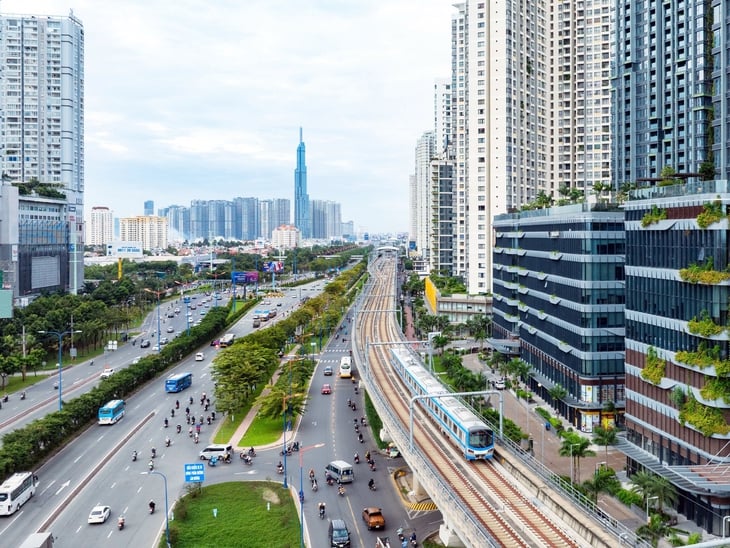
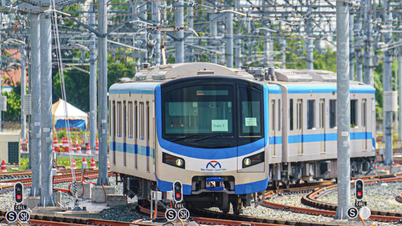
The draft resolution stipulates that Ho Chi Minh City is allowed to use 100% of the revenue from urban development in the direction of public transport. In the photo: Metro No. 1 running through An Phu station - Photo: VAN TRUNG
Allow Ho Chi Minh City and Da Nang to use 100% of revenue from TOD urban development
Minister of Finance Nguyen Van Thang emphasized that the Government's submission to the National Assembly of draft resolutions on specific policy mechanisms for the capital Hanoi, Ho Chi Minh City, and Da Nang City are all breakthrough solutions, many of which are different from the law.
This is to attract investment resources, contributing to realizing the double-digit growth target as well as high growth of the three cities in the coming time, in accordance with the policy of the Politburo as well as the direction of General Secretary To Lam.
Regarding policies in free trade zones, Minister Nguyen Van Thang said the draft resolution allows Ho Chi Minh City and Da Nang City to add outstanding and breakthrough policies to promote exports, industry, research and development activities, and attract high-quality human resources.
This ensures policy similarity and investment attraction among the free trade zones of the three cities of Ho Chi Minh City, Da Nang, and Hai Phong on the basis of a unified legal framework that has been approved by the National Assembly for pilot implementation in Hai Phong and Da Nang.
According to Mr. Thang, the unification and synchronization of policy frameworks among the three free trade zones not only ensures fairness and consistency in implementation, but also creates a network of linked growth poles with the ability to spread widely. From there, it directly contributes to the overall development goals of the whole country.
He added that based on the experience of countries that have implemented free trade zones, the formation of free trade zones creates opportunities to form a supporting satellite network including logistics, supporting industries, business support services, human resource training, urban areas, worker housing, security centers, etc.
This is the driving force for regional connectivity, helping to promote businesses in the localities to participate in regional value chains, instead of competing directly.
According to him, the draft resolution allowing Ho Chi Minh City and Da Nang City to use 100% of revenue from urban development in the direction of public transport (TOD) is to unify the application of the law.
The Railway Law stipulates that the provincial local government retains 100%, the State Budget Law stipulates that the central state budget enjoys 20% and the local budget is 80%. This also creates conditions for localities to ensure resources to focus on implementing local railway projects and transport projects on TOD routes. The scope of land revenue retention is not expanded compared to the provisions of the Railway Law in 2025.
Regarding the expansion of priority industries to attract strategic investors, the Minister proposed a draft proposal to supplement the list of priority projects to attract strategic investors. Specifically, 11 groups with Ho Chi Minh City and 12 project groups with Da Nang City to attract large-scale projects with potential, creating new growth momentum and strongly spreading to socio-economic development.
In addition, the draft has designed appropriate incentive mechanisms, ensuring a full legal corridor and also flexibility for localities in selecting investors with financial capacity, modern technology and management, contributing to the formation of large-scale projects with spillover effects and promoting the process of economic restructuring towards industrial services and high technology.
Source: https://tuoitre.vn/co-che-phai-mo-de-trong-du-thong-ngoai-du-thoang-phat-trien-ha-noi-tp-hcm-da-nang-20251209095238263.htm




![[Photo] Urgently help people soon have a place to live and stabilize their lives](/_next/image?url=https%3A%2F%2Fvphoto.vietnam.vn%2Fthumb%2F1200x675%2Fvietnam%2Fresource%2FIMAGE%2F2025%2F12%2F09%2F1765248230297_c-jpg.webp&w=3840&q=75)















































![[Photo] General Secretary To Lam works with the Standing Committees of the 14th Party Congress Subcommittees](https://vphoto.vietnam.vn/thumb/402x226/vietnam/resource/IMAGE/2025/12/09/1765265023554_image.jpeg)
























Comment (0)