

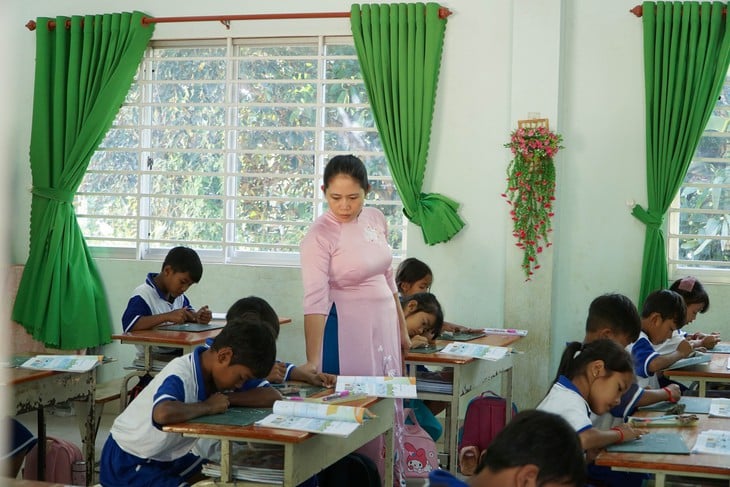
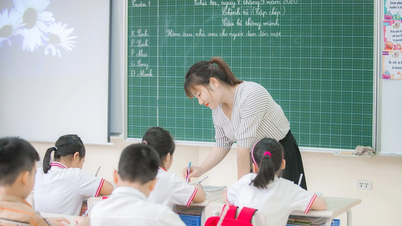
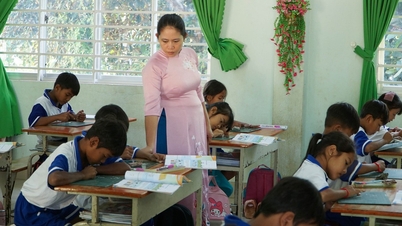
Many students are not yet fluent in Vietnamese, so Ms. Ra goes to each table to tutor them - Photo: THU BUI
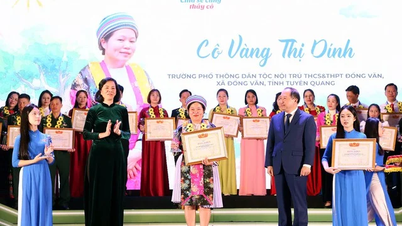
That effort was recently recognized when she became one of the teachers honored at the Sharing with Teachers 2025 program to honor teachers in 248 border communes, special zones and teachers wearing green uniforms.
Happiness every day
After nearly 13 years in the classroom, Ms. Lam Thi Ra always humbly admits that she is just "an ordinary person, teaching in an ordinary way." However, her story is a journey of perseverance, compassion, and a simple dream: "My daily happiness is to see the children learn one more letter."
In the morning at the border school, Ms. Ra's class resounded with loud, clear voices reading out loud: "five minus one equals four." In the small room, sunburned heads leaned close to the blackboard. The school had nearly 100 students, 99% of whom were Khmer. The biggest barrier here was language.
"For the entire month since the school started, when I told the students to take out their boards, they sat still. When I told them to take out their books, they also sat still because they didn't understand Vietnamese," Ms. Ra said.
Ms. Ra is assigned to mainly teach grades 1 and 2 because this is the group of students who need to get familiar with Vietnamese the most.
She confided: "At first, the Kinh teachers could not communicate with the students, so I kept running back and forth between the two classes to translate. Then I made signs so the students knew what to do." Now the students can read, write, and respond to her in Vietnamese.
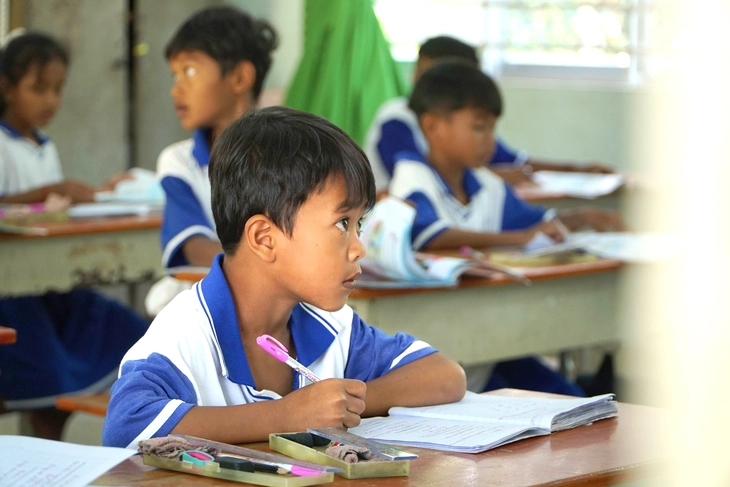
The students' black eyes attentively listen to the lecture at Tan Dong Primary School, Tam Pho Hamlet campus.
According to Mr. Le Van Bao - Principal of Tan Dong Primary School, Ms. Ra is the only teacher at the school who teaches Khmer and holds a special role.
"For first graders, most of them don't know Vietnamese yet and have to learn both languages. Ms. Ra not only teaches knowledge but also acts as a bridge between Kinh teachers and parents, helping children integrate into the class and not miss out on learning opportunities," commented Mr. Bao.
Every time a student stood up to speak, sometimes forgetting Vietnamese, they switched to Khmer. She repeated the correct sentence until they pronounced it correctly. These small repetitions happened dozens of times each lesson, that was how she sowed the seeds of knowledge in the border area.
Ms. Ra said: "There was a new teacher who cried all the time after only one week because the students did not understand the lesson. When asked anything, the students remained silent. But the students were not lazy or bad, they were just shy."
She patiently taught each letter in both languages, holding each child's hand, correcting each stroke, repeating it over and over again. "Every time I see the children speak Vietnamese for the first time, I feel so happy," she laughed.
She always encourages and motivates students to be more courageous. Sah Kim Seng, a 4th grade student, excitedly said: "I like Ms. Ra's Khmer class the most. Because she teaches in a fun way and every time I say something correctly, she makes the whole class clap and praise me."
The school is now more spacious thanks to the efforts of the teachers, support from the local community and benefactors. The classrooms now have televisions and the facilities have also been improved.
"Back then, students wouldn't go to school if they didn't have a phone to contact me. I had to drive to each house to look for them. Some kids ran away to play, so I had to run around the whole neighborhood looking for them," she said, laughing.
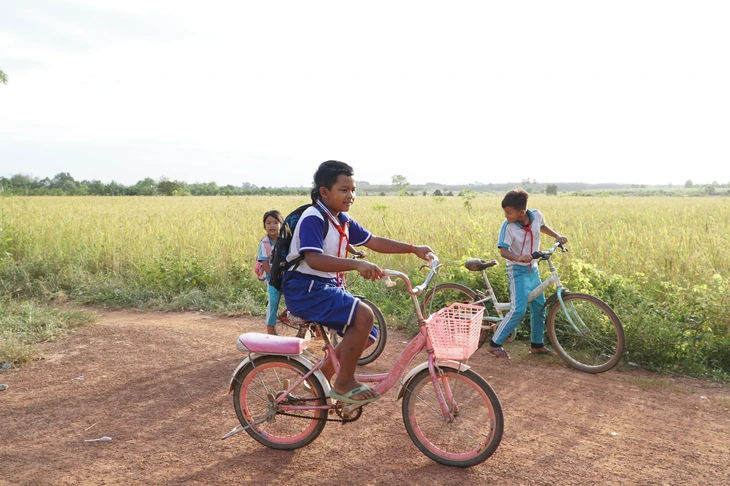
Most students at this school walk or cycle to school - Photo: THU BUI
Where parents place their trust
Most of Ms. Ra's students were children of poor farmers who worked as hired laborers, pulling cassava and cutting sugarcane. Many of their parents were illiterate and left the education entirely to the teachers.
"The school closely works with the hamlet and village elders to keep track of the list of school-age children. Two months in advance, we go to each house to persuade them to complete the admission paperwork. Many families don't know much, so they just leave it all to the school and teachers," said Mr. Bao.
According to Mr. Bao, this is one of the most difficult schools in the border commune. "Ms. Ra teaches very enthusiastically, takes care of and follows each student closely, understands their circumstances and psychology, and supports both their studies and their lives."
Once, a student was seriously ill. His mother was poor and had no money to take him to the hospital. The teachers at the school had to go to his house to persuade him to take him to the hospital in Ho Chi Minh City and pay for him. "Now he is healthy and in 3rd grade. Thinking back, I still feel lucky," said Ms. Ra.
She often asks students: "What is your dream job?". Previously, most of them answered that they would work in the fields or harvest cassava because this was the closest job to them and their families. Some said they wanted to be factory workers because they saw their older siblings sending money home from work. However, now, thanks to education, they have boldly expressed their dreams of becoming "policemen" or "doctors".
What makes her happy is that parents in recent years have been much more aware of their children's education. Those who can afford it buy enough books and pay for health insurance. Students in difficult circumstances are lent books and uniforms by the school. In the past, many children went to school without sandals, but now that is less common. The locality also supports and creates many conditions for ethnic minority children.
"I just hope the kids can learn to read and write and have a decent job so their life will be less miserable than their parents'," she said.
From a difficult childhood to the dream of teaching
Ms. Lam Thi Ra was born into a poor Khmer farming family. Her father died early, and her mother raised her children alone. Her childhood was spent eating simple meals and wearing old clothes. In her first year of college, her mother passed away. She had to be independent and live frugally, but she was still determined to pursue her dream of becoming a teacher.
Ms. Ra worked at the school for a year and then went to Cambodia to continue her studies for four years, teaching Khmer children in Tam Pho hamlet. Although her house is 10km away from the school, she still works hard every day because she wants to help poor children who do not understand Vietnamese to have the opportunity to study.
Provide translation support for colleagues
Nearly 20 years ago, when receiving the decision on Tan Dong B Primary School, Ms. Chu Phuong Uyen - a Kinh teacher who did not know Khmer - was almost stunned. On the first day of class, more than thirty pairs of black eyes looked at her but not a single student spoke. She asked, but they were silent. She instructed, but they remained silent. Not because they were being naughty, but because they did not understand a single word of Vietnamese.
The hardest part for her was teaching first grade. Many children did not understand the words "wipe" or "small board", it took a whole week for them to remember just one word. She used signs instead of words, patiently showing each movement, each way of holding the chalk. Parents did not know Vietnamese, so she had to ask older students or Ms. Ra to help translate. There were years when she and the principal went from house to house to persuade children to go to school, some children hugged the foot of the bed and cried, refusing to go to class.
THU BUI - VU HIEN
Source: https://tuoitre.vn/co-giao-13-nam-bam-lop-vung-bien-hanh-phuc-moi-ngay-la-thay-cac-em-hoc-them-duoc-mot-chu-20251209104403691.htm




![[Photo] Urgently help people soon have a place to live and stabilize their lives](/_next/image?url=https%3A%2F%2Fvphoto.vietnam.vn%2Fthumb%2F1200x675%2Fvietnam%2Fresource%2FIMAGE%2F2025%2F12%2F09%2F1765248230297_c-jpg.webp&w=3840&q=75)















































![[Photo] General Secretary To Lam works with the Standing Committees of the 14th Party Congress Subcommittees](https://vphoto.vietnam.vn/thumb/402x226/vietnam/resource/IMAGE/2025/12/09/1765265023554_image.jpeg)























Comment (0)