

We weighed anchor from Da Lon Island at 5am and arrived at Co Lin Island around 10am the next day. After dropping anchor, we had lunch and took a nap on the ship. At around 3pm, I rowed a rubber boat to the island with the deputy technical team leader, the deputy political team leader and the Party cell secretary.
We went up to the stilt house where the engineering force was staying. The commander of the engineering unit was an old captain with a stern, determined face. We discussed the plan to move the goods to the island. After that, I walked around the stilt house to observe the surrounding island. Looking at Gac Ma Island right next to it, I saw that China had built a spacious 3-storey house.
After that, we visited the officers and soldiers guarding the island on a 4-story bunker similar to the one at Da Lon. Near dusk, we returned to the ship. After dinner, I met with the whole team and divided them into 8 groups in 8 boats, each boat had 7 students and 1 commanding officer. The rest went down to the hold to load the cargo to be hoisted onto the boat.
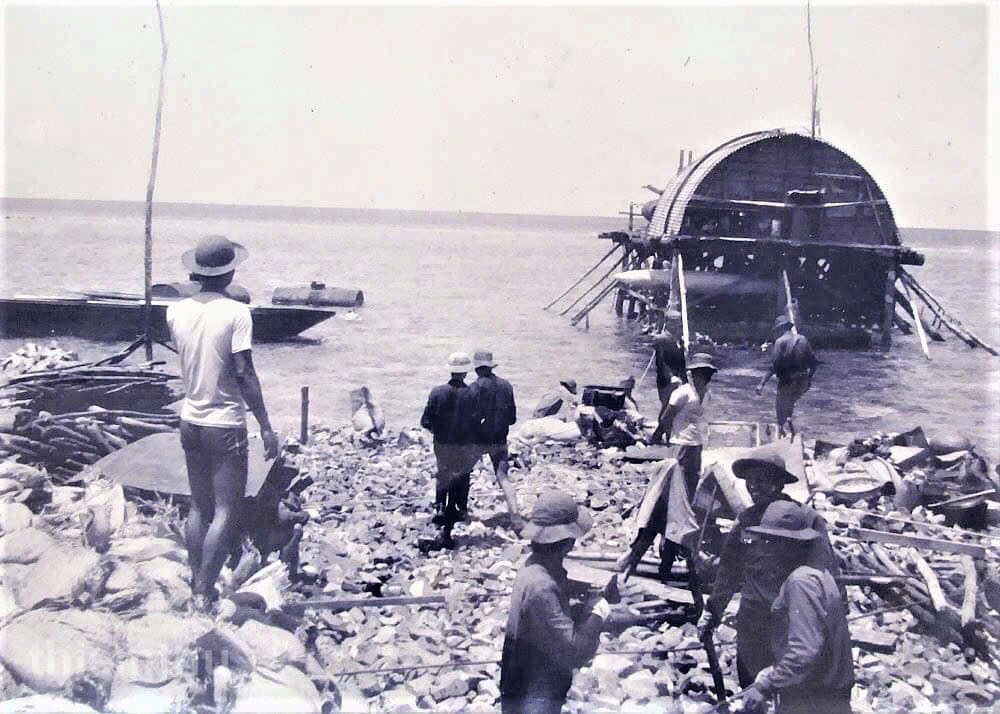
Transporting construction goods on Colin Island, May 1989. Photo: DOCUMENT
The next morning, we immediately implemented the plan to transport goods to the island, including cement, boulders, concrete structures, wooden beams, crushed stone, and bagged sand. The weather was good, the waves were calm, so the transport of goods was very favorable. At the end of the first day, there were 6 boats that could carry 7 trips and 2 boats that could carry 6 trips. On the last trip, I ordered the crew to lift the boat and tie it to the deck. I explained: "There are often sudden storms here. When the storm comes, the boat must weigh anchor and move away to avoid being drifted onto the island, at which point it will be too late to lift the boat."
Hearing me say that, the brothers happily brought all the boats up onto the deck and tied them securely, then rested in peace.
In the afternoon, when the tide was at its lowest, we all went fishing on the island. I waded alone near the end of the island, climbed onto the HQ-505 ship, which was pointing its bow up on the coral reef, the back half of the ship still under water. There were still a number of officers and soldiers on board to guard. I crawled into the compartments to see the marks of Chinese artillery shells on the ship. There was the largest hole from a 130mm shell that went from the starboard side to the port side. The rest were mostly 37mm shells. The number of bullet holes penetrating the starboard side of the ship was dense, more than the number of bullet holes penetrating the port side, mainly located in the back half, where the command post and engine room were.
Looking at the ship that was shot and burned during the CQ-88 Campaign, I felt choked up. I suddenly remembered the time when Captain Vu Huy Le reported to the Navy Command about the situation in the area around Co Lin, Len Dao and Gac Ma. He assessed that the situation was very tense and the enemy could open fire on us. When the enemy ship fired at ship HQ-604 and our troops on Gac Ma Island, it turned to fire at ship HQ-505 near Co Lin Island. In that situation, Captain Vu Huy Le drove the ship straight onto the island and we were able to keep Co Lin Island from falling into the hands of China.
That evening, we had a team meeting to review the experience of the first day of delivering goods to the island. After reviewing the strengths and weaknesses of the loading and delivery departments, I assigned a target that each boat must carry at least 7 trips the next morning. Any boat that exceeded its capacity would be rewarded with a pack of cigarettes. The brothers were very excited to hear that. Now, thinking back, I feel even more sorry for my comrades. The soldiers' lives were extremely difficult, and buying a pack of filter cigarettes to smoke was a problem.
The next morning, we delivered the goods very early, but because the tide went out faster, despite our best efforts, we could only make 6 trips. As for the boat of Major Phan Thanh Hai, lecturer of the Faculty of Marxism-Leninism Theory of the Naval Academy, it started first so it made 7 trips.
That evening, I heard some students whispering to each other: "We're only losing by loading this quickly. Try to extend it to 16 days so that we can still enjoy a whole month of food and allowances in Truong Sa?". I had to clarify the thoughts of my brothers: "We have to deliver the goods as quickly as possible. Staying at sea for any extra day is costly for the State, and also dangerous, because storms can arise at any time."

Photo taken by the author on the roof of the bunker of Nui Le Island, June 1989
Understanding the problem, the team was very proactive. In just 4 days, they had shipped 400 tons of goods, round trip only took 10 days, the shortest among all the trips to transport goods to Truong Sa at that time.
Upon arriving at Nha Trang port, I went to the Transport Command Headquarters to report the results of the trip to Lieutenant Colonel Phan Dien. As soon as he saw me, he smiled brightly, shook my hand firmly and said: "Come in, have a drink! You guys did a great job!"
After listening to my report, he was very happy, assessed that our team had completed the mission with absolute safety in record time and decided to reward us 100 dong.
With the results of the trip to Ms. Lin exceeding the expected productivity, the school's Board of Directors decided to send me to continue as the captain of the cargo transport trip to Nui Le Island. Trusted by my superiors, I happily accepted the task but did not expect this trip to be so difficult, full of storms and then had a near-fatal accident on Da Dong Island.
36 years have passed since the day we transported goods to Co Lin Island in May 1989. The image of the HQ-505 ship with half of its hull lying on Co Lin Island and the image of Gac Ma Island - where 64 comrades, including 2 of my students at the Naval Officer School (now the Naval Academy), are forever buried here - are still deeply engraved in my memory.
Every time we pass through this sea area, we burn incense, release wreaths and offerings to commemorate our comrades who heroically sacrificed for the Fatherland.

Source: https://nld.com.vn/co-lin-ky-uc-khong-quen-196251206204425864.htm






















































Comment (0)