

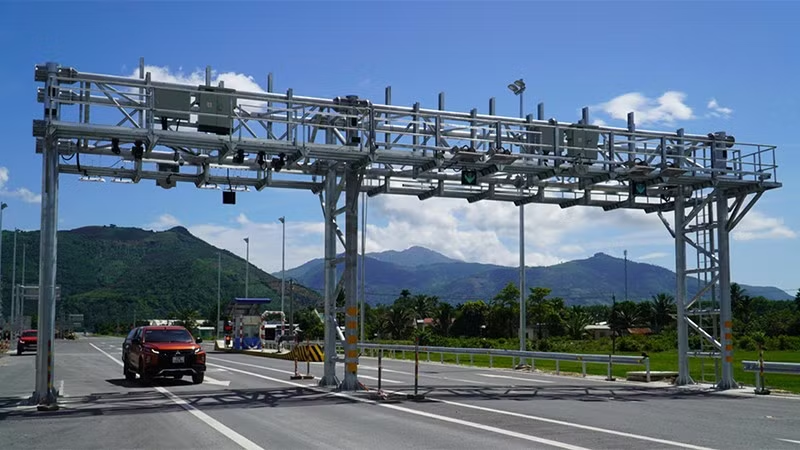
For the first time, products researched and manufactured in Vietnam have the opportunity to compete fairly and be given priority, instead of being overshadowed by imported technology.
Prioritize products Made in Vietnam
One of the new features highly appreciated by the technology business community is that the 2025 Bidding Law prioritizes products researched, developed, and technologically mastered by Vietnamese businesses. This is no longer just a slogan, but a criterion that can be stipulated directly in the bidding documents.
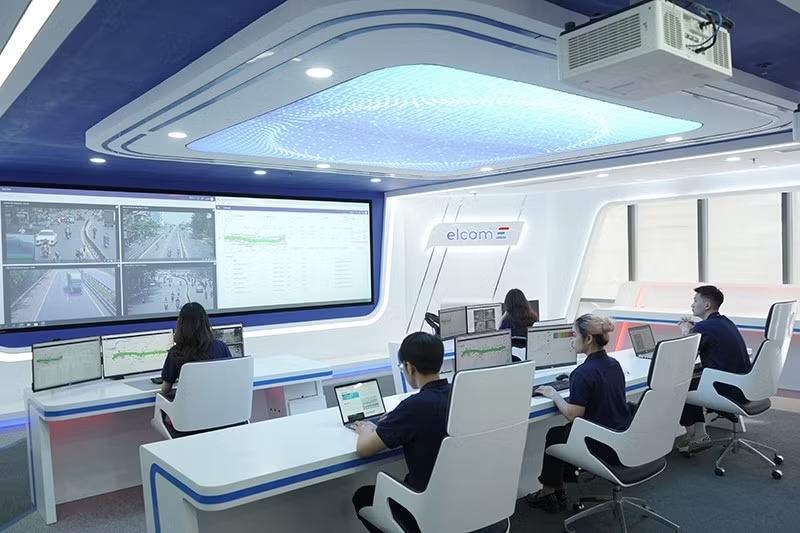
Mr. Pham Minh Thang, General Director of ELCOM Technology - Telecommunications Joint Stock Company, one of the leading enterprises in intelligent transportation solutions and products, shared: Previously, many ITS (intelligent transportation systems) projects in Vietnam were forced to purchase equipment and software from abroad at very high prices, without mastering the technology. He cited an example: “About 10 years ago, the ITS packages on the Hanoi -Hai Phong and Ho Chi Minh City-Long Thanh-Dau Giay expressways had to be imported from South Korea and Japan, which were very good and high-quality systems at the time. If we were to implement the same type of package now, domestic businesses could design and manufacture it entirely themselves, with superior quality and features, and at a lower cost. Especially with the ability to fully master the latest technologies and the strong support of domestic businesses throughout the entire usage process (including many years after the warranty), the efficiency in terms of use and investment is clearly visible, giving investors peace of mind.”
That is precisely the value of "Made in Vietnam" products, which are increasingly establishing their position in the market. A prime example is the multi-lane, barrier-free automatic toll collection system – the first of its kind in Vietnam, applied on the Nha Trang-Cam Lam expressway as part of the ELCOM ITS ecosystem. This technology completely eliminates partitions, cabins, and barriers, saving space and manpower while allowing vehicles to travel at speeds up to 120 km/h while the system accurately scans the toll card and deducts fees, instead of having to reduce speed to 60 km/h as before. In addition, ELCOM has developed the eWIM automatic load control system, capable of handling 100% of overloaded vehicles 24/7 with the accuracy to directly issue penalties according to current Vietnamese regulations.
ELCOM's entire ITS ecosystem is researched and developed entirely by Vietnamese expertise, meeting both domestic and international standards, and designed to solve Vietnam's unique transportation problems. This product recently won the Gold Cup for Make in Vietnam Digital Technology Products, not only optimizing costs and suitability for domestic conditions, but more importantly, helping Vietnam break free from dependence on foreign technology.
Many experts believe that the new law doesn't just chant slogans about "supporting Vietnamese businesses," but focuses on concrete implementation mechanisms. Investors are allowed to set detailed technical criteria, tailored to specific fields such as intelligent transportation, artificial intelligence, and cybersecurity, to select truly capable contractors. At the same time, the law requires contractors to demonstrate their capabilities on-site, not just through theoretical documentation.
Lawyer Nguyen Anh Tuan, Director of Dai Nam Law Firm, assessed that one of the most important changes in this revised Bidding Law is allowing the evaluation of contractor capacity not only through technical documents, but also through the ability to test, accept, and verify products under real-world conditions – something the old law did not clearly facilitate. Accordingly, for high-tech bidding packages, the investor has the right to require the contractor to conduct equipment testing, demonstrating stability, accuracy, processing speed, and compatibility with existing systems. This aims to protect investors from the risk of purchasing technology "on paper" only to find out later that they were "ripped off" after operation – a common situation in the past.
Instead of simply approving PowerPoint presentations and promises of "breakthrough technology," devices like traffic cameras and intelligent operating software are now required to operate, record real data, and verify for errors, latency, and stability before being accepted. A small technical change, but a significant qualitative improvement.
Constructivist thinking: Empowering, supporting, and controlling.
The 2025 Bidding Law adds a series of groundbreaking regulations, especially in the high-tech sector – a field previously considered "off-field" for Vietnamese businesses. The most notable feature of this law is the first-ever clear legal definition of a high-tech bidding package, instead of merely referring to the 2008 High-Tech Law. A high-tech bidding package is defined as having a significant research and development content, not being widely available on the market, possessing innovative qualities, and having the potential to strongly impact productivity, national security and defense, or national digital transformation.
This not only changes the concept but also opens up a new mechanism: allowing direct contracting or limited bidding for high-tech projects when the technological exclusivity, urgency, or confidentiality requirements can be proven. Mr. Tran Quang Tuyen, Deputy General Director of Van Cuong Company, stated: “This is truly a shift in thinking: empowering investors to make deeper decisions, but also holding them directly responsible for the quality and effectiveness of the project. Investors will no longer be ‘confined,’ no longer afraid of making mistakes or being accused of collusion, thus preventing them from choosing truly suitable contractors.”
A particularly noteworthy innovation of the 2025 Bidding Law is that, for the first time, it allows for the calculation of the overall value of a technology product, instead of just looking at the lowest winning bid price. This regulation is especially important for equipment that must operate for a long time, requiring durability, stability, and upgradeability, to avoid the situation where something is cheap but ends up being expensive.
According to Mr. Pham Minh Thang, the new Bidding Law mandates a different approach than before. Simply importing foreign technology, assembling it, and then bidding on projects is no longer acceptable. Winning a bid is only the beginning; what's important is effective implementation in practice and ongoing support (operational assistance, troubleshooting, software modifications, etc.). Low-cost equipment that fails during the warranty period or has poor quality is still more expensive than higher-priced equipment that remains stable for many years after the warranty expires. The investment efficiency and long-term value for the people must be considered. When bidding, the mindset should be to choose high-quality technology to move towards new standards and select the best solutions to build a foundation for even greater achievements.
General Secretary To Lam also warned about the consequences of a bidding mindset that focuses solely on low prices: "Science projects bid on for the cheapest price will only bring in outdated technology. If we only chase low prices while ignoring quality and the ability to master technology, Vietnam risks falling behind and becoming a 'technological dumping ground.' This is also a strong reminder that the criteria for selecting contractors must be linked to the spirit of Resolution 57 NQ/TW on breakthroughs in the development of science, technology, innovation, and national digital transformation."
The new law also opens up an "open-ended requirements" approach, giving investors the right to allow contractors to propose innovative solutions, even organizing practical demonstrations such as "vehicle testing." This not only helps in selecting the right technology that best suits practical conditions, but also creates opportunities for contractors to demonstrate their true capabilities and overcome procedural and paperwork barriers.
According to Ms. Vu Quynh Le, Deputy Director of the Procurement Management Department (Ministry of Finance), the new law shifts from a pre-approval to a post-approval mechanism, creating conditions for entities to be more autonomous. Forms of direct contracting and limited bidding are expanded to include specific cases such as high technology, but must still be accompanied by post-approval supervision to prevent abuse.
National Assembly representative Nguyen Ngoc Son also highly appreciated this shift. According to him, the Law has "added many preferential policies and priorities for science and technology enterprises," such as waiving the requirement to prove financial capacity for innovative enterprises, startups, and high-tech centers. This helps remove barriers for young enterprises with great technological potential - a necessary step to promote the strong and sustainable development of Vietnam's innovation ecosystem.
Source: https://nhandan.vn/coi-troi-cho-cong-nghe-make-in-vietnam-post895789.html

























![[Video] Weather forecast for tonight and tomorrow, May 25, 2026: Widespread heatwave intensifies in Northern and Central Vietnam.](https://vphoto.vietnam.vn/thumb/402x226/vietnam/resource/IMAGE/2026/05/24/1779627756334_thumb-dem-png.webp)





































































Comment (0)