

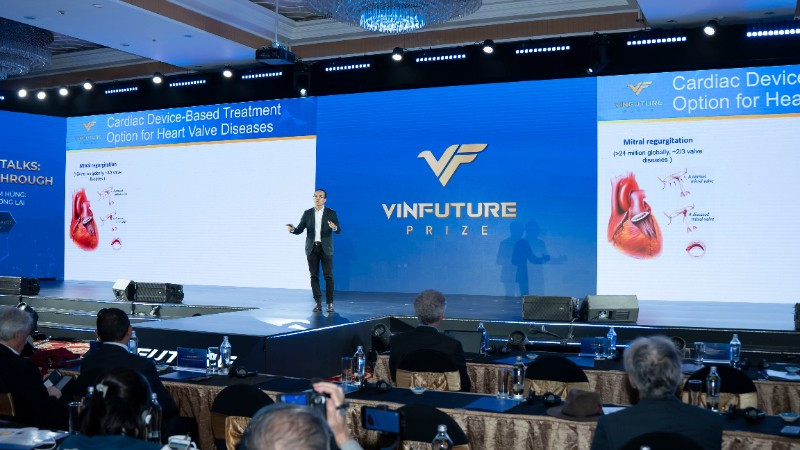
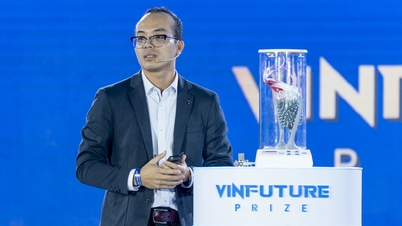
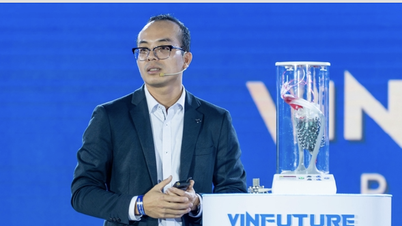
Associate Professor Do Thanh Nho, University of New South Wales (Australia) introduces the artificial heart.
On the morning of December 2, the inspirational speech: "Breakthrough technology of the future" opened the VinFuture Science and Technology Week 2025. Four stories, four directions, converged in a common message: When science is guided by compassion, every invention becomes a bridge between knowledge, life and the future of humanity.
Soft artificial heart and opportunity for patients waiting for heart transplant
Cardiovascular diseases such as heart valve disease, heart failure and stroke are a constant threat to health, claiming more than 20 million lives each year and accounting for nearly 32% of all deaths worldwide.
Associate Professor Do Thanh Nho, University of New South Wales (Australia) shared that it is predicted that there will be about 729.5 million people, an increase of 109% in cardiovascular disease cases by 2050 compared to 2025. In Vietnam, approximately 33% of deaths, 1.6 million people are living with heart failure and the trend is increasing. Of the approximately 24 million cases of cardiovascular disease worldwide, 2/3 are heart valve disease. This is a problem for the health sector in treatment.
Although complex surgical interventions using cardiovascular devices currently play a central role in the treatment of these diseases, patient selection is often based on static images, medical history or simulation, leading to inaccurate assessment, suboptimal treatment planning and increased risk of postoperative complications.
Creating a device outside the body is a clinical challenge for the medical community.
In the sharing about the “soft beating artificial heart” designed specifically for each patient, which can accurately reproduce the movement, pressure and blood flow of a real heart, Associate Professor Do Thanh Nho, University of New South Wales (Australia) shared that this heart will help doctors find the right patients, conduct new cardiovascular device tests, rehearse complex surgeries and identify risks before entering the operating room, thereby significantly improving the safety and success rate in disease treatment.
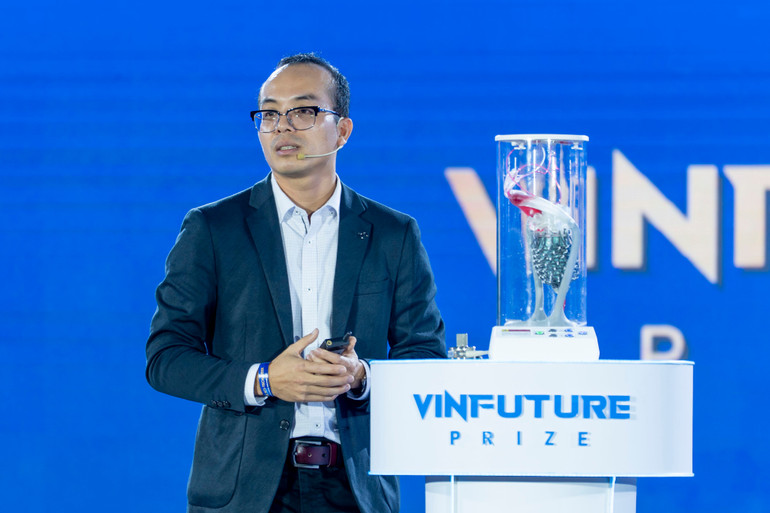
Associate Professor Do Thanh Nho, University of New South Wales (Australia) introduces the artificial heart.
The presentation also mentioned collaboration opportunities to develop smarter and safer “soft robot hearts.”
"Soft heart is a solution for people waiting for a heart transplant. This product brings new hope to heart patients. More than 42,000 patients have been implanted with HeartMate 3 LVAD, but in Vietnam only one case has been used," Associate Professor Nho said.
According to the author, this product is not too expensive because the 3D model is made of common materials, the technology uses MRI, SCAN to describe the human heart and then create a 3D heart model. In the future, it is necessary to coordinate interdisciplinary with robotics, imaging, medicine... to join hands to test artificial soft hearts, aiming for reasonable costs with this technology.
Soft robots and the opportunity to restore mobility for patients
A stroke can rob sufferers of the ability to hold hands, eat, or express love. But what if technology could help the brain heal itself, even when doctors say the recovery process is over?
In his presentation, Professor Raymond Tong, Chinese University of Hong Kong (China) shared his journey from an engineer to an inventor, first announcing his work “Hand of Hope”, a robotic exoskeleton that can “read” the patient’s movement intentions and help them move again, retraining the brain through action.
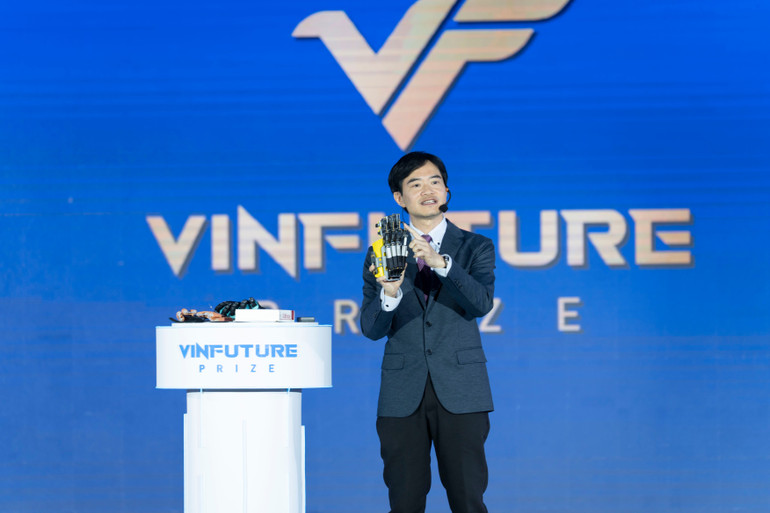
Professor Raymond Tong, Chinese University of Hong Kong (China).
This expert said that 20 years ago, he started researching the brain, nerve signals, after a stroke cells lose function. He discovered: "Our brain is currently only using 10% of its capacity, so what about the remaining 90%? In case something bad happens, spare cells will help restore function?"
Through MRI scans and many methods, this expert found that in the brain, when wanting to move the hand, the hand robot must connect the movement with nerve signals. Compared to the group that only practiced hand movements to be more flexible, practicing connecting movement with nerve signals showed more effectiveness.
In addition, there is a requirement to improve from lighter and more flexible hand robots, then ankle robots, walking braces, etc. to apply research to create other rehabilitation products.
He also introduced XoMuscle, the most powerful muscle that combines the brain with a computer. Practical results show that more than 300 patients, both elderly and children, have been effectively assisted.
"Initially we used EMG signals from the muscles, later connecting them to the machine was more effective. At first, 10% of patients recovered with the help of robots, but now it's up to 80%. We work together to support children with cerebral palsy. We use artificial muscles to synchronize movements and postures so the baby can learn to walk. After 15 practice sessions, the baby stood up without the robot. Everyone said it was impossible, but it happened. We have now deployed this technology in Australia for children with cerebral palsy," Professor Raymond Tong said excitedly.
Through practical technology demonstrations and stories from patients, Professor Tong leads people to a future where science and technology not only create machines but also recreate human life.
According to Professor Tong, this technology has been widely applied to people with strokes, the elderly, people with cardiovascular disease, cases of brain injury and some cases of using prosthetic limbs using brain signals to control prosthetic limbs.
“Although many people said it would not be possible, with the faith and courage of the patients, we did it. We want many people to know about our solution. I have been to Vinmec, in a few days I will go to Hanoi Medical University Hospital,” he said.
According to this expert, the most important thing is to change the mindset and awareness of rehabilitation doctors so that patients will have access to this technology.
Artificial Intelligence and the Journey of Community Service
At the inspirational lecture, Professor Ho-Young Kim, Seoul National University (Korea) with his speech "Spontaneous Physical Intelligence" brought a completely new model in the field of robotics, in which matter is the agent that takes on the role of calculation, not silicon microchips, making intelligence manifest right in the form and materials of robots.
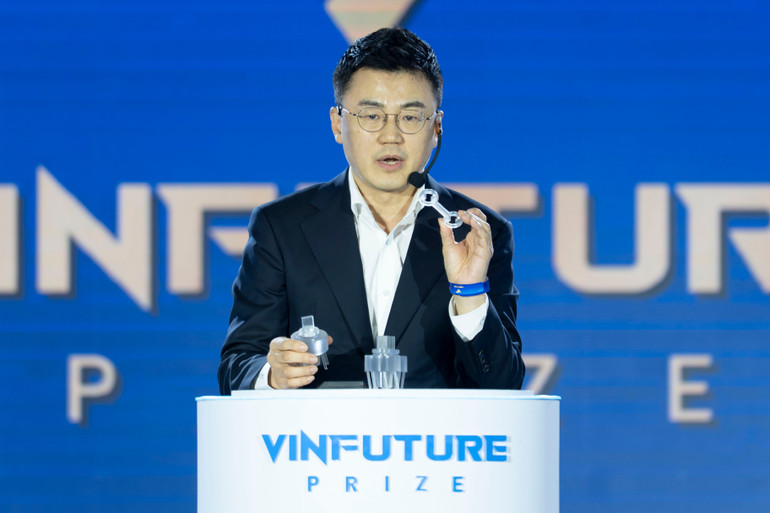
Professor Ho-Young Kim, Seoul National University (Korea) with his speech "Spontaneous Physical Intelligence" brings a completely new model in the field of robotics.
In his presentation, Professor Kim introduced artificial systems developed in his lab – where “intelligent behaviors” are formed entirely thanks to physical interactions between robots and their surrounding environment.
At the presentation, Mr. Nguyen Do Dung, CEO of Enfarm (Vietnam) shared how artificial intelligence (AI) is transforming agriculture into a regenerative subject for the earth. Through two innovative SaaS platforms - Enfarm App and Enfarm FM - the company has created opportunities for both farmers and businesses to make smarter, more sustainable choices.
"The Enfarm App helps smallholder farmers monitor soil health, optimize fertilizer use, and improve productivity with personalized AI recommendations, increasing yields by up to 30% while also reducing fertilizer use by up to 30%. This not only reduces costs and emissions, but also helps farmers meet sustainability standards, earning certifications through fair trade and responsible production," said Dung.
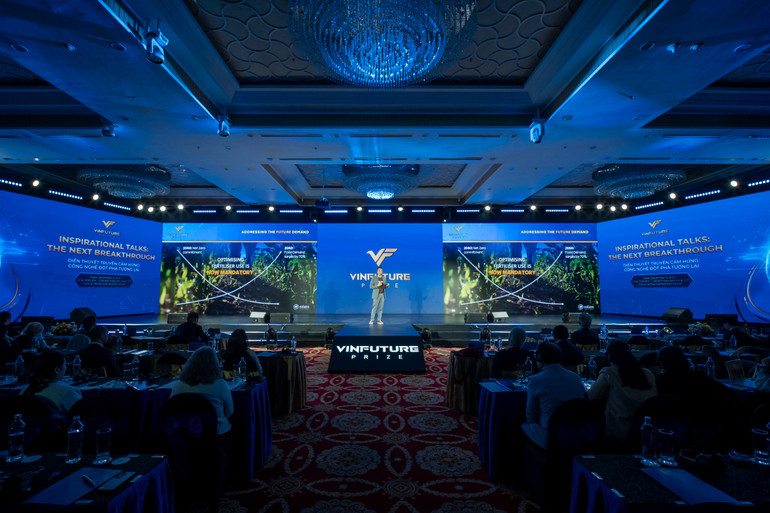
Mr. Nguyen Do Dung, CEO of Enfarm (Vietnam) shares how artificial intelligence (AI) is turning agriculture into a regenerative subject for the earth.
Enfarm FM has also provided agribusinesses with a powerful set of tools to manage their sourcing, monitor performance, and transparently report ESG metrics. By connecting data from farm to business, Enfarm is building a trusted digital ecosystem that supports climate resilience and drives regenerative growth.
With a cost of about 2 USD/month, Mr. Dung affirmed that this is a great device for farmers to have more data about the "health" of the soil and soil treatment.
The product was launched last year, more than 1,200 sensors have been installed, 70% have been sold online. 60% of customers are farmers.
Responding to the question of Professor Maria Esperanza Martinez Romero - MD Anderson Cancer Center, University of Texas (USA) about organic measurement, Mr. Nguyen Do Dung said that based on dynamic data obtained from sensors inserted in the soil, this technology can measure the concentration of nitrogen and nutrients in the soil. "We are researching and have a number of different forms, and will announce the results next year. We will expand the measurement method to measure greenhouse gas emissions to change farmers' practices," Mr. Dung said.
Compared with other products in the world, this device has competitive price, ready to serve 550 million farms in developed markets and dispersed markets (Asia, Africa), organic farms.
He also expressed his desire to have more budget resources to expand on a larger scale, selling this technology to farmers at a lower price.
THAO LE-THIEN LAM



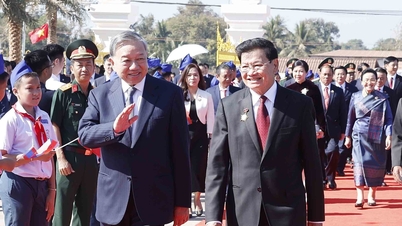
![[Photo] Parade to celebrate the 50th anniversary of Laos' National Day](/_next/image?url=https%3A%2F%2Fvphoto.vietnam.vn%2Fthumb%2F1200x675%2Fvietnam%2Fresource%2FIMAGE%2F2025%2F12%2F02%2F1764691918289_ndo_br_0-jpg.webp&w=3840&q=75)
![[Photo] Worshiping the Tuyet Son statue - a nearly 400-year-old treasure at Keo Pagoda](/_next/image?url=https%3A%2F%2Fvphoto.vietnam.vn%2Fthumb%2F1200x675%2Fvietnam%2Fresource%2FIMAGE%2F2025%2F12%2F02%2F1764679323086_ndo_br_tempimageomw0hi-4884-jpg.webp&w=3840&q=75)













![[Photo] Parade to celebrate the 50th anniversary of Laos' National Day](https://vphoto.vietnam.vn/thumb/402x226/vietnam/resource/IMAGE/2025/12/02/1764691918289_ndo_br_0-jpg.webp)
![[Video] Urgently preparing for the inauguration and groundbreaking ceremony of projects to welcome the 14th National Party Congress](https://vphoto.vietnam.vn/thumb/402x226/vietnam/resource/IMAGE/2025/12/02/1764691316170_dung00-16-00-06still005-jpg.webp)



































Comment (0)