

Tuition fees are just the 'tip of the iceberg'
When the government adjusted its tuition policy, people expected that their spending burden would be significantly reduced. However, in reality, many expenses other than tuition fees increased faster, even sharply.
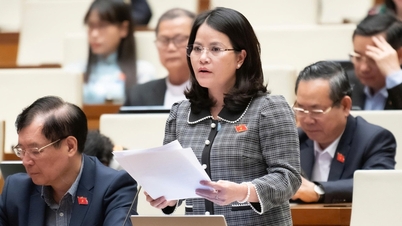
Speaking to reporters of the Vietnam Women's Newspaper, delegate Nguyen Thi Viet Nga, from the National Assembly delegation of Hai Phong city, pointed out the problem: people expect that adjusting tuition policy will significantly reduce the burden of spending. But in reality, many non-tuition revenue items have increased rapidly, even sharply. The female delegate identified three main groups of causes leading to this situation.
Firstly , the system of service fees in schools is increasingly numerous and complex. Boarding fees, 2 sessions/day, intensive English, experiential activities, life skills, assessment tests, boarding services, hygiene, electricity and water, facilities, etc. are all essential services for many families, especially in urban areas.
These are expenses that are not included in tuition fees, but the cost is much higher than the tuition fee that has been exempted or reduced. When services expand, the total cost will increase, delegate Nguyen Thi Viet Nga analyzed.
In addition, the mechanism of " educational socialization" has not been designed clearly enough. Some schools, especially in urban areas or areas with high demand, implement collection under the name of socialization such as: renovating classrooms, buying air conditioners, repairing auxiliary works, equipment... Although the purpose is to improve quality, but if it is not transparent or not suitable for people's ability to pay, it can easily lead to the situation of "free tuition but other collection fees appear" causing parents to worry.
Finally, the difference in conditions between regions creates pressure to increase costs other than tuition fees. Schools in rural and mountainous areas have more difficulty mobilizing social resources, so many expenses that should be the responsibility of the locality are 'shared' with parents. At the same time, the process of financial autonomy at some educational institutions also causes service costs to increase according to fluctuations in market prices, the female delegate expressed.
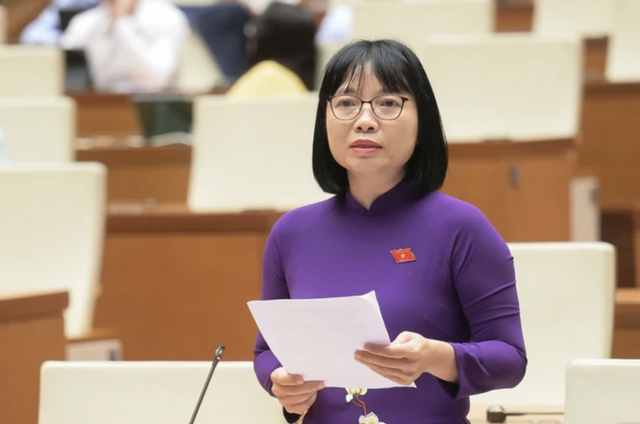
Delegate Nguyen Thi Viet Nga, Deputy Head of the National Assembly Delegation of Hai Phong City (Photo: National Assembly Media)
"It can be said that tuition fees are just the 'tip of the iceberg', while the hidden part is service expenses, supplementary expenses, experience expenses, socialized expenses... which are increasing faster and accounting for a larger proportion. Therefore, if we only focus on reducing or exempting tuition fees without strictly controlling expenses other than tuition fees, the total cost of education of the family will not decrease, and even tend to increase according to actual needs," delegate Nguyen Thi Viet Nga emphasized.
Controlling non-tuition revenue is key
Regarding the proposed scholarship policy for teachers' children to create peace of mind, reduce the burden on families, and encourage attachment, delegate Nguyen Thi Viet Nga affirmed: "If the goal is to reduce the burden on teachers and their families, the scholarship proposal needs to be placed in the overall picture of reducing educational costs, not just narrowed down to tuition fees."
Accordingly, delegate Nguyen Thi Viet Nga proposed four important groups of solutions.
Firstly , perfect the mechanism to control non-tuition fees. For many years, tuition fees are no longer the only expense. Parents still have to pay for services, facilities, boarding, etc. If these fees can be controlled, the burden on every family, including teachers, will be significantly reduced.
Second , the State needs to increase investment in general education, especially in facilities, classrooms, kitchens, and restrooms. When schools ensure minimum conditions, the need for additional fees from parents will naturally decrease.
Third , it is necessary to adjust the concept of socialization. Socialization does not mean "outsourcing" the State's responsibility to parents. Only when this activity is within a framework, on the principle of voluntariness, and does not become a burden, can it bring about positive effects.
Finally , stabilize the prices of school-related services. Especially boarding and school nutrition, the biggest expenses for millions of families. If there is a suitable subsidy mechanism or public-private procurement, these costs can be reduced significantly.
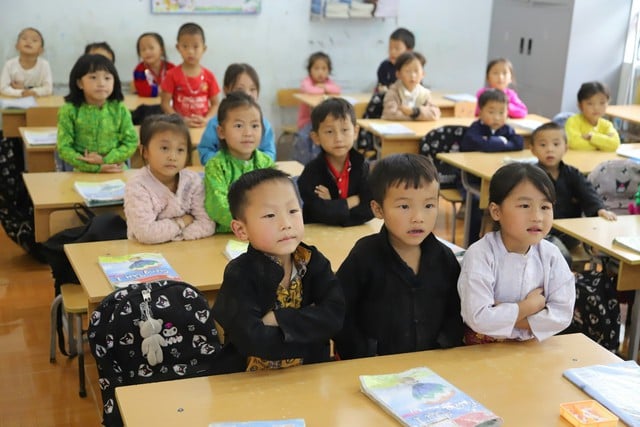
The proposal to support scholarships for teachers' children comes from the spirit of humanity and respect for the teaching staff. Photo: Hien Nguyen
Regarding the four groups of solutions above, delegate Nguyen Thi Viet Nga emphasized: We must shift from the mindset of "free tuition" to the mindset of "reducing school costs". Only when the total cost is controlled, can students' families, including teachers, truly benefit from support policies.
According to the female delegate, the proposal to support scholarships for teachers’ children comes from the spirit of humanity and respect for the teaching staff. However, no matter how good the policy is, it needs to consider fairness, reasonableness and suitability with budget conditions.
Source: https://phunuvietnam.vn/dai-bieu-quoc-hoi-mien-hoc-phi-nhung-nhieu-khoan-chi-phi-khac-tang-nhanh-tang-manh-23825120814404557.htm



![[Photo] Urgently help people soon have a place to live and stabilize their lives](/_next/image?url=https%3A%2F%2Fvphoto.vietnam.vn%2Fthumb%2F1200x675%2Fvietnam%2Fresource%2FIMAGE%2F2025%2F12%2F09%2F1765248230297_c-jpg.webp&w=3840&q=75)












































![[Photo] General Secretary To Lam works with the Standing Committees of the 14th Party Congress Subcommittees](https://vphoto.vietnam.vn/thumb/402x226/vietnam/resource/IMAGE/2025/12/09/1765265023554_image.jpeg)
























Comment (0)