

In caring for social security, our Party and State always identify “settling down” as the foundation for people to “settle down”. However, in reality, thousands of poor households in the localities face great obstacles when they lack money, stable jobs and land. For them, poverty has hit rock bottom, and their lives have nothing to do with themselves.
Meanwhile, most programs to support solidarity houses and charity houses require beneficiaries to have land or be guaranteed legal housing. So what should poor households with no land do? This seemingly deadlocked problem has found a solution from a creative approach in Long Xuyen City (before the merger). That is, using public land funds to build adjacent housing areas for poor and near-poor households without land.
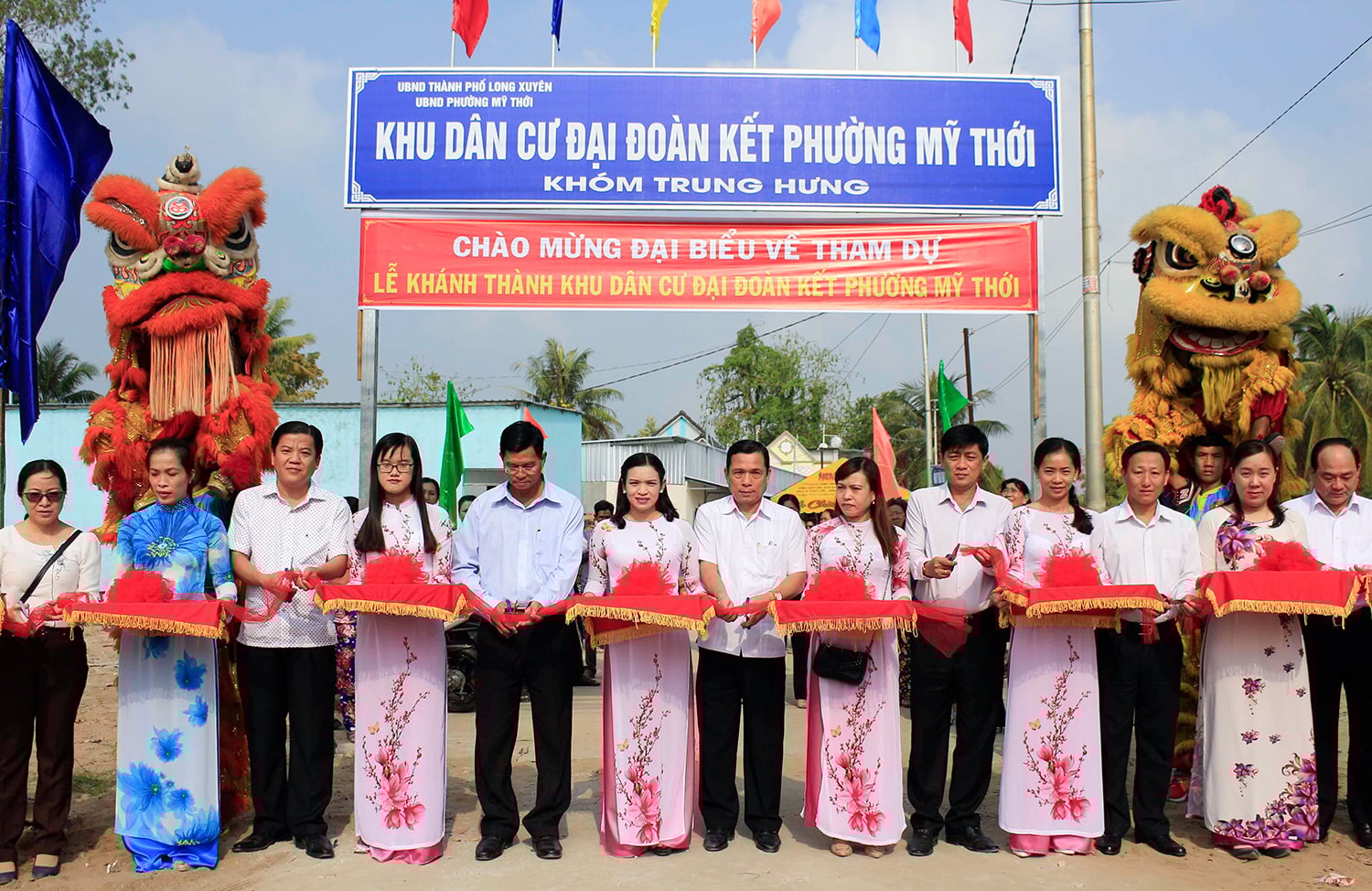
Inauguration ceremony of My Thoi ward great unity residential area in 2020. Photo: GIA KHÁNH
Mr. Nguyen Thanh Quang - Vice Chairman of Long Xuyen Ward People's Committee (former Chairman of Vietnam Fatherland Front Committee of Long Xuyen City before the merger) recalled that before 2016, Long Xuyen City had more than 1,500 poor households and nearly 2,800 near-poor households. Among them, many families lived temporarily on borrowed land, rented land or dilapidated rented rooms. Many people worked for hire all their lives, their assets were only a few sets of clothes, a few household items, and they did not have a "piece of land to settle down".
Although there is funding from socialization, the Fatherland Front and local organizations really want to support, but because poor households do not have legal land, the house building procedures cannot be implemented. The government and philanthropists all regret having to refuse cases of households that are really in difficulty with housing. These concerns require a way to do things beyond the usual framework, so that they are not left behind.
“This is an unprecedented policy, because public land is often used for public works, infrastructure or urban development goals. However, with high political determination, the City Party Committee and People's Committee discussed and agreed to implement it with the viewpoint: Public land must serve the common interest, in which social security is the top priority. The policy quickly received strong consensus throughout the political system.
Specialized departments and offices started to implement. The Department of Natural Resources and Environment is responsible for converting public land from agricultural land to residential land. The Urban Management Department designs residential areas, determines appropriate land area standards, and ensures minimum infrastructure. The People's Committees of wards and communes review public land funds and coordinate site clearance. The Vietnam Fatherland Front Committee of the city plays a key role: reviewing poor households, making public lists, mobilizing socialized housing construction, and supervising construction," Mr. Nguyen Thanh Quang informed.
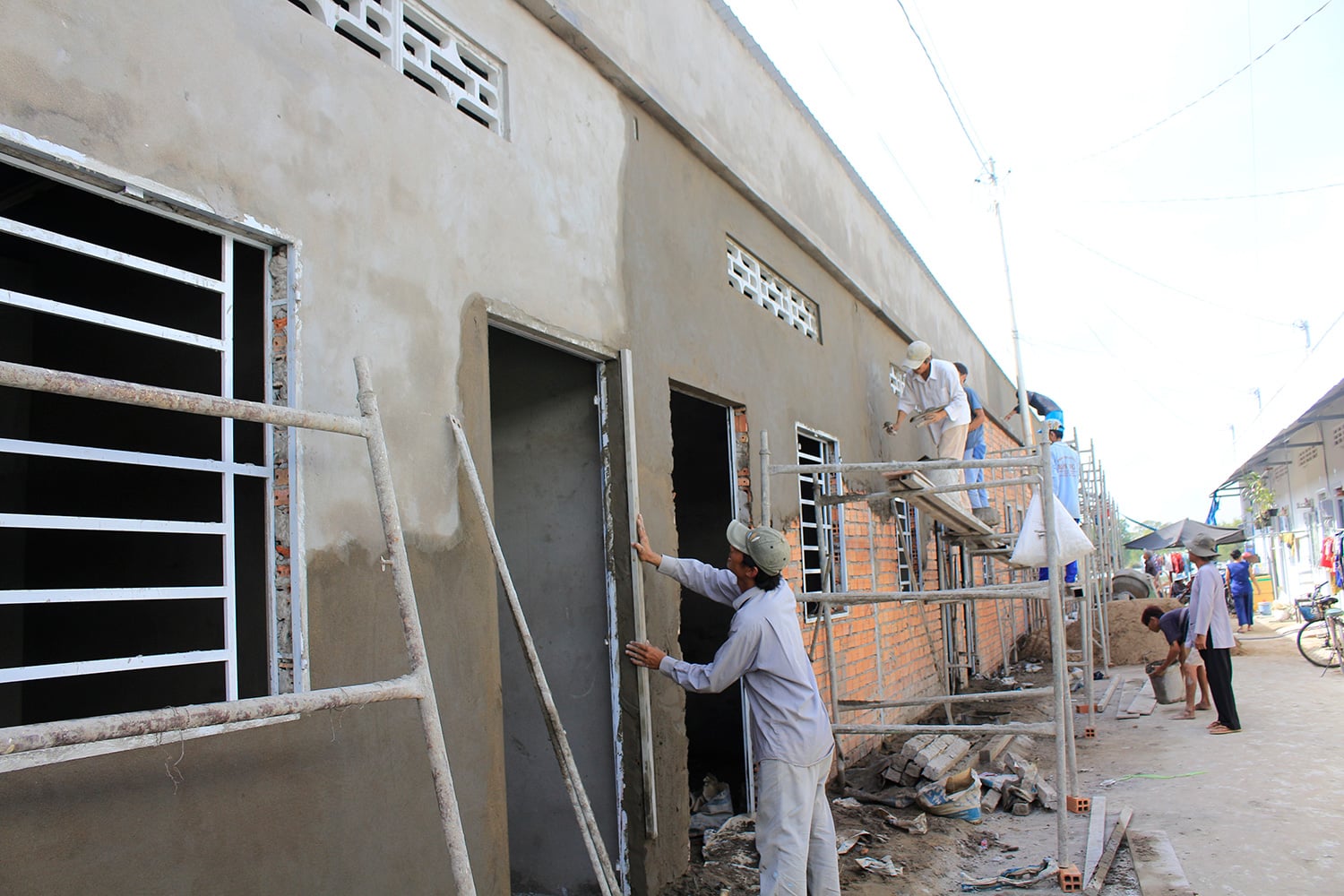
The adjacent houses were solidly built, with the cooperation of many organizations and individuals. Photo: GIA KHÁNH
Strong determination turns ideas into "visible and tangible" housing areas. A series of solidarity residential areas for poor and near-poor households without land are built in the style of townhouses, appearing in all wards and communes in the area. Each house is built according to the common criteria of "4 hard": Brick floor, walls, prefabricated frame, corrugated iron roof, area from 36 - 40m2. From mid-2016 to 2018, the locality built 18 solidarity residential areas, arranging for 396 poor, near-poor and extremely disadvantaged households without land to settle down, with a total cost of over 46 billion VND.
In addition to the State budget supporting the leveling of the land and drainage system of over 16 billion VND, the housing areas contain the solidarity of many units and enterprises for people in difficult circumstances. Typically, Song Hong Limited Liability Company supported the construction of the first two residential areas in My Khanh commune (now Binh Duc ward) and My Hoa ward (now Long Xuyen ward), with 50 houses.
An Giang Lottery One Member Limited Liability Company supported the construction of My Hoa Hung commune residential area with 23 houses, My Thanh ward residential area (now My Thoi ward) with 10 houses, My Phuoc ward residential area (now Long Xuyen ward) with 11 houses, Lo Bun residential area, My Thoi ward with 8 houses. The Central Committee of the Vietnam Fatherland Front supported the My Hoa extended residential area with 10 houses.
An Giang Stone Exploitation and Processing One Member Limited Liability Company supported the construction of 10-unit My Thanh residential area. Tan Thang Investment - Construction - Trading Joint Stock Company supported 42 units in many areas...
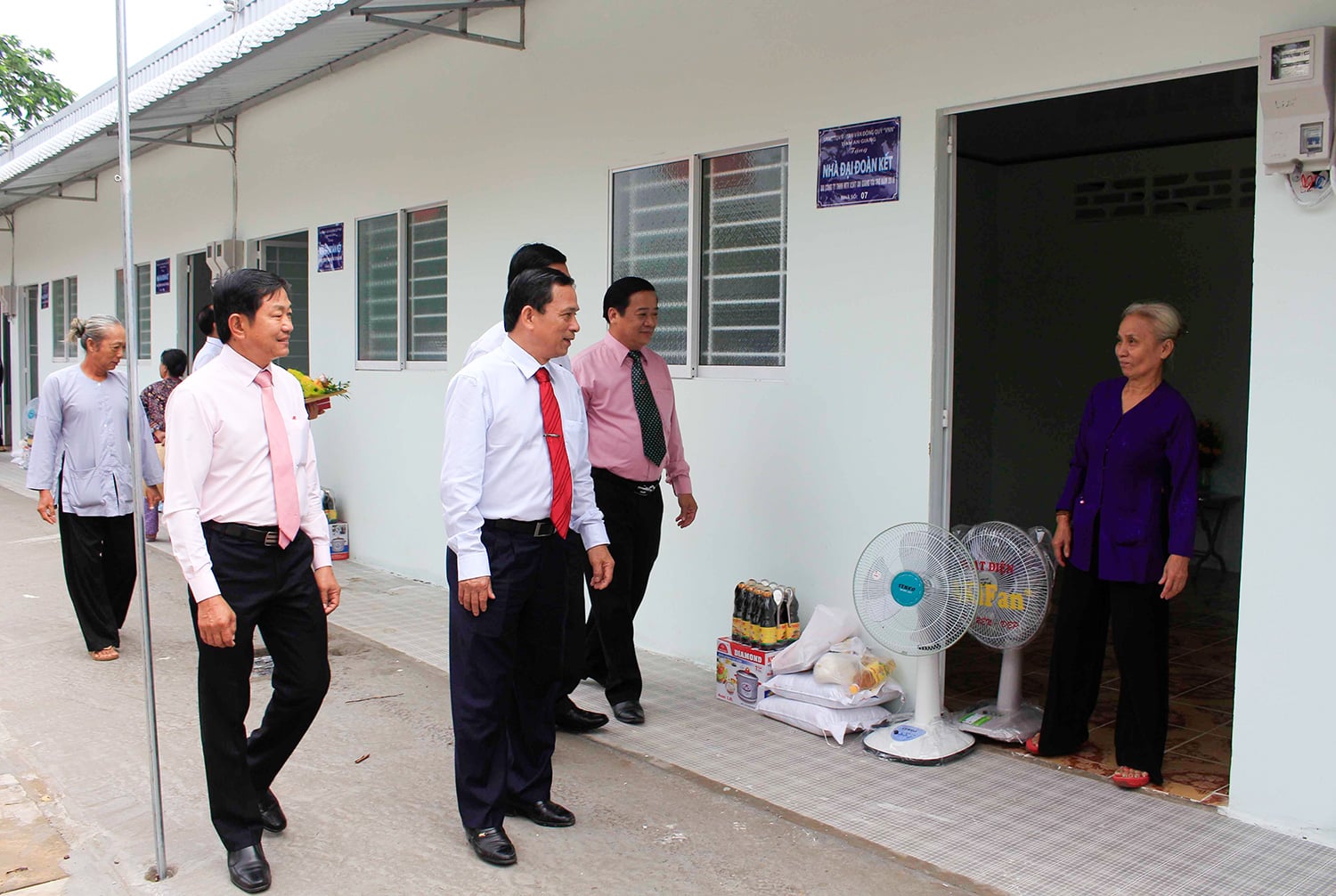
Local leaders visited and inquired about the lives of households that were assigned to solidarity houses. Photo: GIA KHÁNH
In August 2018, attending the inauguration ceremony of the My Hoa Great Unity residential area, learning about this model, and listening to the list of over 20 units and individuals from the Central to the local level contributing to the construction of the housing area, Secretary of the Party Central Committee, Chairman of the Central Committee of the Vietnam Fatherland Front Tran Thanh Man (now Chairman of the National Assembly) praised: "The policy of using public land to build houses for poor households is a creative, humane and effective step, in line with the sustainable development orientation of the Party and the State". The model from Long Xuyen proves: Just put the interests of the people first, dare to think, dare to do, then things that seem impossible can become reality. And those housing areas are truly imbued with the spirit of great unity, which can be replicated in many places.
After that, the public land fund of Long Xuyen urban area gradually narrowed, unable to continue the model. However, this is an important premise for the locality to actively respond to the Central Government's policy of "Eliminating temporary and dilapidated houses". In 2025, the locality mobilized resources to build new houses and repair 60 houses, with a total cost of more than 4.3 billion VND.
“This is the first locality in the province to announce the completion of the program to eliminate temporary and dilapidated houses, “finishing” 3 months earlier than the province’s plan, 9 months earlier than the central plan, the provincial leaders are very impressed,” Mr. Le Van Nung - former Standing Deputy Secretary of the Provincial Party Committee, Chairman of the People’s Council of An Giang province (old) affirmed.
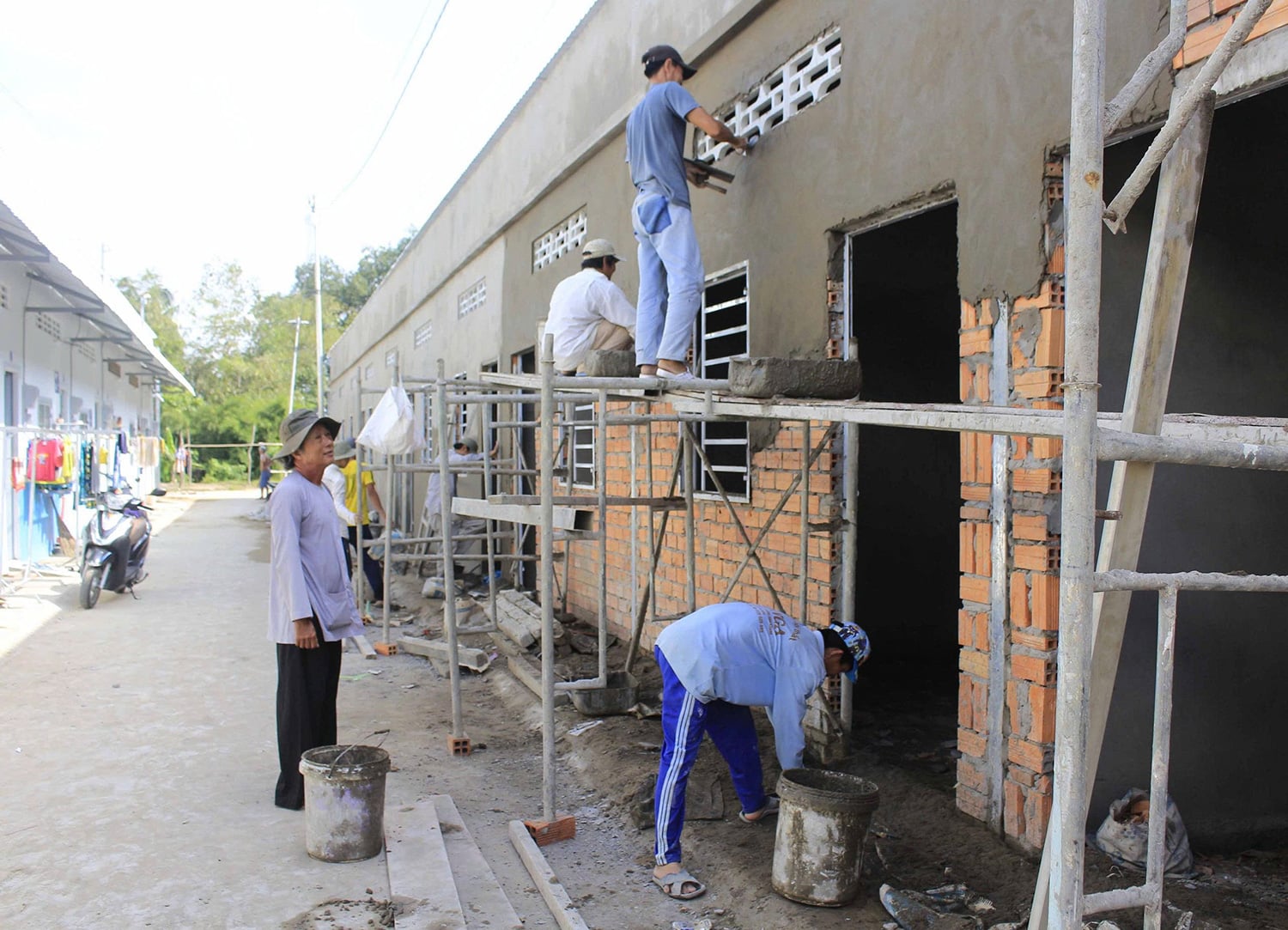
Construction team of Hoa Hao Buddhist Sangha Executive Committee participates in building housing areas in Long Xuyen ward. Photo: GIA KHÁNH
Long Xuyen's approach inspired An Phu district (before the merger). In 2022, the locality mobilized resources to build a solidarity housing area of 50 adjacent houses. Each house has a construction area of 39m2 , reinforced concrete foundation and columns, brick walls, corrugated iron roof, and a construction cost of 96 million VND/house.
The total investment cost for the construction of the housing area is more than 6.9 billion VND from the province's support and socialization. "Riding on the victory", by mid-2025, the entire An Phu district will have built 8 adjacent solidarity housing areas, making the dream of settling down for more than 200 households come true.
The hundreds of houses and dozens of solidarity residential areas that have been continuously built over the past years demonstrate the strong determination of the entire political system of An Giang province, and at the same time affirm the profound humanistic value of the policy of "using public land to care for the poor". Each house and apartment handed over is the result of a correct policy, opening up a journey to change the lives of many families.
(To be continued)
Source: https://baoangiang.com.vn/dai-doan-ket-tren-quy-dat-cong-bai-1-nhung-khu-nha-di-truoc-chu-truong--a469526.html





![[Photo] Urgently help people soon have a place to live and stabilize their lives](/_next/image?url=https%3A%2F%2Fvphoto.vietnam.vn%2Fthumb%2F1200x675%2Fvietnam%2Fresource%2FIMAGE%2F2025%2F12%2F09%2F1765248230297_c-jpg.webp&w=3840&q=75)







































![[Photo] General Secretary To Lam works with the Standing Committees of the 14th Party Congress Subcommittees](https://vphoto.vietnam.vn/thumb/402x226/vietnam/resource/IMAGE/2025/12/09/1765265023554_image.jpeg)





















Comment (0)