


From the lecture hall to the nation's intellectual hub.
One hundred and twenty years ago, the University of Indochina was founded, laying the foundation for modern higher education in Vietnam. But at its anniversary celebration, the story that resonated most was the university's future path in a new phase of national development.
Dr. Nguyen Thanh Long, Chairman of the School Council of the Academy of Policy and Development, believes that Vietnam is entering a very fundamental shift in its growth model. This is a shift from an economy based on capital and cheap labor to an economy based on productivity, innovation, and science and technology. As the development model changes, the role of universities also begins to change accordingly.
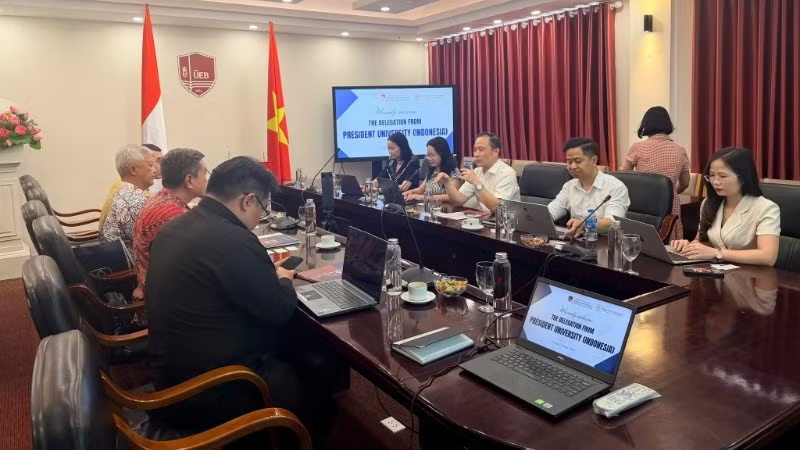
Years ago, universities were often seen as simply providing manpower for the labor market. But as AI, semiconductors, core technologies, and data increasingly determine the competitiveness of the economy, universities are also being drawn closer to the country's development challenges. Dr. Vu Thanh Huong, Head of the Department of International Economics and Business at the University of Economics (Vietnam National University, Hanoi), argues that universities today need to be seen as centers of knowledge, where they can play the role of a "think tank" (strategic and policy advisor) for national development. According to her, after many years, this role is being emphasized more clearly, linked to the need for policy planning, forecasting, critical analysis, and providing scientific arguments.
This change also stems from the rapid pace of technological advancement. AI is transforming the structure of employment globally. Chu Duc Trinh, Rector of the University of Technology (Vietnam National University, Hanoi), shared: “The more established the formula in an industry, the easier it is to be replaced.” Therefore, the story isn't just about vocational training. It relates to each country's position in the rapidly evolving knowledge-based economy. Vietnam's push to improve semiconductor or STEM training now carries a different meaning than before.
It's a competition based on the quality of human resources, technological expertise, and the ability to master knowledge. “For example, semiconductors are an extremely open industry… but also an extremely closed one. It's only open to the most talented people,” said Dr. Chu Duc Trinh. And semiconductors aren't just a story for one particular field of study. When talking about the semiconductor industry… we must talk about a semiconductor industry ecosystem. Within that ecosystem are businesses, laboratories, research groups, foundational technologies, and universities. The place that trains engineers is also the place that fosters research and innovation capabilities for the future.
Perhaps that is why General Secretary and President To Lam mentioned a noteworthy requirement: "Universities must become 'repositories of wisdom' that the State can turn to when it needs scientific arguments for strategic decisions"...
Knowledge must be integrated into economic life.
The "brain bank" that General Secretary and President To Lam referred to not only suggests the expectation of a university that can generate knowledge, data, critical thinking, or ideas for future development. Along with that, there is another requirement: university knowledge must be able to enter economic life, reach businesses and markets. "University knowledge cannot remain confined to lecture halls, laboratories, or scientific publications," General Secretary and President To Lam emphasized.
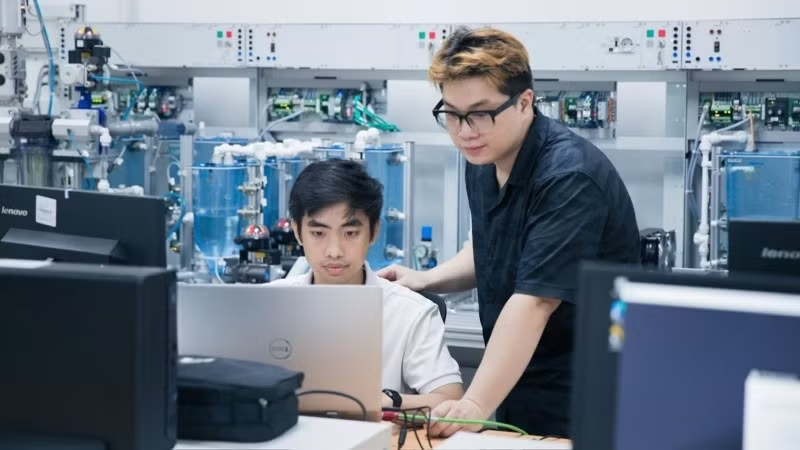
This is also a trend that has been occurring in many universities in recent years. Entrepreneurship, innovation, and technology transfer are becoming more prevalent. But what is noteworthy is that universities are starting to pay more attention to the journey of a research project beyond the lab: who invests, who applies the results, and how to get it to market.
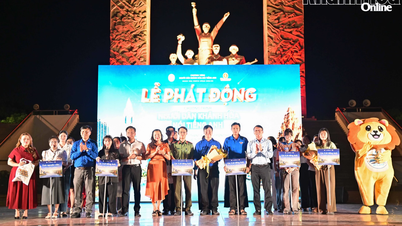
At the Vietnam National University, Hanoi's Innovation and Entrepreneurship Day (VNU Venture Day), alongside student groups showcasing their products, there was also the presence of investment funds, technology companies, expert mentors, and research groups within the university.
Dr. Truong Ngoc Kiem, Director of the Center for Knowledge Transfer and Entrepreneurship Support at Hanoi National University, calls this a place where "scientific research, startup ideas, and investment capital meet." This way of speaking partly reflects a shift in the mindset of universities. Many schools are now beginning to view scientific research as a source of technology that can be further developed into products, businesses, or applied solutions.
Ms. Kim Ngoc Yen, representative of the Sunwah Innovations Foundation, stated that the biggest challenge today is "how to get from the lab to the market." This gap has existed for quite some time in Vietnamese higher education. Many research projects stop at the acceptance stage. Some research is academically sound but struggles to progress to commercial products.
Perhaps that's why, as universities begin talking more about startups, incubators, or innovation hubs, there's also greater pressure behind it: knowledge must create real value for the economy. Dr. Nguyen Thanh Long argues that universities now need to become a "strategic bridge between knowledge and practice."
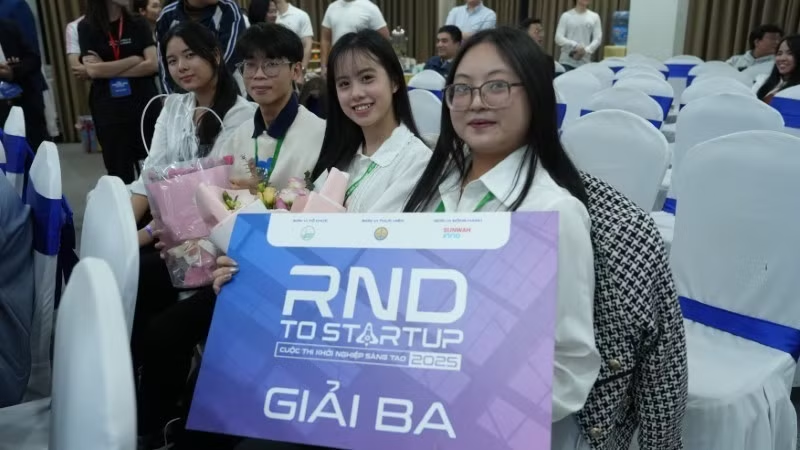
Some projects showcased at VNU Venture Day also partly reflect this shift. Behind the technology products are quite specific problems of the digital economy and green transformation. Many universities are now inviting businesses to participate earlier in the training, research, and development of technology, instead of just waiting to recruit students after graduation.
Businesses are also beginning to view universities in a different light: as places that can generate technology, solutions, and long-term innovation. Perhaps that's why, in recent years, concepts like innovation gateway, startup university, or innovation university have become increasingly common in higher education institutions in Vietnam.
A new competition for knowledge.
Along with stories about technology, markets, and innovation, Vietnamese universities have also begun to compete in recent years based on knowledge, talent, and influence. Perhaps this is why General Secretary and President To Lam mentioned the need for higher education to "contribute to strongly spreading Vietnam's soft power." This framing of the issue suggests a broader role for universities in the current era.
A few years ago, when discussing educational integration, people often thought more about student exchanges, joint training programs, or academic cooperation, but now, the story is different. University quality, research capacity, and the ability to attract talent are gradually becoming part of a nation's standing.
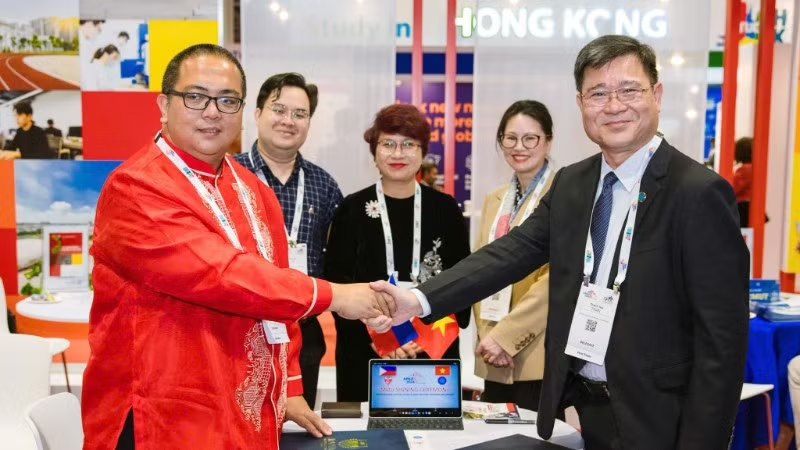
Associate Professor, Dr. Nguyen Thu Thuy - Director of the Department of International Cooperation, Ministry of Education and Training, believes that Vietnamese higher education no longer participates in international events with the mindset of an "observer," but has affirmed its position as a powerful strategic partner in the region. Along with educational integration, the concept of "educational diplomacy" is also being mentioned more frequently.
Behind the narrative of international integration and cooperation lies an increasingly evident competition for talent and knowledge. Universities now compete not only in student recruitment, but also in faculty, scientists, laboratories, international publications, and research capacity. Dr. Chu Duc Trinh argues that talent is vital in high-tech fields such as AI or semiconductors, and the competition for human resources is fierce. Universities must compete directly with technology companies to retain talented individuals, build research teams, and create an attractive academic environment.
That is also why many universities are now talking more about international standards, research universities, English-language programs, or global cooperation networks. Dr. Nguyen Thanh Long believes that Vietnamese higher education is facing the need to "shift from a model of 'training for the domestic market' to a 'global university' model."
The story isn't about increasing the number of international joint programs or attracting foreign students. It's about the ability to participate in global knowledge networks, create impactful research, and gradually establish Vietnam's academic position on the world map of higher education.
Source: https://nhandan.vn/dai-hoc-truc-su-menh-moi-cua-dat-nuoc-post962747.html













![[Video] Weather forecast for tonight and tomorrow, May 25, 2026: Widespread heatwave intensifies in Northern and Central Vietnam.](https://vphoto.vietnam.vn/thumb/402x226/vietnam/resource/IMAGE/2026/05/24/1779627756334_thumb-dem-png.webp)



































































Comment (0)