

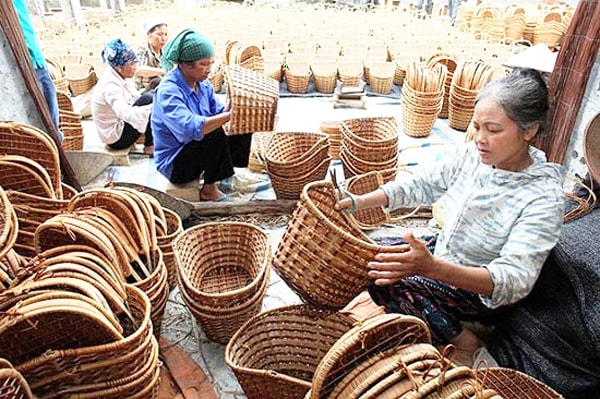
The concerns of Hanoi's traditional craft villages.
Artisan Nguyen Phuong Quang, Director of Viet Quang Bamboo and Rattan Weaving Company Limited (Phu Nghia commune), said: “Handicraft work requires not only skillful hands but also perseverance and persistence. However, the average income only fluctuates around 6-8 million VND/person/month and depends on orders, so it's not stable. At my workshop, the youngest person is already over 40 years old.”
This situation is also occurring in Ha Thai lacquerware village (Hong Van commune). Artisan Vu Huy Men said: "Young people often want high income right from the start of the profession, while lacquerware requires nurturing a long-term passion. Not to mention, traditional products need to be competitive with cheap industrial products, so fewer and fewer young people are pursuing the profession."
Similarly, in the Van Phuc silk weaving village (Ha Dong ward), while there were 500 weaving machines in 2001, only about 300 are still in operation. Pham Khac Ha, Chairman of the Van Phuc Silk Weaving Village Association, shared: “Many people have abandoned silk weaving and switched to other professions with higher incomes. Those who still practice the craft are mostly elderly.”
From the perspective of a social researcher, Dr. Ton Gia Hoa, Vice President of the Vietnam Handicraft Village Association, stated: “The majority of handicraft village workers currently belong to the informal sector, lacking labor contracts and social security benefits. This makes traditional crafts less attractive to young people, as they tend to seek stable work environments with insurance and clear development opportunities.”
Untangling the knots in traditional vocational training.
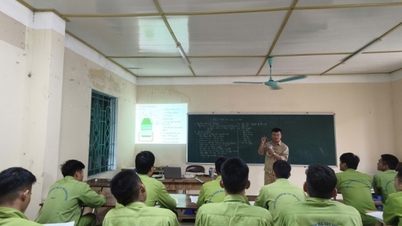
Vocational training in craft villages is largely hands-on or involves short-term courses, resulting in low effectiveness. Traditional vocational training in some vocational schools is also not aligned with real-world needs; many graduates cannot find jobs, or employers require further training. In the context of integration and intense competition, the need for a skilled workforce capable of producing diverse, high-quality, and competitive products is becoming increasingly urgent.
On April 16, 2026, the Hanoi People's Committee issued Plan No. 155/KH-UBND to implement the Program to support the development of the Hanoi labor market for the period 2026-2030, which sets the goal of striving for a trained workforce rate of 75% to 80%.
To achieve the above goal, localities and craft villages need to innovate their training thinking. “Instead of widespread training, vocational training programs should closely follow the actual needs of each craft village and each product group. Units and localities should coordinate with professional associations and businesses to build a flexible training framework, focusing on practical skills, design, production management, and especially business skills in the digital environment. This is a weakness of many craft village workers today: their products are good but they struggle to access the wider market,” commented Ha Thi Vinh, President of the Hanoi Handicraft and Craft Village Association.
Furthermore, solutions to strengthen the linkage between the "three stakeholders": the State, schools, and businesses, also need to be emphasized. "Vocational training institutions need to become a 'bridge' between artisans and the labor market instead of operating in a fragmented manner as they do now. The inclusion of artisans in teaching needs to be institutionalized through flexible mechanisms, reducing administrative barriers. When young people see clear job opportunities, they will be more confident in pursuing the profession," stated Dr. Ton Gia Hoa, Vice President of the Vietnam Handicraft Village Association.
Decision No. 282/QD-UBND of the Hanoi People's Committee on approving the overall plan for the development of craft villages in Hanoi for the period 2025-2030, with a vision to 2050, clearly defines the objective: Preserving and developing craft villages in conjunction with the restructuring of the rural economy and increasing people's income. In this plan, vocational training, skill transfer, and skill propagation are considered key tasks.
Hanoi city has identified digital transformation as a "lever" in vocational training. Classes need to integrate knowledge of e-commerce, branding, and product promotion on digital platforms. Artisan Do Van Cuong, Chairman of the Thiet Ung Fine Arts Wood Carving Village Association (Thu Lam commune), stated: "If equipped with these skills early on, young workers will have more motivation to stay in the profession, because they will not only be craftsmen but can also become 'creative entrepreneurs'."
In addition, traditional vocational education needs to be integrated into schools. According to Pham Quang Vinh, Principal of Vocational School No. 1 of Mechanical Engineering, organizing experiential and career guidance programs in traditional craft villages for high school students will help them better understand the value of these crafts, thereby fostering love and a sense of preservation. This is also a way to "nurture" the next generation of human resources from an early age.
The Employment Law No. 74/2025/QH15, effective from January 1, 2026, recognizes both informal skills and development orientations based on the specific needs of employers. Accordingly, the city encourages artisans to expand training and share their trade secrets; this is accompanied by policies of recognition and appropriate rewards. When income improves and workers can make a living from their craft, this will be a key factor in determining the success of the traditional vocational training policy.
Source: https://hanoimoi.vn/dao-tao-nghe-chia-khoa-giu-lang-nghe-748667.html




























































































Comment (0)