

This content was emphasized by Minister of Construction Tran Hong Minh when presenting the Proposal on investment policy for the Gia Binh International Airport construction project on the morning of November 14.
Minister of Construction Tran Hong Minh said Noi Bai International Airport is the main international aviation gateway of Hanoi Capital and the Northern Key Economic Zone.
Recently, from 2014 to 2024, the number of passengers passing through Noi Bai International Airport increased rapidly, about 11.8%/year, higher than the national average and is currently operating beyond capacity.
At the same time, compared with major international airports in the region, Noi Bai International Airport has lower service quality and technology.

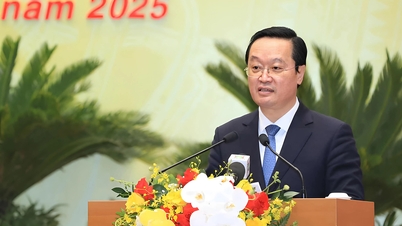
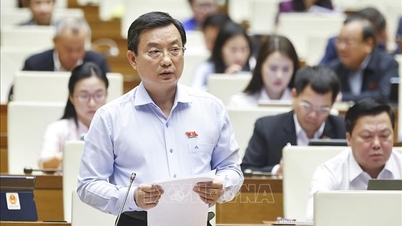
Minister of Construction Tran Hong Minh presented a report on the investment policy for the Gia Binh International Airport construction project.
Although the Ministry of Construction is studying a plan to expand Noi Bai International Airport to the South, it is facing many difficulties due to the need to relocate a large population, huge land clearance costs and the time it takes to implement.
“Therefore, investing in Gia Binh International Airport is a strategic and breakthrough step, contributing to restructuring the Capital Region's aviation network according to the dual-center model that has been successfully applied by many large cities in the world .
The investment in the construction of Gia Binh International Airport will help promote the advantages of location and space to create momentum to promote the development of industry, logistics, e-commerce, tourism and services in the region. At the same time, it will play a strategic complementary role to Noi Bai.
Gia Binh International Airport has special significance in ensuring national defense and security and serving foreign affairs events of the State, especially the 2027 APEC Summit," the Minister of Construction emphasized.
Gia Binh International Airport is invested according to international standards, becoming a new generation smart, green, sustainable airport of international class, meeting the needs of socio-economic development, serving dual-use exploitation, ensuring national security and defense activities and important foreign affairs events, including the 2027 APEC Summit.
The project meets 5-star international airport service standards, is among the top 10 5-star airports in the world according to Skytrax criteria and is among the airports with excellent passenger experience according to Airports Council International.
Gia Binh Airport is the aviation gateway of the North, a transit airport for passengers, cargo, and an aircraft maintenance, repair, and overhaul facility in the Asia-Pacific region.
Gia Binh airport is expected to meet the needs of 30 million passengers/year and 1.6 million tons of cargo by 2030.
The project is invested with a level 4F scale according to the standards of the International Civil Aviation Organization, meeting the demand by 2030 of about 30 million passengers/year, 1.6 million tons of cargo and by 2050 of about 50 million passengers/year and 2.5 million tons of cargo.
Regarding the preliminary design plan for airspace organization and flight methods, the Minister of Construction said that to ensure safe and effective operations between Noi Bai International Airport and Gia Binh International Airport, the air traffic management agency will establish an airspace to control access to cover all airports in the area. Flight routes are designed for each airport using satellite navigation and ground radar, ensuring limited intersection points and distances between aircraft.
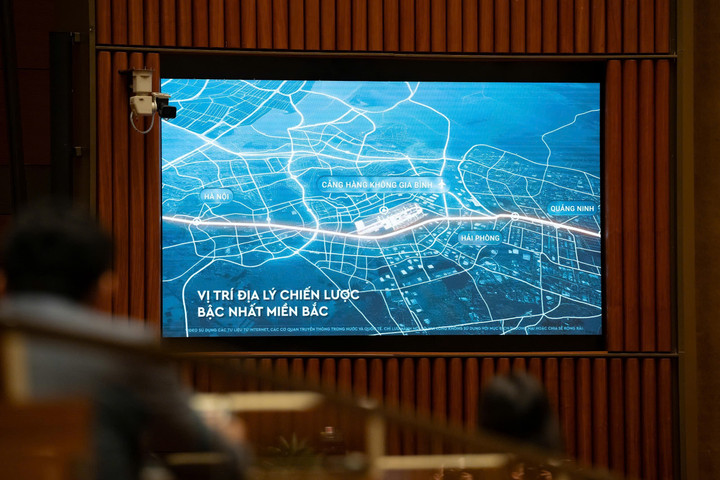
National Assembly delegates watch a video clip about the Gia Binh International Airport project.
Regarding infrastructure, the airport is built with 2 parallel pairs of runways, each pair consists of 2 runways. The runways are 3,500 to 4,000 meters long, meeting all types of new generation wide-body, long-range aircraft.
Regarding the passenger terminal, the passenger terminal is built to meet 5-star service standards, ensuring convenient, friendly and efficient passenger service. The VIP terminal is built independently from the passenger terminal, meeting the need for high-quality service for State foreign affairs events.
Regarding traffic connections, Gia Binh International Airport is synchronously connected to the national, regional and provincial traffic systems, including the Hanoi area which is directly connected through expressways, urban railways and national railways.
Land use demand is about 1,884.9 hectares, of which land demand for converting two-crop rice cultivation to airport land is 922.25 hectares.
According to the preliminary resettlement compensation plan, the project affects about 7,100 households and 118 organizations, is expected to resettle about 5,800 households, and needs to relocate about 18,800 graves. In addition, to implement the project, it is necessary to relocate and restore irrigation infrastructure works, canals, pumping stations, power transmission lines, relocate and restore social infrastructure works such as schools, educational facilities, religious facilities, etc.
The total investment capital of the project is about 196,378 billion VND, including equity capital and legally mobilized capital. Of which, phase one is about 141,236 billion VND, phase two is about 55,142 billion VND.
Minister of Construction Tran Hong Minh said the project's operating period is 70 years, from 2025 to 2095.
The Government proposed that the National Assembly consider approving the investment policy for the Gia Binh International Airport construction project and special policies to support project investment.
Assess the feasibility of meeting the APEC 2027 schedule, carefully study the special mechanism and policies for relocating historical and cultural relics to serve the project.
Need to regulate monitoring every 5 years
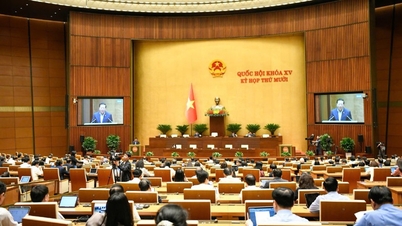
Presenting the review report, Chairman of the Economic and Financial Committee Phan Van Mai said that the Committee had a full report examining the acceptance of the investment policy for the Gia Binh International Airport construction project. The Committee agreed with the necessity of investing in the project, the project met the criteria within the National Assembly's authority to approve the investment policy according to the provisions of the Investment Law, and the project dossier basically had all the required components.
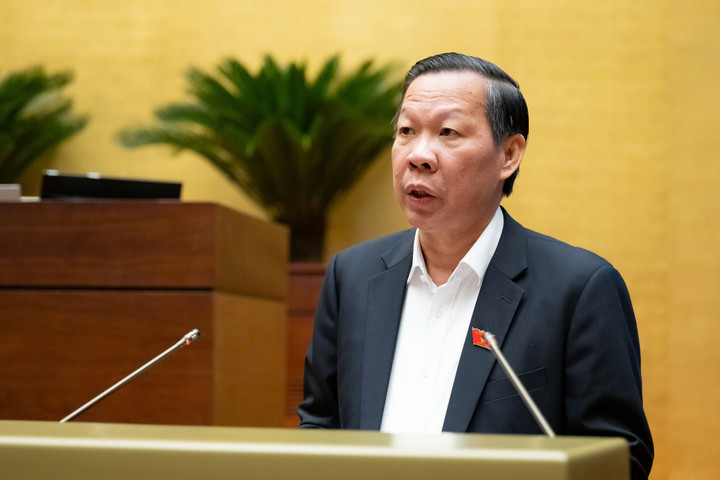
Chairman of the Economic and Financial Committee Phan Van Mai presented the audit report.
The Economic and Financial Committee basically agreed on the contents of the objectives, scale, location, time, progress of investment project implementation, land use needs, site clearance plan, migration, resettlement, main technology selection plan, and environmental protection solutions.
However, Mr. Phan Van Mai suggested that it is necessary to clearly quantify the project's objectives, determine the roadmap and feasibility. "Add an assessment of geology, hydrology, drainage, impact on Ngu River and clarify the investment plan for a multi-modal transport system in sync with the project's completion schedule. Evaluate the feasibility of completing the project to meet the APEC 2027 service schedule in the context of many problems related to compensation, support and resettlement," the Chairman of the Economic and Financial Committee emphasized.
In addition, it is necessary to clarify the method of training, career conversion, and job creation for affected people. In particular, the Economic and Financial Committee proposed to analyze the basis for determining the project's operating period of 70 years, accordingly, it is necessary to determine the project's operating period based on the actual capital recovery period and stipulate periodic monitoring every 5 years to update revenue, costs, profits and make flexible adjustments to ensure the harmony of interests between the State, investors and users.
Regarding the preliminary total investment, Chairman Phan Van Mai proposed to clarify the basis for calculating the project's investment rate, compare the investment rate with similar airport projects in the region and adjust according to local prices to choose the appropriate and optimal cost level.
“Regarding special mechanisms, policies, incentives, investment support and applicable conditions, the Economic and Financial Committee basically agrees with the need to issue special mechanisms and policies to relocate historical and cultural relics to serve the project. However, it is recommended to clearly stipulate the handling of consequences after relocating relics, especially the re-recognition of relics upon relocation, ensuring the preservation of original elements, historical and cultural values,” the Chairman of the Economic and Financial Committee proposed.
In addition, the Economic and Financial Committee requested the Government to promptly report to the National Assembly on the promulgation and implementation of Resolution No. 03 dated August 14, 2025 of the Government on specific mechanisms and policies for the construction of Gia Binh International Airport at the 10th session as prescribed.
Source: https://vtcnews.vn/dau-tu-san-bay-quoc-te-gia-binh-la-buoc-di-chien-luoc-mang-tinh-dot-pha-ar987122.html
![[Photo] Unique art of painting Tuong masks](https://vphoto.vietnam.vn/thumb/1200x675/vietnam/resource/IMAGE/2025/11/14/1763094089301_ndo_br_1-jpg.webp)
![[Photo] Unique architecture of the deepest metro station in France](https://vphoto.vietnam.vn/thumb/1200x675/vietnam/resource/IMAGE/2025/11/14/1763107592365_ga-sau-nhat-nuoc-phap-duy-1-6403-jpg.webp)





























![[Photo] Special class in Tra Linh](https://vphoto.vietnam.vn/thumb/1200x675/vietnam/resource/IMAGE/2025/11/14/1763078485441_ndo_br_lop-hoc-7-jpg.webp)






















































Comment (0)