

On the afternoon of December 2, the National Assembly discussed in the hall the investment policy for the national target program to modernize and improve the quality of education and training for the 2026-2035 period.
Proposal to have a standard set of textbooks
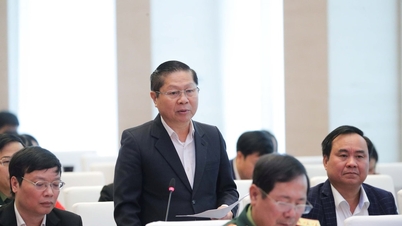
Delegate Nguyen Anh Tri, Hanoi delegation proposed that there must be a set of standard textbooks to successfully implement the spirit of Resolution 71 of the Politburo on students learning with a unified set of textbooks nationwide.
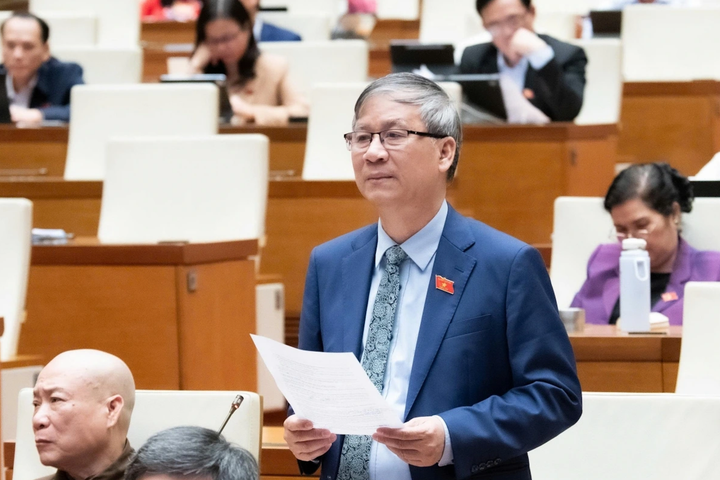
Delegate Nguyen Anh Tri, Hanoi delegation. (Photo: National Assembly)
To do this, the Hanoi delegation clearly pointed out that textbooks must be recognized as very important. From personal experience as a student and successful instructor of over 30 masters and nearly 30 doctors, the delegate realized that books are very important. Especially for high school students, standard textbooks are extremely important.
“A standard textbook set means that it is appropriate, error-free, up-to-date, modern, imbued with Vietnamese culture; and contains Vietnamese ethics. There must be a really good standard textbook set for the national curriculum to be successful,” said delegate Nguyen Anh Tri.
According to the delegate, to have a good standard textbook set, it must be invested in and built. It should not be patched, borrowed, or made up temporarily, and there must be a national drafting board composed of good people, responsible drafters. The drafting of textbooks must be included in the national target program. This is to improve the quality of education as the program's goal.
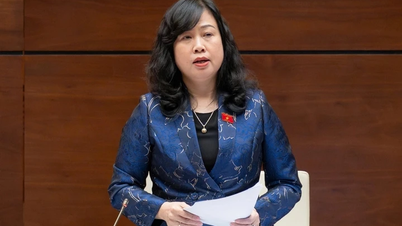
Meanwhile, delegate Huynh Thi Anh Suong, Quang Ngai delegation, proposed that the Ministry of Education and Training (MOET) study a set of bilingual Vietnamese-English textbooks, or textbooks in English, so that educational institutions can choose according to their actual conditions.
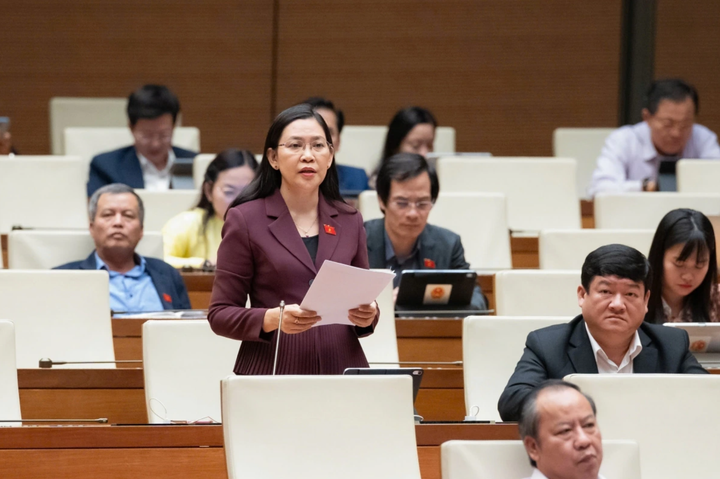
Delegate Huynh Thi Anh Suong, Quang Ngai delegation. (Photo: National Assembly)
The larger goal is to make English the second language in schools. However, according to the female delegate, to achieve this goal, the decisive factor is the teaching staff. Teachers must not only have in-depth knowledge of the subject, but also need good English skills. Meanwhile, in reality, most universities only train English teachers, not teachers who teach subjects in English.
“English teachers cannot teach other subjects in English without in-depth knowledge of that subject. On the contrary, teachers of other subjects do not have enough capacity and English skills to teach in English,” delegate Huynh Thi Anh Suong stated the reality.
The Quang Ngai delegation said that the program's goal of training, education, and improving teachers' qualifications is still general, so it needs to be specific, measurable, and feasible. Specifically, investment in facilities and teaching equipment must be synchronized with the training and development of the teaching staff. For example, the goal by 2030 is that 30% of teachers will be trained and educated to meet the requirements of teaching in English, corresponding to 30% of educational institutions having equipment. "We need to avoid the situation where we have equipment but cannot teach in English, causing a waste of resources."
Proposal to support scholarships for teachers' children
Delegate Nguyen Hoang Bao Tran, Ho Chi Minh City delegation, again proposed solutions to develop the teaching staff. Accordingly, specific support policies for this team must be determined in the direction of "retaining people by opportunities, not just by allowances".
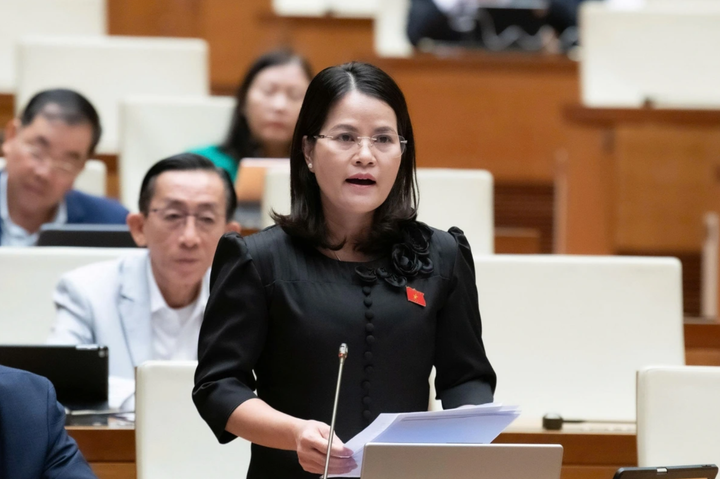
Delegate Nguyen Hoang Bao Tran, Ho Chi Minh City delegation. (Photo: National Assembly)
From there, the female delegate proposed a number of key support solutions. First, support teachers' housing according to minimum standards, because in the highlands and islands, many teachers still have to live temporarily, lacking electricity and water. It is necessary to invest in standard public housing, not luxurious but safe and with basic amenities.
Second, the policy of supporting scholarships for teachers' children. This is a humane policy, creating peace of mind, reducing the burden on families, and encouraging teachers to stay committed.
The delegation of Ho Chi Minh City also raised the issue of inequality in educational opportunities - not only in mountainous areas but also in urban areas or central areas, because the education of children of workers in industrial parks and export processing zones also faces many difficulties.
“The rented houses are cramped, the living environment is not guaranteed, parents work overtime continuously, the income is unstable, not enough time to take care of and support their children's studies. Most of the children's families only live in 10-12m² rented rooms, the children do not have space to study, lack social connections, and do not have access to extracurricular activities,” the representative of the Ho Chi Minh City delegation stated the reality.
The delegate suggested that the National Target Program should clearly identify workers’ children as a group that needs priority support, not just a general group. Specifically, the female delegate suggested that in addition to scholarships, there should be policies to support the construction of public schools near industrial parks, organize boarding school models for workers’ children, and create community learning spaces in boarding houses.
Source: https://vtcnews.vn/dbqh-bo-sach-giao-khoa-dung-chung-phai-chuan-hien-dai-tham-dam-van-hoa-viet-ar990679.html



![[Photo] Worshiping the Tuyet Son statue - a nearly 400-year-old treasure at Keo Pagoda](/_next/image?url=https%3A%2F%2Fvphoto.vietnam.vn%2Fthumb%2F1200x675%2Fvietnam%2Fresource%2FIMAGE%2F2025%2F12%2F02%2F1764679323086_ndo_br_tempimageomw0hi-4884-jpg.webp&w=3840&q=75)

![[Photo] Parade to celebrate the 50th anniversary of Laos' National Day](/_next/image?url=https%3A%2F%2Fvphoto.vietnam.vn%2Fthumb%2F1200x675%2Fvietnam%2Fresource%2FIMAGE%2F2025%2F12%2F02%2F1764691918289_ndo_br_0-jpg.webp&w=3840&q=75)





















































































Comment (0)