

Serious impacts from climate change
Land subsidence, erosion, flooding, and saltwater intrusion in the Mekong Delta are becoming more complex and severe than before. Many areas are experiencing particularly dangerous erosion, and urban flooding is increasing. Currently, most areas in the Mekong Delta are experiencing subsidence of 0.5-3 cm/year; coastal areas commonly subside at 1.5-2.5 cm/year, with some places exceeding 2.5 cm/year.
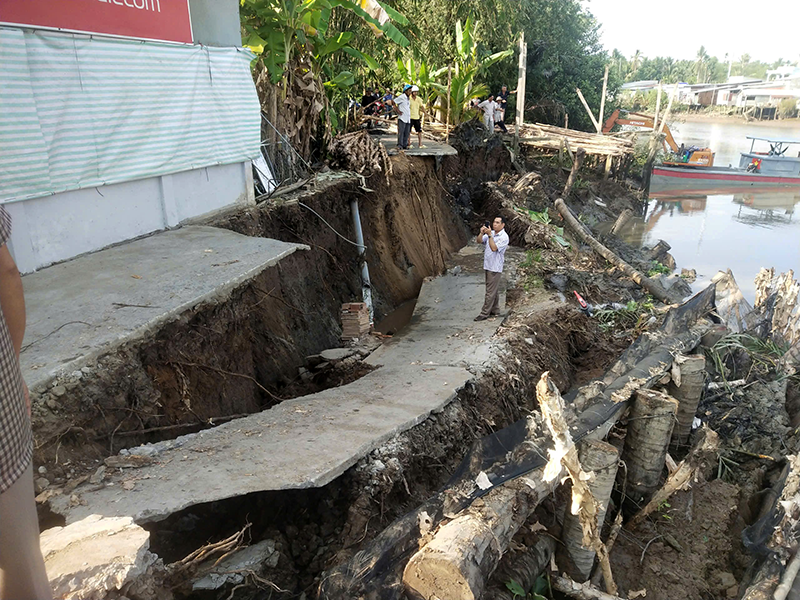
Serious landslides have occurred in Nhon My commune.
Measurements by the Ministry of Agriculture and Environment (MARD) show that land subsidence in the Mekong Delta region has ranged from less than 5cm to over 10cm in the last 5 years. In the Ca Mau Peninsula region alone, from 2016 to the present, 2,137 points of land subsidence have appeared along rural roads and embankments along canals and ditches, with a total length of over 53km.
Regarding landslides, from 2016 to the present, 812 landslide points have appeared with a total length of over 1,210.876 km. Flooding caused by high tides has increased significantly in both area and depth, with an average flood depth of 0.2-0.4m (a 5-6% increase compared to 10 years ago), and in some areas of Can Tho City and Vinh Long, the flood depth reaches 0.6-0.7m; the flooding usually lasts from 2-4 hours per high tide. In Can Tho City alone, flooding usually lasts 4-6 hours per event, and in cases where high tides combine with heavy rain, the flooding time can last from 10-12 hours.
Salinity intrusion in the Mekong Delta tends to occur 1-1.5 months earlier (compared to 2013 and earlier). Furthermore, severe droughts and salinity intrusion are occurring more frequently. In the last 10 years, the Mekong Delta has experienced three major droughts and salinity intrusion events, including two historically high events: the dry season of 2015-2016 (4g/l salinity boundary penetrated 60-73km inland) and 2019-2020 (4g/l salinity boundary penetrated 70-80km inland)...
Mr. Pham Duc Luan, Director of the Department of Dike Management and Disaster Prevention under the Ministry of Agriculture and Environment, stated: “The main causes of these phenomena are economic development upstream of the Mekong River, the construction of reservoirs; sand mining; increased irrigated area; and the operation of the Phu Nam canal… In addition, there are impacts from socio-economic development within the Mekong Delta, population growth, and climate change.”
The overall solution to the adaptation problem.
According to the Ministry of Agriculture and Environment, these phenomena are no longer just local issues but long-term, inter-regional, inter-sectoral challenges that directly impact people's livelihoods, sustainable development, and national security. In this context, the Politburo issued Conclusion No. 26-KL/TW on April 24, 2026, on preventing and combating subsidence, landslides, flooding, drought, and saltwater intrusion in the Mekong Delta region for the period 2026-2035.
Conclusion No. 26-KL/TW emphasizes the proactive approach to adapting to climate change and respecting natural laws to address the root causes of development obstacles in the Mekong Delta. The solutions must ensure a comprehensive, inter-regional approach, harmoniously combining non-structural and structural approaches. In this approach, people's well-being is the benchmark, socio-economic development is the focus, and environmental protection and national defense and security are fundamental principles.
In addition, the Conclusion identifies tasks and solutions to focus on implementation. These include: completing the review and supplementation of disaster scenarios for the Mekong Delta region into the national planning system; reviewing and evaluating the effectiveness and impact of invested projects and infrastructure (including transportation projects), promptly addressing limitations and inadequacies, prioritizing the construction of comprehensive, multi-purpose projects and infrastructure serving population relocation; promoting research and application of high-tech science and technology, integrating artificial intelligence, digital transformation, and building a database system; strengthening bilateral and multilateral international cooperation, especially the Mekong sub-regional cooperation mechanism; Strengthening the organizational system and state management apparatus for water resources, irrigation systems, dikes, and disaster prevention and control; prioritizing resource allocation and implementing appropriate policies to encourage and attract foreign investment projects; and effectively exploiting supplementary resources such as carbon credit sales and other resources...
To date, the Ministry of Agriculture and Environment has developed a plan to implement Conclusion No. 26-KL/TW, and simultaneously drafted a Government Resolution on the issuance of an Action Program to implement this Conclusion. In addition, the Ministry has proposed 8 investment projects to be implemented in the 2026-2030 period, with a total budget of 32,593 billion VND from the state budget, loans, and aid.
Minister of Agriculture and Environment Trinh Viet Hung directed: “At this very moment, the provinces and cities in the Mekong Delta region and the units under the Ministry must thoroughly understand the core spirit of Conclusion No. 26-KL/TW. That is, to shift strongly from a “passive response” mindset to a “proactive prevention and adaptation” mindset; respect natural laws; address issues in a holistic, inter-regional, multi-objective manner; harmoniously combine structural and non-structural solutions; put the people at the center, and make sustainable development the overarching goal. Through this, they must promptly concretize the conclusion into specific action programs and plans for each locality, each sector, each agency, and each unit in accordance with the Politburo's directives…”
Text and photos: HA VAN
Source: https://baocantho.com.vn/dbscl-thich-ung-thuan-thien-la-muc-tieu-cot-loi-a205010.html
























































































Comment (0)