

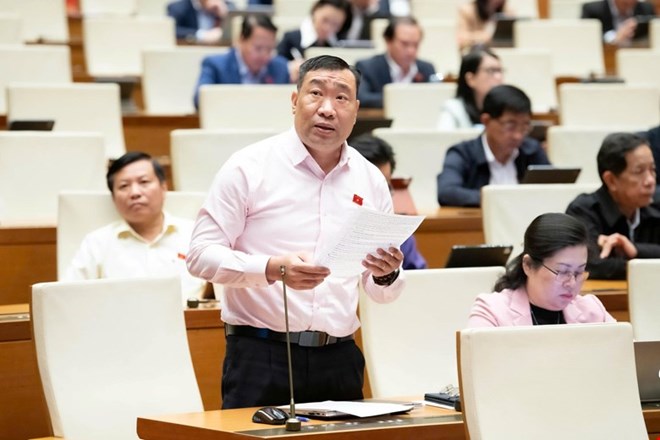
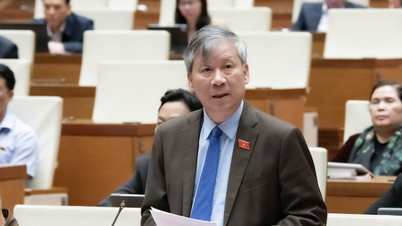
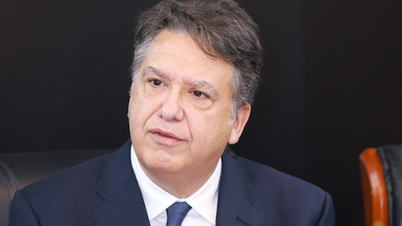
National Assembly delegate Thach Phuoc Binh proposed raising basic and preventive health allowances to a uniform level of 100% nationwide. Photo: Quochoi.vn
On the morning of December 2, the National Assembly discussed the draft Resolution of the National Assembly on a number of breakthrough mechanisms and policies for the work of protecting, caring for and improving people's health.
National Assembly Delegate (NAD) Thach Phuoc Binh - Deputy Head of the NA Delegation of Vinh Long province - said that increasing the benefit level and moving towards exempting hospital fees for the 2026-2030 period is a humane policy, but implementation shows many bottlenecks.
Accordingly, 30% of health stations do not have doctors and 35% of health stations provide insufficient or substandard medicine.
If health insurance benefits are expanded when the lower levels are not yet consolidated, people will continue to flock to the higher levels, increasing expenditure from the health insurance fund and overloading, going against the goal of reducing financial burden.
Delegates also said that the procurement system is still inadequate, lacking unified guidance, causing disruptions in supply sources. Many hospitals have been overpaid , with health insurance arrears reaching up to 7,000 billion VND in the period 2018-2021.
Increasing benefits in the context of an unstable payment mechanism can easily lead to service abuse and prolonged treatment, especially in autonomous units.
Delegates proposed adding to Article 2 the prerequisites (pre-checks) before expanding health insurance benefits. Before 2026, 70% of commune health stations must be standardized in terms of facilities, equipment, essential drug lists, and must ensure that each health station has at least one doctor.
Regarding the salary and allowance regime for medical staff (Article 3), delegates commented that the regulation of ranking doctors' salaries from level 2, although improving initial income, does not fundamentally solve the problem of low income. Reality shows that medical staff quit their jobs in large numbers, and the income gap between public and private sectors is growing. This solution is not enough to retain human resources.
The new 100% preferential allowance applies to a number of specific specialties. Meanwhile, many fields with equivalent levels of danger such as emergency, resuscitation, anti-poisoning, infectious diseases, epidemic prevention, and testing have not yet received it, creating inequality and reducing work motivation.
According to the delegates, the allowances for primary health care and preventive medicine are still low, not attractive enough to retain doctors in the commune. This leads to the risk that in the next 10-15 years there will be no more doctors working in preventive medicine, a shortage of 8,000 doctors (only 42% of the demand).
Delegates proposed to complete Article 3 in the direction of: Building a specific salary table for the health sector linked to risks, responsibilities, seniority, applying allowances according to job positions instead of equalizing according to qualifications. Expanding 100% of preferential occupational allowances for resuscitation, anti-poisoning, ICU, infectious diseases, epidemic prevention, emergency, high-risk testing.
In particular, it is necessary to raise basic and preventive health allowances to a uniform level of 100% nationwide; disadvantaged areas enjoy additional attraction allowances from 30% to 50%.
Delegates also suggested that it is necessary to ensure the source of allowances from the budget, avoiding dependence on the level of hospital autonomy.

National Assembly Delegate Tran Kim Yen speaks. Photo: Quochoi.vn
Also talking about the salary and allowance policies for medical staff, delegate Tran Kim Yen (Ho Chi Minh City Delegation) said that in reality, the lack of doctors at the grassroots health care and preventive medicine levels is a huge challenge for the health sector nationwide.
From there, the delegates proposed to add that foreign emergency staff would be entitled to a 100% preferential allowance. At the same time, remove point b, clause 3, article 3 so that those who regularly and directly work in medical professions at commune health stations and preventive medicine would all be entitled to a 100% preferential allowance, regardless of whether it is 100% or 70%.
Source: https://laodong.vn/thoi-su/de-xuat-nang-phu-cap-y-te-co-so-va-y-te-du-phong-len-muc-100-tren-toan-quoc-1618870.ldo



![[Photo] Worshiping the Tuyet Son statue - a nearly 400-year-old treasure at Keo Pagoda](/_next/image?url=https%3A%2F%2Fvphoto.vietnam.vn%2Fthumb%2F1200x675%2Fvietnam%2Fresource%2FIMAGE%2F2025%2F12%2F02%2F1764679323086_ndo_br_tempimageomw0hi-4884-jpg.webp&w=3840&q=75)
![[Photo] Parade to celebrate the 50th anniversary of Laos' National Day](/_next/image?url=https%3A%2F%2Fvphoto.vietnam.vn%2Fthumb%2F1200x675%2Fvietnam%2Fresource%2FIMAGE%2F2025%2F12%2F02%2F1764691918289_ndo_br_0-jpg.webp&w=3840&q=75)







































































Comment (0)