

One of the key requirements mentioned in Resolution 72-NQ/TW, dated September 9, 2025, of the Politburo is to shift from "treating diseases" to "preventing diseases for the entire population," with grassroots healthcare as the foundation.
Based on that, Ho Chi Minh City has implemented strong reforms to its grassroots healthcare system. Health stations have begun operating under a new model, becoming the "first point of contact for healthcare" with the goal of providing increasingly better healthcare for the people.
Providing healthcare for people at home.
For over a month now, residents of Hiep Phuoc commune, Ho Chi Minh City, have become familiar with the sight of medical staff from the commune's health station visiting homes to check and monitor the health of local residents, especially the elderly and those with mobility difficulties.
“Previously, every month I had to ask my nephew to take me to the hospital for checkups for hypertension and diabetes, but now I don't need to go anymore. Doctors come to my house to examine me, which is great,” shared Mrs. Le Thi Mang (78 years old, residing in Hamlet 34, Hiep Phuoc Commune).
Hiep Phuoc is one of the first three communes in Ho Chi Minh City to establish continuous healthcare teams linked to residential areas starting from April 7, 2026.
Hiep Phuoc is one of the first three communes in Ho Chi Minh City to establish continuous healthcare teams linked to residential areas starting from April 7, 2026.
According to Dr. Nguyen Van Gam, Director of Hiep Phuoc Commune Health Station, since its launch on April 7th, the health care teams of the commune health station have been taking turns visiting the homes of the elderly, disadvantaged people, and those with underlying health conditions to check their health.
With 43 doctors and nurses and 148 community health collaborators, Hiep Phuoc Commune Health Station has established 7 continuous health care teams, responsible for the overall health of more than 75,000 people in the area.
Similarly, in Dat Do commune, healthcare teams have been continuously visiting people's homes to provide healthcare, especially to the elderly and those with mobility difficulties, since their launch on April 7th.
When doctors and nurses from the Dat Do Commune Health Station came to his house for a check-up, Mr. Nguyen Van Muoi (70 years old, Hiep Hoa Hamlet, Dat Do Commune) went from surprise to joy: "Never before have we received such dedicated healthcare. The city's policy of bringing healthcare to people's homes is truly commendable."
Dr. Phan Thi Tuyet Xuan, Director of the Dat Do Commune Health Station, said that the locality has established four health care teams that provide continuous home visits for medical examinations. Initially, the unit prioritized home visits for the elderly, those living alone, and those with underlying health conditions.
Simultaneously, the continuous healthcare teams in Dat Do commune will create electronic health records for all residents. The goal is for every resident, especially the elderly, to have their health managed and cared for continuously, right where they live.
Associate Professor, Doctor Tang Chi Thuong, Director of the Ho Chi Minh City Department of Health, stated that the implementation of healthcare teams linked to residential areas is a practical step towards bringing healthcare services closer to the people. This not only contributes to improving the quality of primary healthcare at the local level but also helps to gradually shape a multi-tiered healthcare system, in which grassroots healthcare truly plays the role of the "gatekeeper" of the healthcare system.
Following the implementation in Hiep Phuoc, Dat Do, and Bac Tan Uyen communes, the Department of Health plans to expand this model to many other communes and wards throughout the city.
"First point of medical contact"
Instead of going to a higher-level hospital, recently, Mrs. Tran Thi Lan (72 years old, residing in Ward 12, Binh Dong Commune) has been going to the commune's health station to register for regular check-ups for diabetes and high blood pressure.
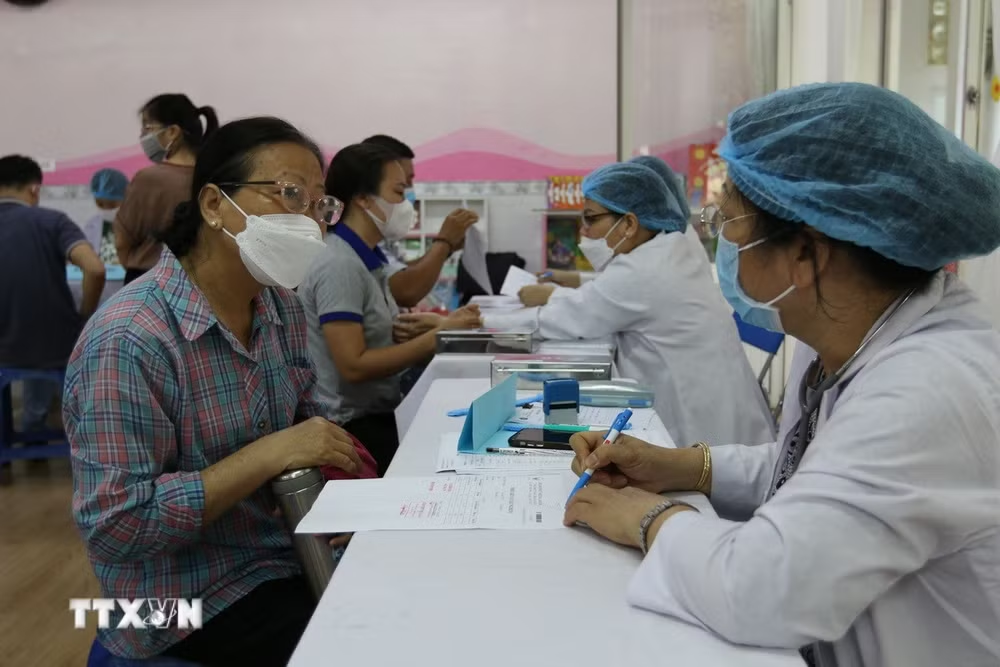
Ms. Lan said that the ward's health station has all the necessary specialties and blood tests, just like a hospital. She felt completely reassured when receiving treatment there: "The doctors at the health station are very dedicated and attentive to each patient. I only went for two check-ups, and the doctors already remembered my face and name, giving careful and thorough instructions."
According to Dr. Hoang Van Cuong, Director of Binh Dong Ward Health Station, from January 1, 2026, Binh Dong Ward Health Station officially received the modern and spacious facilities along with the team of doctors, nurses, and medical staff from the former District 8 Health Center.
In particular, having inherited the operations of the General Clinic of the former Health Center, the Binh Dong Ward Health Station now provides medical examination and treatment in many specialties: General Internal Medicine, General Surgery, Dentistry, Pediatrics, Dermatology, Ear, Nose and Throat, etc.
In particular, the Traditional Medicine Clinic, which combines traditional and modern medicine, is one of the highlights of Binh Dong Ward Health Station, attracting many patients in the area for examination and treatment.
Similarly, the Xuan Hoa Ward Health Station also inherited the former administrative headquarters of Vo Thi Sau Ward, District 3, with spacious facilities and significant investment in modern medical equipment. Currently, the Health Station has 63 staff members, including 18 doctors, tasked with providing healthcare to over 38,000 residents in the area. It is understood that these are model health stations that Ho Chi Minh City will be building in the near future.
According to the Ho Chi Minh City Department of Health, health stations in the city are being reorganized and operated according to a new model. Besides implementing national target programs such as community health management and improvement; protection and care for mothers, children, and the elderly; care for people with disabilities and social welfare…, health stations are also promoting medical examinations and treatment, health counseling, and basic first aid. More importantly, health stations are now undertaking the task of creating electronic health records for all residents in the city.
According to the plan, Ho Chi Minh City will strengthen and improve the capacity of commune-level health stations in terms of human resources, ensuring the structure and sufficient number of doctors according to their functions and tasks; maintain a team of community health collaborators and population collaborators according to their functions and tasks; and ensure basic facilities, medicines, and medical equipment.
During the period 2026-2030, the city will rotate and assign at least 1,000 doctors to work temporarily at commune-level health stations each year; and supplement the permanent medical staff at commune-level health stations so that by 2030 there will be enough doctors to meet the functions and tasks.
Each commune-level health station is also equipped with sufficient basic medical equipment as prescribed, with priority given to allocating land and funding for construction and upgrading so that the health stations meet national standards.
The city has also significantly reformed the operational model of health centers, shifting from a passive approach of waiting for people to come for examinations to a model of "continuous health care teams linked to the local area," proactively monitoring and managing people's health right from the community level, with people at the center and disease prevention as the foundation.
“These solutions not only overcome the long-standing limitations of primary healthcare, but also create a foundation for health stations to truly become the ‘first point of medical contact’ for the people – a place for proactive, continuous, and comprehensive primary healthcare, in line with the spirit of Resolution 72 and the sustainable development orientation of the health sector,” affirmed Mr. Tang Chi Thuong, Director of the Ho Chi Minh City Department of Health.
We invite our readers to follow this series of articles:
Source: https://www.vietnamplus.vn/de-y-te-co-so-tro-thanh-nguoi-gac-cong-tin-cay-post1111533.vnp





























































































Comment (0)