
The tomb of Emperor Minh Mạng is home to many documentary heritage sites.
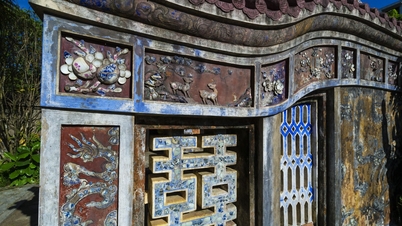
The literary heritage of Hue's imperial architecture is a system of exquisite poems and literary works in Chinese characters, selected from the writings of emperors, princes, and officials of the Nguyen dynasty. These works were carved, inlaid, inlaid, glazed, or embossed on imperial architectural structures in the capital city of Hue during the period 1802-1945. This heritage includes thousands of poems, essays, and couplets displayed on various materials such as wood, ivory, bone, mother-of-pearl, enamel, and ceramics on imperial architectural structures as a unique form of decoration found only in Hue.

Poem panels on wooden architecture at the Thai Hoa Palace relic – Imperial Citadel
The majority of the literary and poetic heritage on Hue's imperial architecture is presented in the form of "one poem, one painting" —each poetic panel is usually accompanied by a painting, creating a distinctive style of traditional Hue decorative art that cannot be found anywhere else. Despite the ravages of war, natural disasters, and man-made calamities, the ancient capital of Hue has preserved a very large number of these unique literary and poetic works in three main materials: 2,967 poetic and poetic panels on wooden architectural materials ; 146 poetic and poetic panels on enamelwork; and 88 poetic and poetic panels on modern materials such as concrete and brick .

There are many poetic verses inscribed on wood in the Dong Khanh mausoleum.
In terms of content, the classical Chinese literature and architecture of the Hue imperial palace possess unique and irreplaceable value. These are the only original manuscripts remaining in the Hue Imperial Citadel complex and are the most authentic and accurate source of historical information reflecting the ideology of an era, the worldview and philosophy of life of the royal family and nobility, and also the talent of contemporary poets through poems describing scenery, people, the moon, sky, clouds, water, spring, summer, autumn, and winter. This is the only source of preserved literary works containing valuable information, contributing to the study of the politics , culture, society, and people of a nation during a historical period.
 di
di
From an artistic perspective , these are highly valuable works of art used in the decoration of architectural structures, unique pieces of craftsmanship showcasing the talent and soul of ancient artisans. This decorative style has left a mark on the history of Vietnamese architectural and decorative art. Furthermore, it is also a collection of paintings and calligraphy that is incredibly diverse, rich, and significant to Vietnam and the region.
Now, when visiting the Hue Imperial Citadel Complex, one needs time to appreciate the unique and unparalleled values of the " one poem, one painting " artworks that adorn the seemingly forgotten imperial architecture, now awakened and becoming heritage. These works bear the imprint of the era in which they were created, forming a distinct cultural form of Nguyen Dynasty imperial architecture within the Hue Imperial Citadel Complex.
Source: https://heritagevietnamairlines.com/di-san-tu-lieu-o-co-do-hue/





















































































Comment (0)