

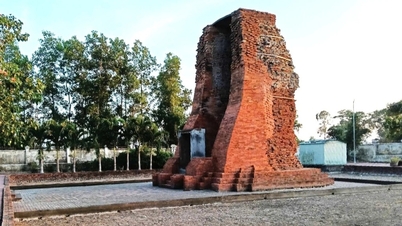
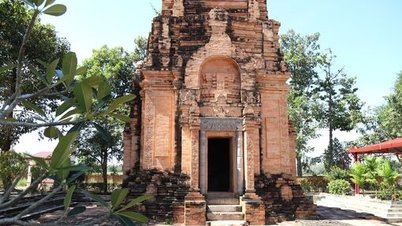
Located in Tan Thanh hamlet, Cho Gao commune, Dong Thap province (formerly Tan Thuan Binh commune, Cho Gao district, Tien Giang province), the excavated Go Thanh archaeological site is a relic of the Oc Eo culture, an ancient civilization that flourished in the Southern region from the 1st to the 8th century.
With its outstanding historical, cultural and archaeological values, Go Thanh archaeological site is not only a precious heritage of Dong Thap province but also a vivid source of documents with rich potential to connect with educational activities and develop sustainable tourism in the locality.
According to Master Le Ai Siem, former Director of the Museum of the former Tien Giang province (now Dong Thap province), in 2 years (1988-1989), the Tien Giang Museum (now Dong Thap Provincial Museum) in collaboration with the Center for Archaeology (under the National Institute of Social Sciences and Humanities in Ho Chi Minh City) conducted 2 excavation seasons and an exploratory dig at this relic.
Mr. Phan Van Hoa, 58 years old, Secretary of the Party Cell of Dang Phong Duoi Hamlet, Cho Gao Commune, Dong Thap Province (who directly witnessed the excavation in 1988, at that time he worked at the Cho Gao District Police, former Tien Giang Province) shared: The number of artifacts found in the Go Thanh relic includes more than 100 gold artifacts (both intact and broken into small pieces), including leaf-shaped bracelets, oval-shaped beads and some gold artifacts in the shape of 6-petaled apricot flowers, or quadrilaterals, with elephants carved inside.
There are 6 bronze artifacts, including 2 rings, 1 small bronze tube and 2 trapezoidal bronze pieces.
Among the 22 stone artifacts, there is an intact statue of Vishnu (the God of Protection). Among the terracotta artifacts, there are many pieces of vase spouts, many rough and smooth ceramics painted red or brown, with decorative patterns...
According to experts, this is a very special relic, rich in types of sites, diverse in artifacts, representing an ancient civilization, formed among the earliest in Southeast Asia. The Ministry of Culture and Information (now the Ministry of Culture, Sports and Tourism) recognized the Go Thanh Archaeological Site as a National Monument in 1994.
In particular, the statue of Vishnu was recognized as a National Treasure by the Prime Minister in 2017, along with a collection of 18 gold leaves carved with elephants, which were also recognized as National Treasures in 2021. These treasures are currently being preserved and displayed at Dong Thap Provincial Museum.
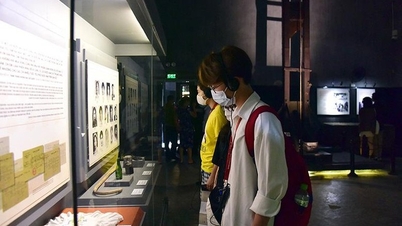
Ms. Nguyen Thi Khac Diep, a tour guide at the Go Thanh archaeological site (belonging to Dong Thap Provincial Museum) said: Every year, the Go Thanh archaeological site welcomes about 1,000 visitors to visit, learn, and research, including groups of university students.
Nowadays, there are also students from local history schools who come here to visit, research and make presentations.
Before excavation, the site was a simple soccer field for local people to socialize and play soccer. After heavy rains, local people occasionally picked up small and thin pieces of gold (about 16k), only the size of a part of a fingernail.
On the ground there are brick layers, scattered with colored and uncolored pottery pieces, some broken statues and quite a lot of pebbles.
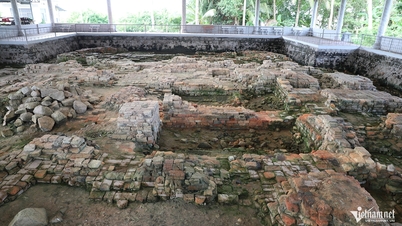
The excavation results show that the relic is located in an artificial mound about 1 hectare wide, 3 meters high above sea level. In the canal bed, the cultural layer is exposed on the wall with many pieces of pottery and some animal bones and teeth, showing that in Go Thanh there are many types of relics such as: residential relics, architectural relics and burial relics; especially architectural relics with many temples and towers next to each other of different scales, very majestic, although only the foundation remains.
After two excavations and a reconnaissance dig, archaeologists found that in the low fields to the west and southwest of the high mound were residential sites. At a depth of about 1.5-3m, many ancient ceramics with broken spouts; many buffalo, cow, pig remains and fish bones; many traces of ash, charcoal, fruit peels, water coconut leaves, along with a few wooden stakes with traces of processing. In the center of the high mound, brick architectural foundations were discovered, no longer intact.
In it, there are 2 square foundations in the form of “rooms”; 1 rectangular foundation has an entrance from the south, inside there is a (collapsed) brick wall separating this architecture in two.
To the south of the rectangular structure is a rectangular granite block with pegs at both ends and a square altar with a hole in the middle (these artifacts were brought to the old Tien Giang Provincial Museum, now Dong Thap Provincial Museum).
In the North, there are traces of broken bricks arranged in a circle, about 1 meter in diameter and 1.5 meters deep. In addition, there is a brick structure resembling a sidewalk, about 2 meters wide, with a ditch on one side resembling the road's "drainage".
Also on the high mound, archaeologists discovered 12 tombs, with square well-shaped pits scattered on the mound. The tombs were covered with intact bricks or broken bricks, creating a raised mound of more than 100 square meters. However, there were some tombs that were not raised like that.
The square pits are 1.8-3m on each side and 2.5-3m deep. Most of the pits are filled with layers of cobblestones mixed with gray sand, with bricks on top.
At the bottom of the grave there is a quadrilateral chamber built of bricks or wood, inside the chamber there is sand, charcoal ash and artifacts made of gold leaf (very thin)./.
Source: https://www.vietnamplus.vn/di-tich-go-thanh-bao-vat-song-cua-nen-van-hoa-oc-eo-post1080561.vnp

![[Photo] Worshiping the Tuyet Son statue - a nearly 400-year-old treasure at Keo Pagoda](/_next/image?url=https%3A%2F%2Fvphoto.vietnam.vn%2Fthumb%2F1200x675%2Fvietnam%2Fresource%2FIMAGE%2F2025%2F12%2F02%2F1764679323086_ndo_br_tempimageomw0hi-4884-jpg.webp&w=3840&q=75)

![[Photo] Parade to celebrate the 50th anniversary of Laos' National Day](/_next/image?url=https%3A%2F%2Fvphoto.vietnam.vn%2Fthumb%2F1200x675%2Fvietnam%2Fresource%2FIMAGE%2F2025%2F12%2F02%2F1764691918289_ndo_br_0-jpg.webp&w=3840&q=75)















































































Comment (0)