

"No matter where people trade, if they see the Dâu Pagoda tower, they will return. No matter what trades people engage in, on the eighth day of the fourth month, they will remember to return to the Dâu festival."
Remembering the Strawberry Festival...
According to archaeological evidence and ancient texts, the Dau - Luy Lau region was a crossroads of three major cultures: Vietnamese, Indian, and Chinese. It is from this multicultural flow that the Dau Pagoda Festival was born, a crystallization of indigenous beliefs combined with the compassionate teachings of Buddhism, creating a unique and distinctive heritage.
 |
The procession of the Four Dharma Buddhas during the Dâu Pagoda festival. |
Every year, the Dau Pagoda Festival is held on the 8th day of the 4th lunar month (Buddha's Birthday) and is jointly organized by the people of 12 villages belonging to the former Dau - Luy Lau district, now part of Tri Qua and Song Lieu wards. This year's Dau Pagoda Festival takes place from May 22nd to 25th (corresponding to the 6th to 9th day of the 4th lunar month) at the system of temples dedicated to the Four Dharma Protectors, with Dau Pagoda as the central temple.
The ceremonial part includes rituals such as: lowering the altar, bestowing Buddhist robes and hats, incense offering ceremony, the return to the temples of Pháp Vân, Pháp Vũ, Pháp Lôi, and Pháp Điện, along with many processions from villages in the Dâu region... The highlight is the opening ceremony at the outer courtyard of Dâu Pagoda (Trí Quả ward) and the ceremony to receive the National Treasure, the Buddha Mother Man Nương, at Tổ Pagoda (Phúc Nghiêm Temple, Song Liễu ward).
The festival features a variety of cultural, artistic, and sporting activities that are both community-oriented and honor traditional values, such as: folk art exchanges, water puppetry, chess competitions, card games, pigeon flying competitions, volleyball, badminton...; exhibitions of traditional craft products...
| Researchers believe that the Dâu festival is a vivid testament to the Vietnamese people's capacity for cultural adaptation and innovation. It is both the origin of Vietnamese festivals and a living legacy of a culture that knows how to absorb new things, preserve its indigenous core, naturally transform foreign elements into its own, and then pass them on to future generations through sacred rituals rich in cultural identity. |
According to Mr. Nguyen Chi Bao, Vice Chairman of the People's Committee of Tri Qua Ward, this year's festival will continue to be organized in a solemn and economical manner, ensuring the preservation of the unique traditional rituals of the Dau region, while also meeting the religious needs of the people and visitors from all over.
To ensure the festival is solemn, safe, and well-organized, the local authorities established an Organizing Committee, assigned specific tasks to each subcommittee, and meticulously prepared plans to ensure security and order, traffic management, environmental sanitation, fire prevention and control, food safety, and to prevent superstitious practices within the festival area.
Organizing the Dau Pagoda Festival not only preserves age-old values but also awakens pride and a sense of preserving national cultural identity among all segments of the population. By attending the Dau Pagoda festival, venerating the Four Dharma statues, and immersing themselves in the ceremonial and festive activities, visitors feel as if they are returning to their roots and experiencing an endless flow of culture from ancient times to the present day.
Someone once said that if you have the chance to visit the ancient land of Dau - Luy Lau, to feel the ancient spirit lingering in the heritage space, you will want to return many more times to savor the unique "intoxicating charm" of this sedimentary region on the other side of the Duong River...
The "source code" of Vietnamese festivals.
Within the tradition of Vietnamese festivals, the Dau Pagoda Festival is considered one of the earliest, most representative, and most complete examples of the Vietnamese festival structure. Ancient documents and texts indicate that Dau Pagoda was built in the 2nd century, around 187 AD, and completed in 226 AD.
This is a long-standing cultural and religious site with exceptional historical and cultural value. Therefore, it is no coincidence that cultural researchers call the Dau Pagoda festival the "source code" of Vietnamese festivals.
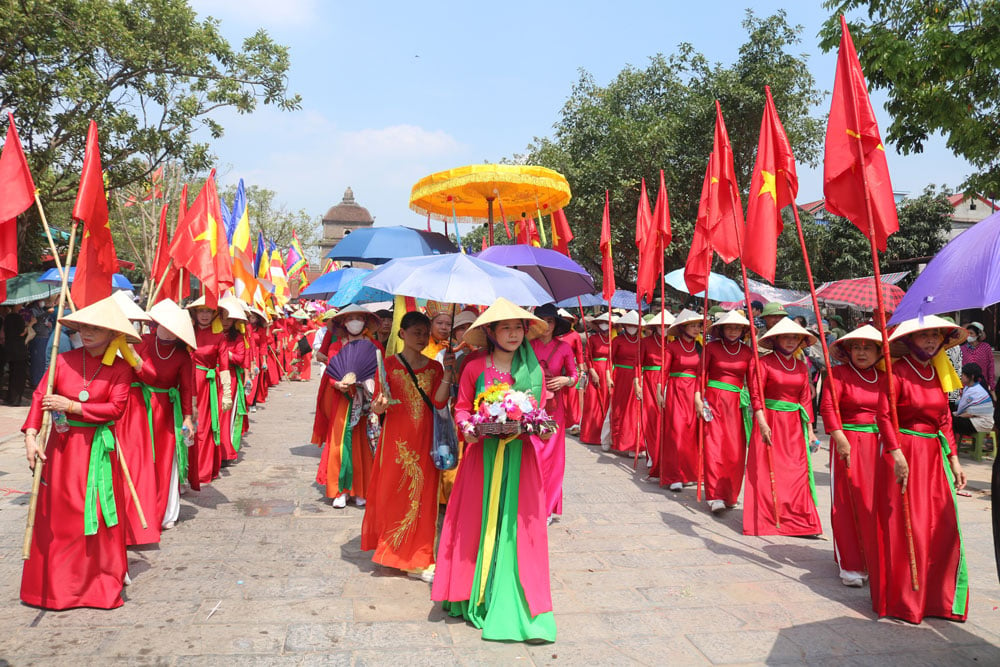 |
The villages in the Dâu region participated in the procession. |
With a history spanning over 1,800 years, since Indian monks arrived in Luy Lau by sea, the Four Dharma belief system quickly took root, integrating the Eastern spirit of indigenous agricultural beliefs to create an exemplary, self-contained, and sustainable festival model that has lasted for thousands of years.
Legend says that the Four Deities of Clouds, Rain, Thunder, and Lightning (Phap Van, Phap Vu, Phap Loi, Phap Dien) are the children of the Buddhist Mother Man Nuong. The Buddhist Mother Man Nuong was a girl from Man Xa village who once fell asleep in front of a temple and became pregnant thanks to the miraculous intervention of the Buddhist monk Khau Da La from India.
From the mulberry tree stump that Man Nuong left for the temple, four statues were carved, depicting the four sisters Tu Phap. These four statues are housed in four temples belonging to the former "Quang Khuong" region: Dau Temple (Phap Van), Dau Temple (Phap Vu), Tuong Temple (Phap Loi), and Dan Temple (Phap Dien), all located in what is now Tri Qua ward.
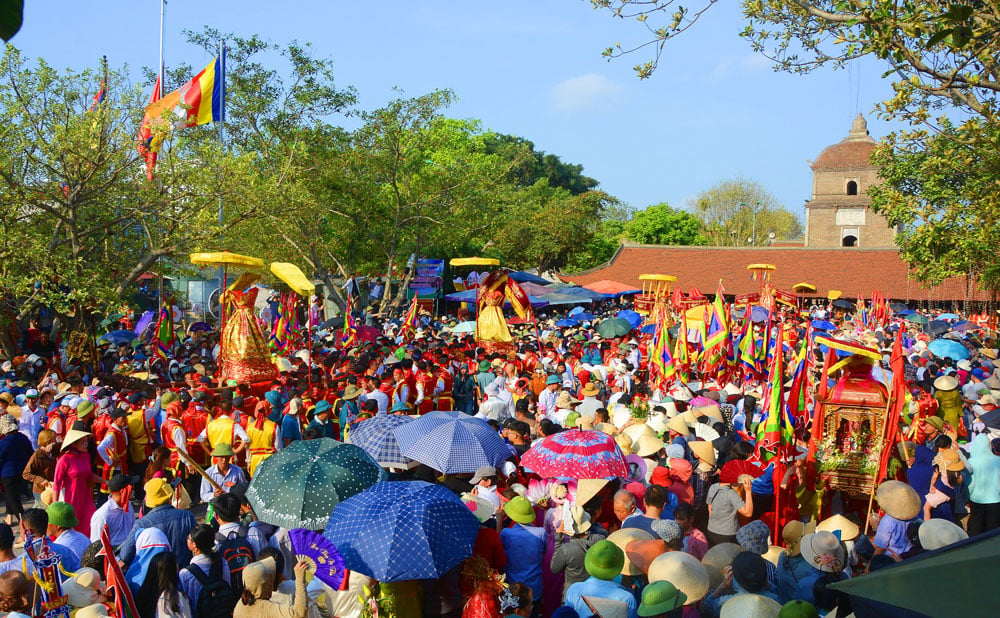 |
Dâu Pagoda, a special national historical site, during the festival. |
Legend has it that during the Ly Dynasty, the kings often brought the Phap Van statue from Dau Pagoda to Thang Long to pray for national peace and prosperity. This demonstrates the high regard the court held for the indigenous beliefs of the Dau region.
Locals still proudly recount the procession of the Four Dharma Buddhas – a unique ritual that forms the "soul" of the Dau Pagoda festival. On the main day of the festival, the statues of the Four Dharma Buddhas from the village pagodas are carried to the communal hall at Dau Pagoda, followed by the unique ritual of "mother chasing child." In addition, there are folk performances rich in symbolism such as the "water snatching" between the Rain Goddess (Phap Vu) and the Thunder Goddess (Phap Loi) to predict the harvest; the White Staff and Red Staff dance; or the ritual of the Four Dharma Buddhas' procession at night, completing a closed circle from East to West, connected to the concept of the cycle of heaven and earth and the seasons.
Before the festival concludes, the palanquin carrying the Thach Quang Buddha and the Four Dharma Protectors is carried back to the ancestral temple to pay respects to the ancestors, followed by the ritual of bowing to sisters and brothers... However, according to local elders, due to the practical conditions of the historical site's space and the current regulations and requirements for organizing the festival, the Dau Temple festival does not always include the full procession of the Four Dharma Protectors and these ancient rituals every year.
Source: https://baobacninhtv.vn/bg2/dulichbg/doc-dao-le-ruoc-phat-tu-phap-o-hoi-chua-dau-postid446245.bbg













































































Comment (0)