

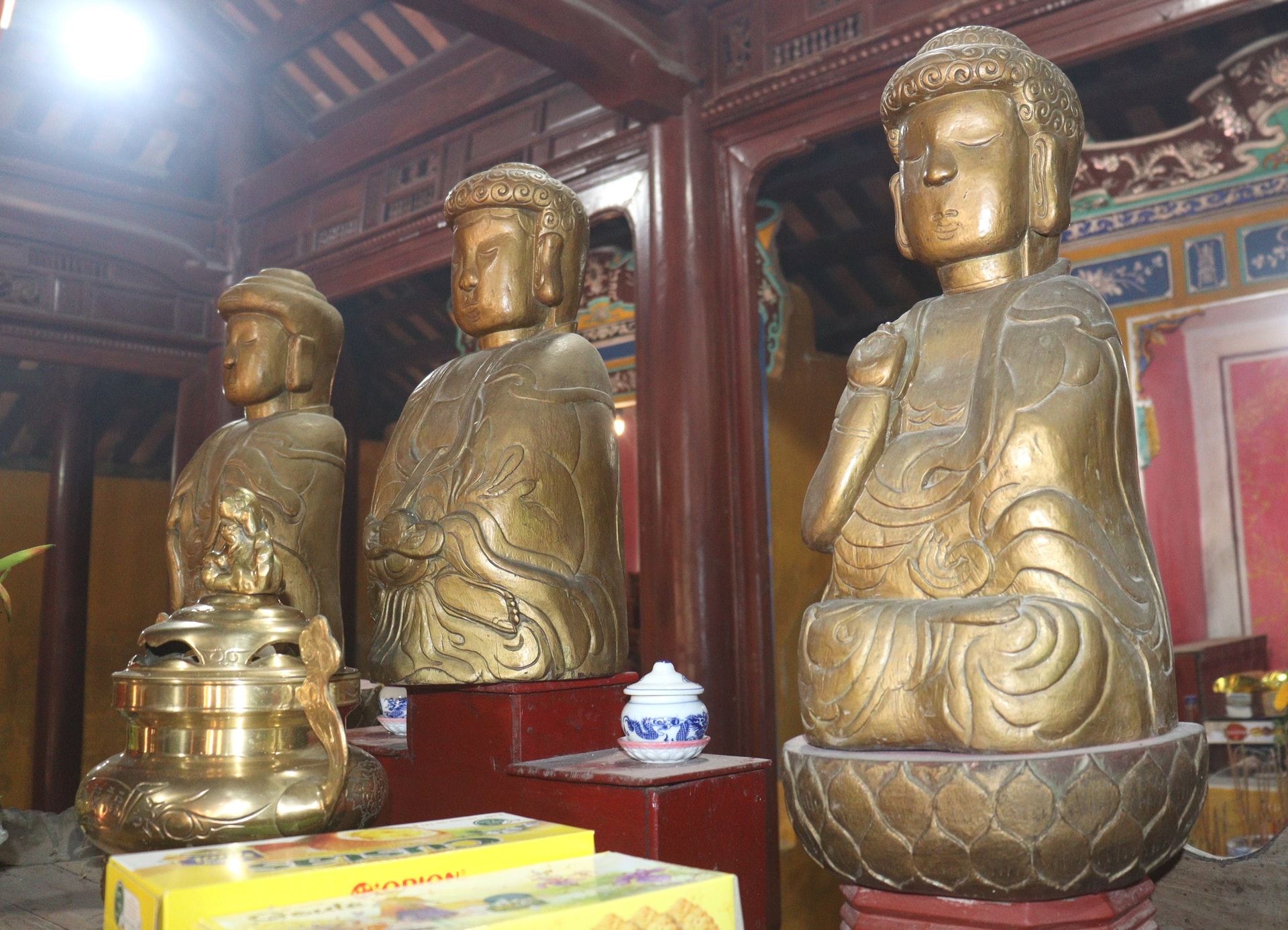
3 statues of the Holy Mother from the 3 regions
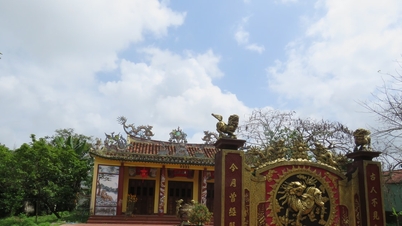
Within the historical site, Kinh Ai Temple is a communal temple dedicated to the 42 ethnic groups who lived in the area known as Hai Chau. Upon entering the temple, in the central hall is an altar with three bronze-colored female statues. These are the "Three Holy Mothers," representing the three regions of the country.
Mr. Nguyen Van Ngoc (a resident of Hoang Dieu Street, Hai Chau Ward) said that according to legend, the statue in the middle is dedicated to Mother Lieu Hanh. The two statues with lotus pedestals on either side are the Holy Mother Thien YA Na and the Lady of Sam Mountain, two mother goddesses of the Central and Southern regions of Vietnam in the ancient Buddhist land of the Champa people.
The folk knowledge and beliefs expressed through the perspectives on these three jackfruit wood statues are the accumulated folk beliefs of many generations, making this place even more sacred yet close to everyday life.
Mr. Nguyen Duy Minh, an artisan specializing in the preservation and management of the village communal house, confirmed: "The worship of the three Holy Mothers representing the three regions of the country is a way for our ancestors to convey, guide, and teach future generations about 'pioneering, settling, establishing livelihoods, and ensuring the well-being of the people.' For those with a Buddhist understanding and perspective, these three statues also serve as a means for our ancestors to teach their descendants about the 'truth, goodness, and beauty' of Buddhism. This is the unique feature of the western temple of the Hai Chau village communal house."
Another unique feature is that these three statues sit atop an ancient altar with exquisite and distinctive carvings, closely associated with the name of Hai Chau village. Unlike the commonly seen "two dragons vying for a pearl" or "two dragons worshipping the moon" motifs, the border of this altar features two wavy sea-like patterns (hai) on either side and a pearl (chau) in the center.
Statue of the traveler and commemoration of ancestors.
Behind the three statues of the Holy Mother, there is a shrine with a small wooden statue (only about 30cm high and 10cm wide) carved hundreds of years ago depicting a fisherman standing on a pedestal, with a serene expression, resembling an immortal being. This statue embodies many distinctive features of the spiritual beliefs, culture, people, and land of Hai Chau.
Ms. Nguyen Thi Thanh Ly (residing in Hai Chau ward) said: "Admiring this statue of the fisherman not only evokes images of the ancestors and benevolent figures of Hai Chau village who made their living fishing in this area by the Han River, but also allows us to think of the benevolent deities, saints, and water gods who protected the villagers."
According to artisan Nguyen Duy Minh: “This statue has the appearance of a Vietnamese person, with a long beard and braided hair, but wearing the coarse trousers and shirt of the Cham people. He wears a straw cloak on his back to protect himself from the sun and rain while fishing, like people in the countryside working in the fields. It's a pity that the hat and fishing rod are gone… but it still gives an idea of the everyday attire of the people of Hai Chau in the past. This statue has high artistic, cultural, and spiritual value, and reflects the real life of our ancestors when they came to this land by the Han River.”
Respect and inherit culture and beliefs.
Within the Hai Chau village communal house complex, there are also tangible and intangible heritage sites that demonstrate the Hai Chau villagers' respect for the culture and spirituality of the Cham people.
Notably, on the roof truss of the main temple of the village communal house, a cluster of linga and yoni, symbols of Cham culture, is stylized and placed at the center of the truss…
To the east of the temple dedicated to the ancestors, there is a small shrine dedicated to the Holy Mother Thien YA Na. The people of Hai Chau have continued to offer incense to the Holy Mother since their migration and maintain this tradition to this day.
Hai Chau village communal house is considered one of the oldest places of worship dedicated to the Holy Mother Thien Ya Na in the heart of Da Nang city, after the shrine dedicated to the Holy Mother in the Con Market area was dismantled more than 40 years ago…
Source: https://baodanang.vn/doc-dao-tuong-go-mit-o-dinh-lang-hai-chau-3336912.html























































































Comment (0)