

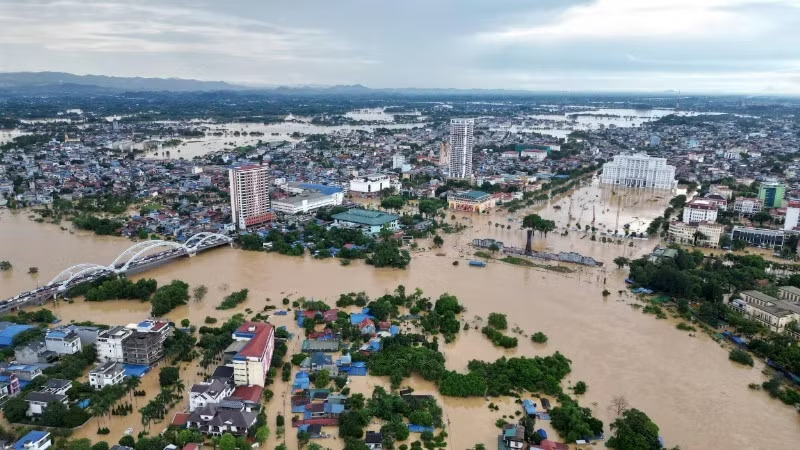
Each person is trying to recover in their own way, but the losses keep repeating year after year. Amidst the increasingly severe storms and floods, it's time for an economic "shield"—a natural disaster risk insurance mechanism—to provide people with a safety net during disasters.
After the flood - we shake off the mud and stand up, but...
I am still haunted by the choked sobs of Mr. Tran Van Tuan, the owner of a food warehouse in Hoang Van Thu ward, Thai Nguyen province, on the night of October 7th. As the water began to rise, Mr. Tuan and his colleagues stayed up all night moving goods, one load after another, trying to elevate rice, corn, and flour. But the water kept rising, higher than anyone could hope. In his helplessness, he could only stand and watch as the muddy water swallowed his warehouse. “The walls of the house collapsed, the motorbikes, cars, and televisions are all submerged… Everything is lost,” he cried.
When the floodwaters receded, Tuan rolled up his sleeves and opened each sack of rice, trying to salvage whatever was still usable. He asked the distillers to help him retrieve the sacks that weren't completely soaked; the rest had to be thrown away – unfit for livestock, as even the pigs and chickens had been swept away. Then, he and his relatives shoveled mud out of the house, repaired the door, and discussed borrowing capital to try and get back on their feet again. Wiping away the mud from his face, he whispered, “As long as we’re alive, we’re still lucky. We’re much luckier than many others. But if there were some kind of disaster insurance for small businesses like mine, that would be so much better… Because every time the water comes, we lose everything like this, who has the strength to get back on their feet?”
Having just paid off a debt of over one billion dong incurred from last year's flooding caused by Typhoon Yagi , Ms. Thu Ha stared blankly at her 1,600 m² shop, now covered in mud after this year's flood.
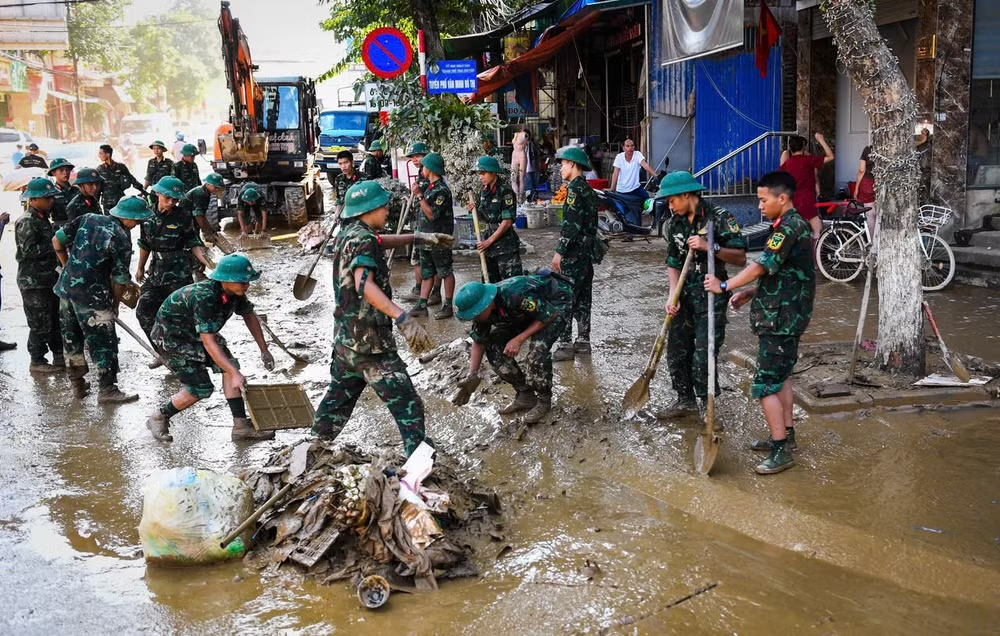
On Ben Tuong Street, Phan Dinh Phung Ward, on the afternoon of October 10th, Ms. Ha and more than 30 others were busily cleaning up. In the chaotic space resembling a battlefield, some were diligently pushing away mud, others were using hoses to wash each item, and other groups were laboriously carrying stacks of buckets and containers to the sidewalk. "I have to work continuously so I don't have to look up at the mud-covered goods; I don't know how long it will take to scrub them clean," Ms. Ha shared.
Five days ago, when heavy rains came and water from upstream surged in, her family raised their goods to a height of 80 cm, a safe level based on experience from the record flood of 2024 which only reached 50 cm.
But no one anticipated the power of the floodwaters this year. The water rose incredibly fast, reaching three meters in just one night. For two days afterward, the couple watched helplessly as the floodwaters submerged everything. When the water receded, they were speechless. The entire warehouse and household goods retail area were covered in mud. More than half of their merchandise had been swept away by the flood into the river.
"This is unbearable," Ms. Ha lamented. Last year's flood cost her family over a billion dong. This year, the estimated damage is three, even five times that amount. Currently, her family has to hire 10 workers, along with 20 relatives, to spray, wash, and sort the items. Any usable plastic and stainless steel items will be sold at a discount to recoup some of the losses.
After Typhoon No. 10, the water receded, but mud still clung to the warehouse walls, and the air was thick with the smell of dampness, mold, and rust. Mr. Le Duy Binh, owner of the Lam Ne construction materials facility in Nong Cong commune (Thanh Hoa province), stood amidst piles of soaking wet cement and rusty steel. The storm submerged more than 200 tons of cement, 100 tons of steel, flooded five warehouses, and broke down delivery trucks. The total damage to the warehouses alone is estimated at nearly 5 billion VND. Mr. Binh started with the smallest tasks: sorting each package, drying usable steel bars, and raising each bag of cement to a higher level.
But Mr. Binh wasn't just worried about the warehouse. He was concerned about upcoming orders: the steel market was experiencing shortages after the storm, and many customers were canceling contracts due to delays. He borrowed from the bank and relatives, determined to buy more steel and cement to import new stock, while also cleaning up the old warehouse. Every decision was a risky one, but he knew that if he stood still, no one could save him. At night, he sat on the pile of drying steel, looking out at the waterlogged fields of Nong Cong commune, listening to the sound of the cooperative's pumps nearby, and felt his hope return: people could still survive, and could still rebuild from the ruins. Now, when he sees the steel bars gleaming in the sun, and the workers returning to the warehouse, he smiles: "As long as there's strength, a profession, and people, the business will be revived , but it also needs a foundation to stand up again."
Disaster insurance - a safety net against risks.
According to statistics, as of 7:00 AM on October 13th, the estimated damage from floods and heavy rains following Typhoon No. 11 (Typhoon Matmo) exceeded 8,720 billion VND, with Thai Nguyen province suffering the greatest losses at 4,000 billion VND. As of October 8th, Bao Viet Insurance recorded 372 claims, with estimated compensation of 119 billion VND due to Typhoons Bualoi and Matmo. Property, construction, and motor vehicle insurance were the most severely affected. However, the percentage of individuals and businesses receiving insurance compensation was very low; the majority still have nowhere to turn for help.
After the storms and floods, families like those of Mr. Tran Van Tuan and Ms. Thu Ha, as well as businessman Le Duy Binh, suffered heavy property damage – yet lacked any form of insurance to provide support. This story, repeated after each natural disaster season, raises an increasingly urgent question: Is it time for a genuine natural disaster risk insurance mechanism – as an economic "shield"?
Disaster risk insurance is not just a policy slogan, but a financial emergency tool and a "lever" for livelihood recovery. Dr. Le Thi Thuy Van, Deputy Director of the Institute for Economic and Financial Strategy and Policy (Ministry of Finance), emphasized: "Strengthening the capacity to respond to and recover from natural disasters is not only an urgent requirement, but also a foundation for sustainable development."
According to the Insurance Supervision and Management Department (Ministry of Finance), after Typhoon Yagi at the end of last year, insurance companies received approximately 9,000 claims, totaling over 7 trillion VND – while the national economic damage amounted to 40 trillion VND (equivalent to 0.15% of GDP). This discrepancy shows that the majority of people and businesses did not receive compensation because they had never purchased or only purchased fire and explosion insurance, overlooking the risks of storms and floods.
The insurance market also reveals its limitations. Mr. Pham Van Dung, co-founder of the online insurance company IBAOHIEM, cited the example of many businesses that were left empty-handed after the storm, such as the start-up Ecos - which produces straws from fruits and vegetables - whose assets were almost completely swept away by floodwaters without receiving any compensation because they hadn't had time to purchase insurance.
According to Mr. Dung, Vietnam needs a specialized insurance product for storms and floods – similar to what many countries frequently affected by natural disasters have adopted. If there were a product specifically designed with reasonable fees and appropriate coverage, people would be more willing to participate instead of leaving the risks to chance.
A major obstacle remains in perception: many people still view insurance as an "unnecessary expense," only buying it when necessary, rather than considering it an investment to protect their livelihoods. Meanwhile, in countries frequently affected by natural disasters like Japan or the Philippines, disaster risk insurance has become a common safety net for both farmers and small businesses.
From an implementation perspective, the insurance industry has taken initial steps: the Vietnam Insurance Association, along with businesses, has sent officials to the scene, advanced compensation payments, and resolved paperwork to expedite disbursement – helping many households immediately access liquidity to repair their homes, buy seeds, and restore production, instead of having to borrow at high interest rates or sell their assets. Mr. Nguyen Xuan Viet, Chairman of the Association, affirmed: “The Association will always stand alongside the people and businesses, promoting payment mechanisms and supporting the quick and transparent processing of claims.”
However, as insurance expert Tran Nguyen Dan warned, the current products and mechanisms are still insufficient: agricultural insurance premiums are still high compared to the capacity of small households; the scope of protection is narrow; and the payment process is slow. He proposed subsidizing insurance premiums, designing simple and easy-to-understand products, and applying an index-based payment mechanism so that people can truly access and receive payments in a timely manner.
Regulatory agencies are also getting involved. From the Decree on agricultural insurance to policies supporting fees for vulnerable groups, the Ministry of Finance and the Ministry of Agriculture and Environment are expanding the scope of participation, while simultaneously promoting the "insurance - credit - agricultural extension" linkage model so that people have both capital and risk protection.
In reality, if insurance is to truly "save livelihoods" after storms and floods, four key things need to be done simultaneously: designing simple products suitable for each risk area; providing subsidies for poor and near-poor households; ensuring a fast and transparent payment mechanism; and investing in a data system for warning and assessing risks to ensure accurate and timely compensation.
When those conditions are met, insurance will not only be a form of compensation, but will also become a bridge helping people return to their fields sooner, restore the production chain - and more importantly, reduce the burden on the state budget after each natural disaster season.
Source: https://nhandan.vn/don-bay-phuc-hoi-sinh-ke-sau-bao-lu-post916631.html

















































































Comment (0)