
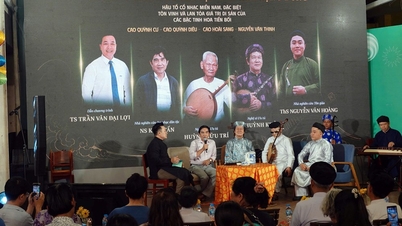
A corner of the memorial area dedicated to traditional Vietnamese folk music and musician Cao Văn Lầu in Bạc Liêu ward ( Cà Mau ).
Worthy of being recognized as a cultural heritage
In 2010, the People's Committee of Bac Lieu province (formerly) and several southern provinces and cities petitioned relevant ministries, agencies, and the Government to request UNESCO to recognize Southern Vietnamese folk music (Don Ca Tai Tu) as a representative intangible cultural heritage of humanity. Fortunately, in 2013, the art of Southern Vietnamese folk music was officially inscribed by UNESCO.
According to researchers, this encouraging result is thanks to the pioneering efforts of the former Bac Lieu provincial government and the enthusiastic support of the local people. Mr. Tran Phuoc Thuan, who served for many years as Chairman of the Bac Lieu Provincial Folk Arts Association and is a specialist in the study of traditional Southern Vietnamese folk music (Don Ca Tai Tu), stated: The ancient land of Bac Lieu was considered the "cradle" and homeland of Don Ca Tai Tu, as it had produced many pioneering artisans and artists. Bac Lieu also gave birth to immortal musical pieces and songs for Don Ca Tai Tu, fostering a strong creative movement from the beginning of the 20th century. In the 1930s, Don Ca Tai Tu activities in Bac Lieu developed both in quantity and quality, gaining renown throughout Southern Vietnam.
During the aforementioned period, musician Cao Văn Lầu and his fellow students established the Bạc Liêu Traditional Music and Singing Troupe, which stirred up the movement not only within the province but also gained renown throughout the region… Notably, musician Cao Văn Lầu composed the song “Dạ cổ hoài lang”, the precursor to the Vọng Cổ style and the art of Southern Vietnamese traditional music and singing.
Keep shining
According to artisan Do Ngoc An, Chairman of the Ca Mau Provincial Association of Literature and Arts: Just in the former Bac Lieu province, there are now nearly 70 clubs, teams, and groups dedicated to traditional Southern Vietnamese folk music (Don Ca Tai Tu), with over 500 artisans and performers participating. This number demonstrates the vibrant energy of the movement in this region. “Having been involved with Don Ca Tai Tu for nearly 40 years, not only I but many other Don Ca Tai Tu enthusiasts here are very proud that this art form has been recognized as an Intangible Cultural Heritage of Humanity. Therefore, we always have a responsibility to preserve and further spread it,” Mr. An shared.
According to Tu Duy Toan, a traditional folk music artist from Bac Lieu ward, his folk music club operates regularly. Since the merger of the province and ward, most of the folk music clubs in the ward have continued to function normally. This art form has become deeply ingrained in him and many local residents. "I hope that the provincial authorities and relevant agencies will pay more attention to the local folk music movement through concrete and practical actions," artist Tu Duy Toan said with passion.
Mr. Tran Phuoc Thuan stated: "Immediately after the merger of Bac Lieu and Ca Mau provinces, we noticed that the leaders of the (new) Ca Mau province continued to pay attention to the local traditional folk music movement. Specifically, the People's Committee of Ca Mau province directed relevant departments and agencies to accelerate the implementation of the project to renovate and prevent the deterioration of the Southern Traditional Folk Music and Cao Van Lau Memorial Area in Bac Lieu ward. For many years, this place has been a typical tourist destination of the province and the Mekong Delta region, always attracting a large number of tourists from inside and outside the province. This memorial area has been recognized by the Mekong Delta Tourism Association as a typical tourist destination and has been recognized by the provincial government as a 4-star OCOP product in the tourism sector."
Traditional Southern Vietnamese folk music (Đờn ca tài tử) in general, and in Bac Lieu (formerly) in particular, remains vibrant because it has become deeply ingrained in the blood and flesh of many generations of people in this beloved southern land. This has been affirmed by many officials and residents in conversations with us and with tourists from all over the country.
Source: https://nhandan.vn/don-ca-tai-tu-tiep-tiep-toa-sang-post949381.html

























































































Comment (0)