

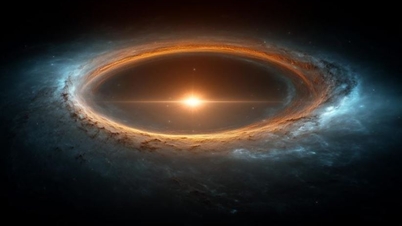
Scientists are launching an ambitious project called SQUIRE with the goal of turning our entire planet into a giant physics detector.
By putting ultra-sensitive quantum sensors into orbit, the project hopes to detect strange “spin-dependent interactions” – crucial clues that could lead to the discovery of dark matter and forces beyond our current understanding.
The project envisages installing precision measuring instruments on space platforms such as the Chinese Space Station, according to research published in the journal Science China Press.
The core principle is based on the discovery of rare physical interactions between elementary particles, which depend on their "spin" (rotational angular momentum) and relative velocity.
These interactions can produce tiny changes in atomic energy levels, which manifest as "pseudo-magnetic fields" that can be picked up by quantum sensors.
The space environment offers unique advantages that ground laboratories cannot replicate.
First, the space station's extremely high speed (about 7.67 km/s) significantly enhances the signal of velocity-dependent interactions.
More importantly, Earth acts as a huge natural source of spin-polarized particles. Unpaired electrons in the planet’s crust and mantle create a source hundreds of quadrillions of times larger than the best artificial sources available today.
Additionally, the periodic rotation of the Earth converts the signals being sought into periodic waves, allowing scientists to filter out background noise more effectively. This increases the sensitivity of the device by millions of times compared to current detection limits.
To realize this idea, the research team successfully developed a dual noble gas spin sensor prototype, using two isotopes Xenon-129 and Xenon-131.
This design allows the device to cancel out common magnetic field interference up to 10,000 times, and is equipped with anti-vibration technology and radiation protection for durable operation in harsh space environments.
The initial success of this prototype lays the foundation for building an integrated sensor network between space and ground.
In the distant future, when humans expand their activities deep into the Solar System, scientists expect to be able to take advantage of giant planets like Jupiter and Saturn as natural sources of spin, opening a new era in decoding the deepest mysteries of the universe./.
Source: https://www.vietnamplus.vn/du-an-trung-quoc-bien-trai-dat-thanh-may-do-khong-lo-giai-ma-bi-an-vu-tru-post1081491.vnp























































































Comment (0)