


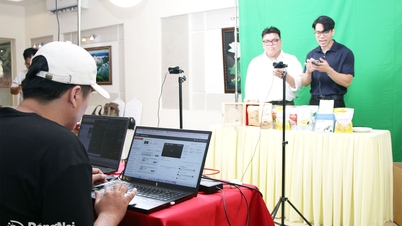
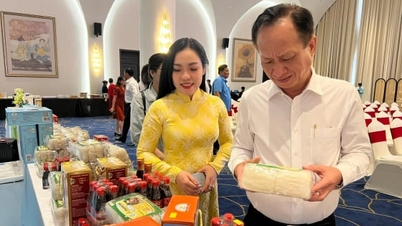
Our country's potential for breakthrough exports through cross-border e-commerce is huge - Illustrative photo
According to Ms. Lai Viet Anh, Deputy Director of the Department of E-commerce and Digital Economy ( Ministry of Industry and Trade ), Vietnam's e-commerce development potential is still large thanks to the business community, especially the small and medium-sized enterprises, which have the ability to adapt quickly, are willing to experiment with new technologies and have a strong desire to grow. Vietnam is even rated by international organizations as one of the leading countries in the region in terms of e-commerce application skills of small and medium-sized enterprises.
Not only is Vietnam advantageous in digital infrastructure, it also has traditional strengths in exports. Our country is among the world's leading exporting countries with many key products such as agricultural products, seafood, textiles, footwear, and electronic components. However, only 20% of businesses exploit e-commerce for export. That means the market still has great potential to expand exports through online channels.
However, Ms. Lai Viet Anh acknowledged that despite the wide open space, businesses, especially medium, small and micro enterprises, still face many challenges when exporting via digital platforms. Among them, the biggest difficulty lies in meeting technical standards, inspection, safety and legal compliance in import markets.
In addition, businesses also face limitations in the skills to apply digital tools to optimize operating costs. Although international e-commerce platforms provide a powerful set of support tools, to use them proficiently and generate actual orders, businesses need significant time and resources. The cost of participating in the platform, from opening a booth, promoting, and operating, is a problem that many small businesses consider.
Along with that, language barriers, payment and especially logistics are still big bottlenecks. When exporting directly to consumers, orders are small in value and low in volume, so logistics costs per unit of product increase. Therefore, cost optimization is still a big challenge for small businesses when they want to expand sales to international markets via e-commerce.
To support businesses in digital transformation and exploit cross-border e-commerce more effectively, Ms. Lai Viet Anh said that recently, the Government has had a series of major policies. That is Decision 645/QD-TTg in 2020 approving the Master Plan for National E-commerce Development for the period 2021 - 2025, orienting training, improving skills and providing digital solutions for businesses, while promoting market expansion through domestic and international e-commerce.
Decree 80/2021/ND-CP guides the Law on Support for Small and Medium Enterprises, providing a clear financial support mechanism. An important point is that businesses can be supported up to 50% of the cost of opening and maintaining booths on domestic and international digital platforms.
Decision 1415/QD-TTg in 2021 supports businesses in accessing foreign distribution systems, with the goal of promoting 5,000 businesses to participate in exporting via cross-border e-commerce. Support programs from training, market connection to standard consulting, help businesses proactively access new markets.
Along with the Government's very practical support channels, the Deputy Director of the Department of E-commerce and Digital Economy recommends that businesses carefully study current policies to choose the right support channel to exploit their needs.
Anh Tho
Source: https://baochinhphu.vn/du-dia-lon-tu-xuat-khau-qua-nen-tang-so-102251209104302068.htm
![[Photo] Urgently help people soon have a place to live and stabilize their lives](/_next/image?url=https%3A%2F%2Fvphoto.vietnam.vn%2Fthumb%2F1200x675%2Fvietnam%2Fresource%2FIMAGE%2F2025%2F12%2F09%2F1765248230297_c-jpg.webp&w=3840&q=75)




































































![[Photo] General Secretary To Lam works with the Standing Committees of the 14th Party Congress Subcommittees](https://vphoto.vietnam.vn/thumb/402x226/vietnam/resource/IMAGE/2025/12/09/1765265023554_image.jpeg)

























Comment (0)