


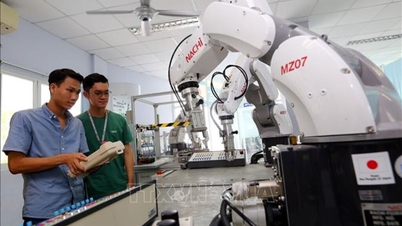
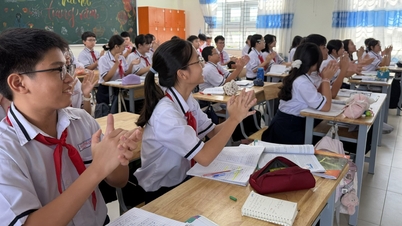
Students at Dong Nai College of Mechanics and Irrigation - Photo: DUY DONG
At a recent meeting of the National Assembly Standing Committee, the Ministry of Education and Training said that one of the new points of the draft revised Law on Vocational Education is to allow qualified higher education institutions to register to provide college training in a number of professions.
Many vocational education experts have had opinions on this issue.
Be careful when allowing universities to train college level
MSc. Nguyen Van Chuong, Principal of Dong Nai College of Mechanics and Irrigation, is quite concerned about the new proposal. According to him, there are fundamental differences between the two current levels of education, especially in training philosophy and program structure.
For example, according to Circular 03/2017, the college training program is clearly regulated that the theory ratio only accounts for 30 - 50%, while practice, internship, and experiments are required at 50 - 70% depending on the profession.
In addition, the Law on Vocational Education 2014 requires teachers to be given time to practice at enterprises to update technology and improve practical capacity.
Mr. Chuong added that many colleges today have invested heavily in workshops, practice equipment, experimental models, internship centers, and training of lecturers around practice criteria, as well as building a network of businesses so that students can practice continuously.
There are industries where the level of investment and practicality in training even exceeds that of some universities that do not have a tradition of vocational training.
Therefore, he is concerned that if the right to train colleges is given to universities, the question is whether universities can ensure the required conditions for practice - internship - connection with businesses? Will they really shift to training skills and professions, or will they still maintain a heavy approach to academics and research?
Dr. Tran Manh Thanh, Principal of Bach Viet Polytechnic College, said that allowing some universities to train at college level should only be applied to some specific and highly interconnected fields.
For example, sports , arts… have a continuous training path from short-term to intermediate, college and university. Or with pedagogical colleges in the context of pedagogical colleges being oriented to merge into universities.
However, Mr. Thanh emphasized that it is necessary to define criteria for some specific fields, which cannot be expanded indiscriminately. If universities train colleges in all fields, the college system will be under great pressure in enrollment and will have difficulty competing with universities. This can cause an imbalance in stratification and affect the stability of the vocational education network.
Need clear "regulation"
MSc. Nguyen Ngoc Hien, Principal of Ho Chi Minh City College of Technology, said that it is not unreasonable for universities to enter this field, especially in the context of increasingly high demand for quality human resources and the vocational school system is also undergoing restructuring.
From the perspective of the labor market, Mr. Hien said that if social needs require college-level human resources in certain fields, universities participating in training is something that can be considered. The important thing is that the need must be real, the profession must be clearly defined and the training must not overlap or disrupt the human resource structure.
He emphasized forecasting national human resource needs, identifying which sectors society really needs and allocating training targets reasonably. Without this orientation, the system may fall into a situation of overlapping training, disrupting the balance between levels of education and reducing the effectiveness of the restructuring process of the training network.
Dr. Hoang Ngoc Vinh, former Director of the Department of Vocational Education (Ministry of Education and Training), said that the story of universities participating in college-level training still depends largely on the capacity of localities to forecast and order human resources.
After the restructuring period, many colleges have operated in line with local human resource needs, but in reality, new occupations will still arise, especially in the context of digital transformation, new industries, logistics, automation, etc. Those occupations sometimes require high technology, complex equipment or rapid deployment capacity.
"Instead of having to establish a new college, the locality can completely assign the training task to a university with enough resources," he said.
However, Mr. Vinh also warned that this proposal needs to be implemented cautiously, with a clear roadmap and avoiding the mechanism of asking for and giving. He pointed out the risk that some universities, especially private ones that are having difficulty in recruiting students, could take advantage of the policy to open majors en masse to "sweep" enrollment.
This can easily lead to unfair competition, diminish the role of colleges and, more importantly, deviate from the goal of human resource training.
"The most important principle is that training should be linked to real needs, have reliable human resource forecasts and have close coordination between central - local - training facilities," he said.
How is it in other countries?
Many countries have allowed universities to participate in vocational or college training, but all are implemented within a very tight management framework, clearly defining the roles between academic training and applied training.
In Australia, the "dual-sector institutions" model allows some schools such as RMIT or Swinburne to offer both university and VET programs. These institutions are monitored by the Tertiary Education Quality and Standards Agency (TEQSA) and the Australian Skills Quality Authority (ASQA), to ensure that the practicality and industry connections of vocational degrees are not diluted when placed in universities.
In Germany, the Fachhochschule system has developed in the direction of applied training that can be part of a university but still be independent of research training. These schools strongly operate a "dual training" model - combining theoretical learning with long-term practice at a company - helping to maintain the professional character of the program even though it is implemented by a university.
Source: https://tuoitre.vn/du-kien-cho-dai-hoc-dao-tao-he-cao-dang-lo-mo-nganh-o-at-thieu-thuc-hanh-20251209102847781.htm



![[Photo] Urgently help people soon have a place to live and stabilize their lives](/_next/image?url=https%3A%2F%2Fvphoto.vietnam.vn%2Fthumb%2F1200x675%2Fvietnam%2Fresource%2FIMAGE%2F2025%2F12%2F09%2F1765248230297_c-jpg.webp&w=3840&q=75)




















































![[Photo] General Secretary To Lam works with the Standing Committees of the 14th Party Congress Subcommittees](https://vphoto.vietnam.vn/thumb/402x226/vietnam/resource/IMAGE/2025/12/09/1765265023554_image.jpeg)

























Comment (0)